On Tuesday evening, the Ada County Republican Central Committee hosted a forum featuring candidates for governor, U.S. Senate, and U.S. House of Representatives.
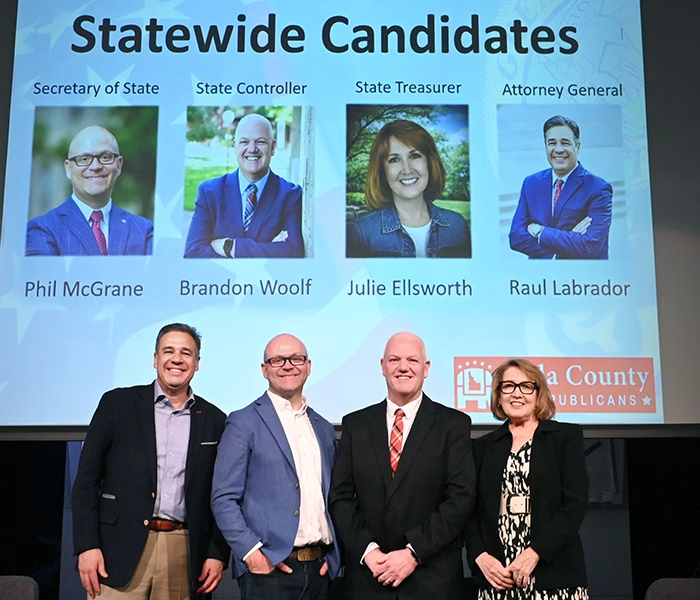
Some unopposed primary candidates attended—namely Secretary of State Phil McGrane, Controller Brandon Woolf, Treasurer Julie Ellsworth, and Attorney General Raúl Labrador. Each made a short statement and interacted with attendees afterward.
I played a small part in the event, recording short “elevator pitch” interviews with candidates in the contested races. They will be posted on the ACRCC’s social media soon and are already available on YouTube. Take a few minutes to watch the videos and hear, in their own words, what their campaigns are about.
Unfortunately, none of the incumbents were able to attend. Gov. Brad Little, Sen. Jim Risch, and Congressman Russ Fulcher addressed the crowd via prerecorded video, while Congressman Mike Simpson was completely absent.
The nature of politics being what it is, all four of those incumbents will almost certainly win reelection next month, which raises the question: what is the point of all this? Only three gubernatorial challengers have reported any fundraising, and only one—Mark Fitzpatrick—has raised more than a few thousand dollars. Even then, his $122,791 haul is still less than a tenth of the incumbent’s contributions. Gov. Little has raised nearly $1.7 million this election cycle.
Nevertheless, seven people have put their names on the ballot, each hoping to be the one who can seize that one-in-a-million chance to unseat the governor.
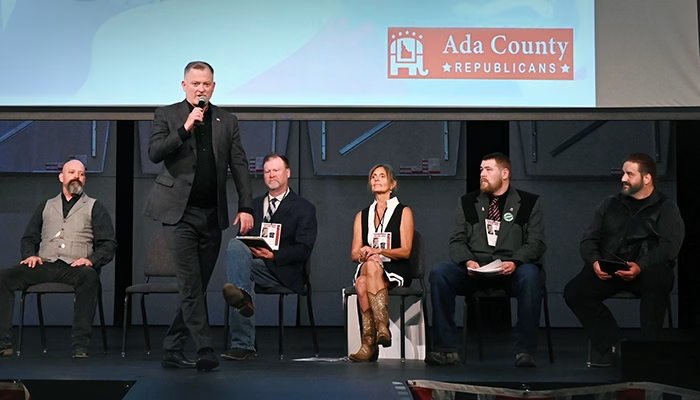
I appreciated the opportunity to speak with each candidate one-on-one while recording videos for the ACRCC. Each brings valuable insights and perspectives to the table, and it would be a shame for those voices to disappear after May 19. Mark Fitzpatrick is a dynamic speaker who has clearly captured the imagination of thousands of engaged citizens across Idaho and is focused on eliminating corruption and dishonesty in government. Justin Plante has developed a comprehensive plan for reforming government and increasing citizen involvement. Ron James understands the challenges facing local government in a rural, tourism-dependent region. Sean Crystal, despite my personal skepticism on the cannabis issue, is an engaging speaker with a deep knowledge of the issues.
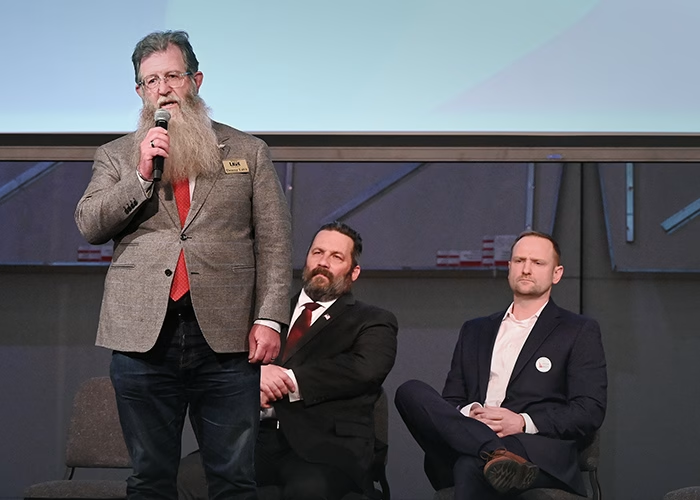
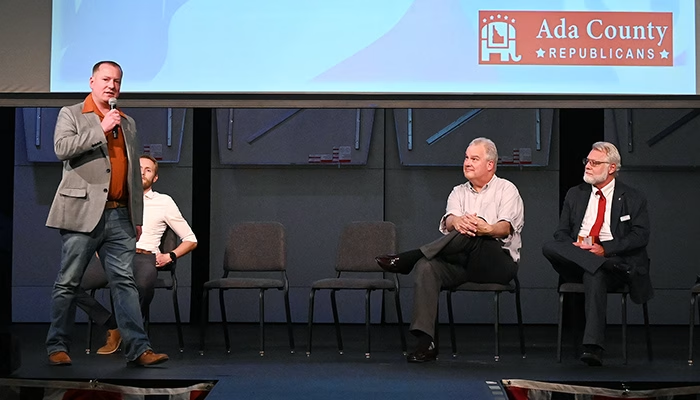
A similar dynamic was at play among the federal candidates. Senatorial candidate Denny LaVé has taken a fascinating journey—from Marine Corps boot camp to a French monastery to the construction industry. (He recently gave me a copy of his book, which I look forward to reading.) Joe Evans is well-spoken and focused on issues that matter to voters, while Josh Roy brings a fresh face to the political sphere.
Hoping to make it to the other side of the Capitol rotunda in Washington, D.C., were four challengers to Congressmen Fulcher and Simpson.
In the First Congressional District, challenging Fulcher, were Joe Morrison, who brings a blue-collar perspective and a focus on reviving manufacturing, and Andy Briner, who is concerned about government transparency.
In the Second District, challenging Simpson, were Brian Keene and Perry Shumway, each bringing a lifetime of private-sector experience to their campaigns.
One thing all of the federal candidates agreed on, unsurprisingly, was that the incumbents have been in office for far too long. We all understand that, despite Congress having abysmal approval ratings, incumbents continue to be reelected year after year. I’ve written before about how Congressman Simpson, for example, is part of what I see as a broken political system fueled by massive amounts of tax dollars and campaign contributions. But as long as he continues directing some of that money back to his constituents, he will doubtlessly continue winning reelection until the end of time.
In the Senate race, it’s true that Sen. Risch is 82 years old and will be nearly 90 by the end of another term. Yet he made a fair point in his taped remarks: with Donald Trump in the White House and himself chairing the Foreign Relations Committee, he is finally in a position to exert meaningful influence on behalf of Idaho. Replacing him with a freshman senator would mean starting over in that regard.
It’s a paradox of politics that national issues receive the lion’s share of attention, even though local issues often matter more in the long run. Your city council members have a greater impact on your day-to-day life than the president or your senator, yet many citizens—even those who consider themselves well-informed—couldn’t name them.
I hope the candidates I spoke with remain involved after May 19. We need people like this serving as city councilors, county commissioners, and state legislators. We need individuals willing to invest the time and energy required to drive political change from within the Republican Party. These roles may not receive the same attention as governor or senator, but they are vitally important. Building a movement from the ground up requires people willing to serve wherever they are needed to advance conservative policy and protect the liberties we often take for granted.
It was a pleasure speaking with these men and women, and I hope to see them in the trenches for the battles ahead.
The Gem State Chronicle delivers daily analysis, op-eds, press releases, and Idaho Insider updates — free to your inbox.
Free newsletter · Unsubscribe anytime · View on Substack
About Brian Almon
Brian Almon is the Editor of the Gem State Chronicle. He also serves as Chairman of the District 14 Republican Party and is a trustee of the Eagle Public Library Board. He lives with his wife and six children in Eagle.