Click here to listen to this article as a podcast.
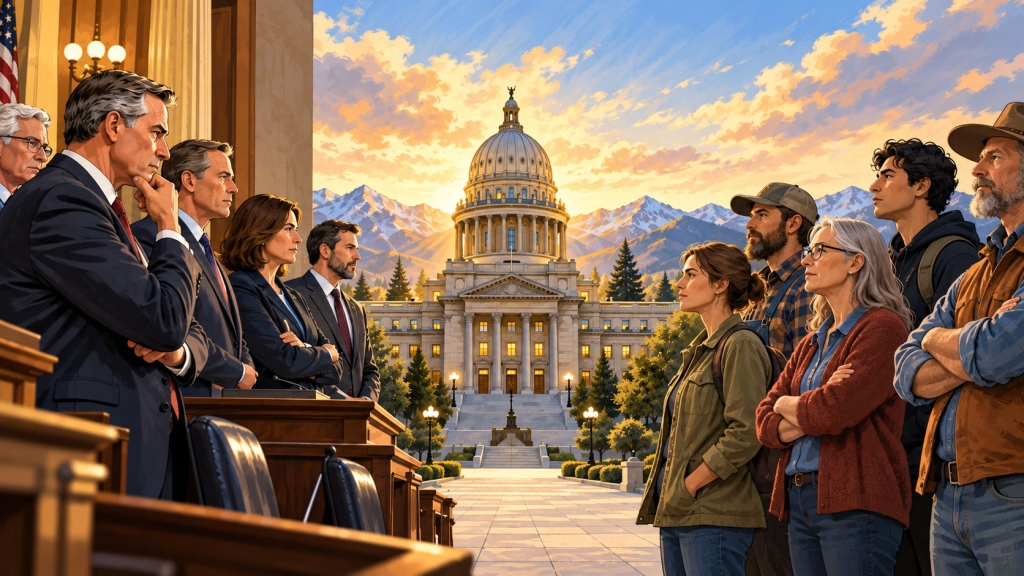
I’ve written before about the paradox of republican government: legislators are elected by their districts, which consist of about 52,000 people each, yet they are increasingly part of large statewide strategies as various factions vie for control of the Legislature. This dynamic was clearly visible in this week’s primary results. In fact, I would venture to say that Idaho is really two different states combined into one.
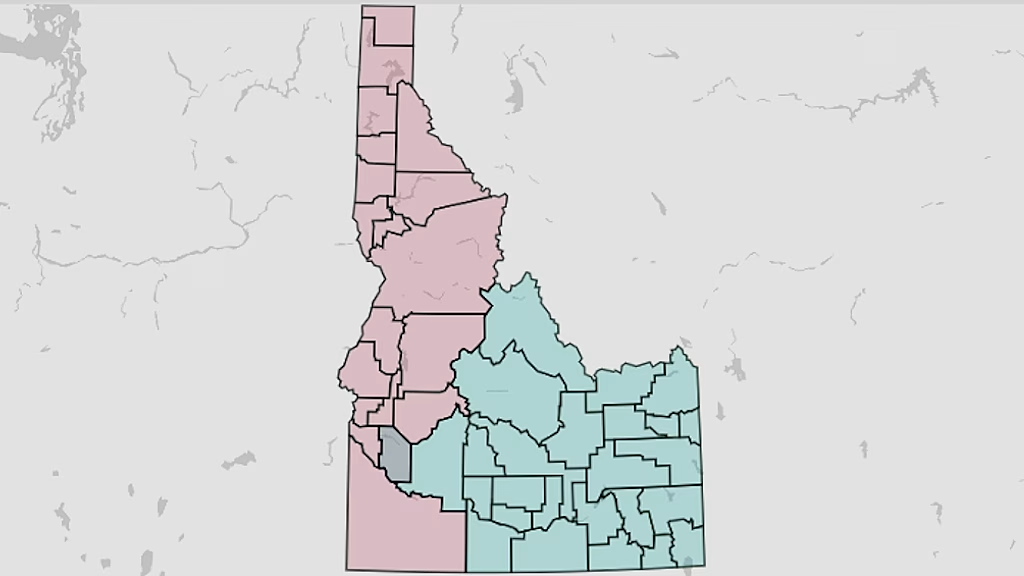
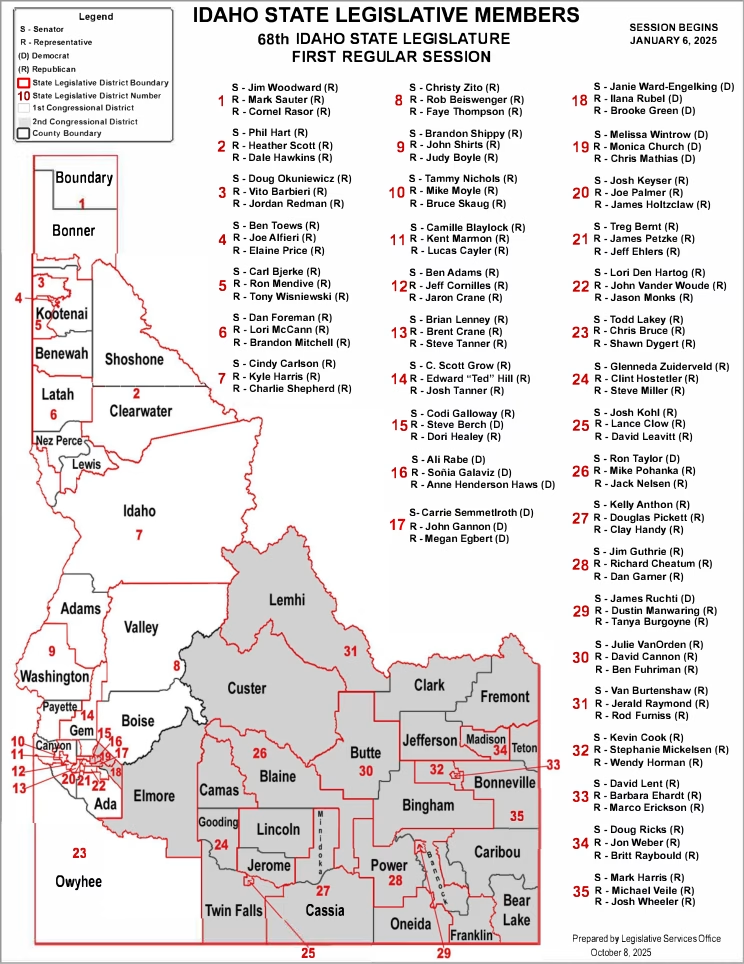
You could divide the state in dozens of different ways, but for the sake of simplicity let’s use the existing congressional districts. CD1 is roughly the western half of the state, including the panhandle, covering 18 counties plus the western half of Ada County. CD2 encompasses the southeastern portion of the state, covering 25 counties plus the eastern half of Ada.
Ada is the only county split between the two congressional districts. Two precincts in my own District 14 are in CD2, as well as one precinct from Legislative District 21. Elsewhere, Legislative District 8 is split evenly between the two congressional districts, with Boise and Valley Counties in CD1 and Custer and Elmore Counties in CD2.
Congressman Russ Fulcher won his CD1 primary with 78.1% of the vote, with a total turnout of 127,948 voters. Congressman Mike Simpson won his primary in CD2 with 63.31% of the vote, with 100,225 voters casting their ballots. Exactly half of the counties above the median in voter turnout are in CD1, while 62% of the counties in the bottom half for turnout are in CD2.
Not counting the split District 8, CD1 is currently represented by 51 Republicans and not a single Democrat. CD2, on the other hand, is represented by 36 Republicans and 15 Democrats. Additionally, in my opinion, quite a few of those 36 CD2 Republicans appear more comfortable aligning with Democrats than with conservative Republicans from CD1.
Most Idaho citizens consider themselves conservative. Republican candidates in every region of the state describe themselves as true conservatives, as opposed to their opponents, who are either liberal RINOs or libertarian extremists, depending on whom you ask. Yet it is clear that there are very different prevailing views of what conservatism means, depending upon which side of the state one lives in.
In western Idaho and the panhandle, conservatism tends to emphasize individual liberty, self-sufficiency, the smallest government possible, and the freedom to live life your own way. Homeschooling is a major part of the culture in this region. It’s no surprise that one of Idaho’s most notorious stories of the past half century involved a man and his family who were persecuted by the government despite simply wanting to be left alone.
In eastern and southern Idaho, conservatism often centers more on community institutions such as churches, public schools, and farming co-ops. Government is viewed as necessary to maintain jobs and economic opportunity, while the large businesses that provide those opportunities are seen as pillars of the community deserving support. Conservatism there is often tied more closely to stability, continuity, and maintaining longstanding traditions.
There are exceptions, of course. Gov. Brad Little seems to identify more with the CD2 brand of conservatism despite hailing from Emmett. Is Gem County an outpost of the east here in the west? The governor and his allies spent significant time and money supporting eastern Idaho incumbents, including Sen. Jim Guthrie, whose voting record and rhetoric often resemble Boise liberals more than what many would consider standard Idaho conservatism.
Both sides attempted to gain ground in the other’s territory. CD1 conservatives, including this author, donated to challengers in eastern Idaho such as David Worley, James Lamborn, and Julianne Young. I know many people who traveled to Blackfoot and American Falls to knock doors on their behalf. Yet those challenges ultimately proved unsuccessful.
On the other hand, CD2-aligned figures were equally unsuccessful in challenging conservative incumbents in southwest and North Idaho. Big machine PACs spent heavily on Biden/Harris fangirl Christa Hazel in District 4, Rep. Lori McCann and Cindy Agidius in District 6, Michael Collins in District 7, and Kody Daffer in District 13, but came up short in every race. Additionally, Sen. Jim Woodward and Rep. Mark Sauter, who regularly aligned themselves with their eastern Idaho colleagues, lost their primaries in District 1.
Districts 24 and 25 are firmly in CD2, yet bucked the trend in 2024 by electing four western-style conservatives. However, three of those four lost their primaries this week following a major barrage of outside spending. Reps. Clint Hostetler and Barbara Ehardt, in Districts 24 and 33 respectively, remain among the last western-style conservatives standing east of Glenns Ferry.
District 8, split evenly between the two regions, elected three moderates in 2022 and three conservatives in 2024, but this year replaced Rep. Faye Thompson with Brian Beckley.
There are minorities within each region, of course. Groups like the North Idaho Republicans in Kootenai County espouse a far more eastern-style perspective, with several of their PC candidates this year having signed the initiative to legalize abortion. They view the majority faction as radical right-wing extremists. Conversely, groups like the Magic Valley Liberty Alliance and East Idaho Patriots represent a more western-style conservatism, viewing the eastern establishment as liberal Republicanism masquerading as conservatism.
This leaves us at something of an impasse. The words “conservative” and “Republican” increasingly mean different things in western Idaho than they do in eastern Idaho. Yet both factions remain part of the same Legislature, working together—or against each other—to enact their preferred policies. Barring some dramatic political realignment, we will continue sharing the same state and the same government.
I’ve long said that eastern Idaho remains a tough nut to crack. Many voters there appear motivated by factors beyond ideology, which may explain why candidates like David Worley and Kelly Golden failed to secure majorities despite presenting strong evidence that their opponents’ records diverge sharply from the conservative ideals they claim to uphold. Yet they came close. Golden reduced a 1,900-vote loss in 2024 to just 900 votes this year, Worley came within 500 votes of unseating one of the longest-serving senators in the state, and James Lamborn fell only 235 votes short of defeating Rep. Rick Cheatum.
Winning in the east will require finding young, principled community leaders who speak the same language as their voters—leaders who can not only demonstrate where incumbents have strayed from conservative principles, but also present a compelling alternative rooted in local trust and credibility. Idaho conservatives should be looking for the next generation of leaders like Kevin Andrus, Wendy Horman, and Barbara Ehardt: people who are community-focused first, yet still willing to champion firmly conservative policies in the Legislature.
In the west, conservatives must continue supporting leaders who consistently practice what they preach. It is encouraging to see representatives like Cornel Rasor, Elaine Price, Kyle Harris, Rob Beiswenger, Steve Tanner, and Chris Bruce win overwhelming victories despite heavy opposition spending. These legislators, along with figures such as Reps. Jordan Redman, Josh Tanner, Heather Scott, and many others, represent an energetic and growing conservative movement within Idaho.
In the end, whether we live in Bonners Ferry or Bear Lake, whether we call Salmon home or call it dinner, whether we are fifth-generation Idahoans or refugees from blue states, we all share Idaho and a responsibility to preserve it for future generations. No matter how deep these regional divides become, Idaho’s future will ultimately depend on whether its competing visions of conservatism can learn not merely to coexist, but to govern together. Those of us in the west should continue articulating our beliefs in individual liberty and limited government, working to persuade all Idahoans of the merits in our cause.
The Gem State Chronicle delivers daily analysis, op-eds, press releases, and Idaho Insider updates — free to your inbox.
Free newsletter · Unsubscribe anytime · View on Substack

About Brian Almon
Brian Almon is the Editor of the Gem State Chronicle. He also serves as Chairman of the District 14 Republican Party and is a trustee of the Eagle Public Library Board. He lives with his wife and six children in Eagle.