Idaho is a red state, and has been for a very long time. The Legislature has been controlled by Republicans since at least the late 1950s. The last time Idaho voted for a Democratic presidential candidate was Lyndon Johnson in 1964. Cecil Andrus and John Evans are the only Democratic governors to have been elected in the past half-century. And the last time Republicans did not hold a two-thirds supermajority in both chambers of the Legislature was in the early 1990s.
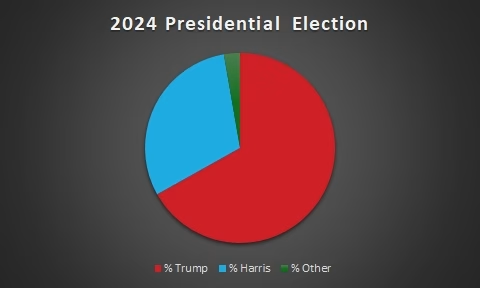
Today, there are 631,344 registered Republicans in Idaho, compared to 257,003 unaffiliated voters and 120,644 Democrats. More than three out of every five Idaho voters are affiliated with the Republican Party. President Trump carried the state in 2024 with just under 67% of the vote.
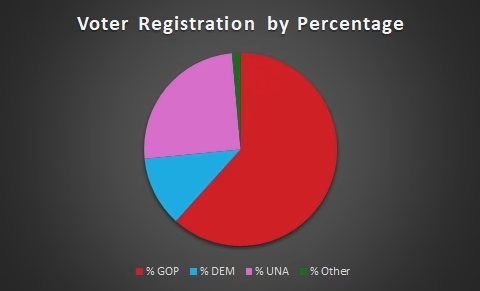
All that said, we all know that not everyone who affiliates as a Republican has what we would call Republican values. Leftists and moderates registering as Republicans—or even running for office in the Republican primary—is distasteful to many conservatives, but it is also a rational strategy in what is essentially a one-party state. Progressive activists face the choice of either remaining in the Democratic Party, which has virtually no power outside the Idaho Statesman editorial page, or crossing over into the GOP to support what they see as the lesser of two evils.
The Idaho Republican Party has long been concerned about crossover voting. Dr. Matthew May’s dissertation on the history and effects of primary elections in Idaho reports that Republicans took issue with the direct primary as far back as the early 1900s due to fears that Democrats would influence the selection of Republican nominees. In 2007, the Idaho Republican State Central Committee voted in favor of a rule calling for a closed primary, along with a court challenge should the Legislature fail to respond during the following session.
Nine days after the close of the 2008 session, the Idaho GOP filed suit, arguing that the First Amendment protected its right to require participation in its primary to be limited to registered Republicans. In Idaho Republican Party v. Ben Ysursa, U.S. District Judge Lynn Winmill agreed that crossover voting was likely occurring and that the Idaho GOP had the right to limit participation in its own primary election. In the closing days of the 2011 session, the Legislature passed House Bill 351, allowing parties to close their primaries if they wished while still leaving them the option of remaining open. Today, the Idaho GOP maintains a closed primary, while the Idaho Democratic Party allows independents and members of other parties to select its ballot in the May election.
Dr. May suggested that the party and the state have two competing interests when it comes to how primary elections are conducted:
The Idaho Republican Party had argued that participation by non-party members in their primaries produced nominees that did not accurately reflect the platform of the Party and that a more restrictive primary system would mitigate those effects. To argue these effects in district court, the Party cited several academic studies. In explaining their reluctance to shift to a closed primary system, the State of Idaho (through its then Secretary of State, Ben Ysursa) argued that more restrictive systems served to depress voter turnout and the state was better off sticking with the open primary system that had been implemented in 1972.
The state, as the neutral arbiter of elections, believes participation is the highest priority, while the party, as a private coalition of activists working toward particular policy goals, believes ideology is more important. In other words, the government wants more people to participate regardless of their views, while parties want their collective views to prevail.
Interestingly enough, primary election turnout appears to have actually increased following the closure of the Idaho GOP primary in 2012:
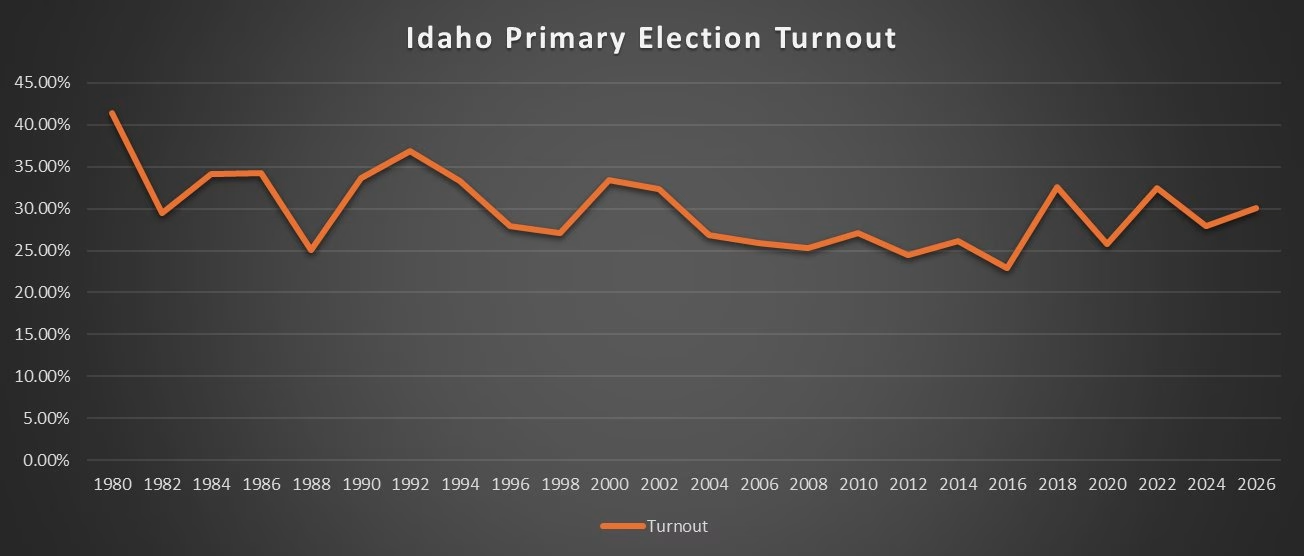
Nevertheless, 30% turnout is still far too low. Despite the May primary mattering far more than the November general election in Idaho, many voters treat turning out in November as the beginning and end of their civic participation. At the same time, conservative activists have grown increasingly frustrated with the outcomes of legislative races, especially in eastern Idaho. Several prominent Republicans have called for replacing the current primary system with a caucus system in which engaged Republican voters would meet to select the party’s nominees. Former Blaine County GOP Chairwoman Heather Lauer recently explained why she supports such a system:
This debate is not just about process. In much of Idaho, Republican primaries effectively determine who governs the state. Property taxes, government spending, immigration, education reform, regulatory policy, and countless other issues are ultimately shaped by who wins Republican nominations.
I have become increasingly convinced that the long-term solution is not winning every short-term political fight. The long-term solution is electing a Legislature willing to pursue meaningful conservative reforms and fundamentally change the direction of the state.
We are unlikely to consistently elect that Legislature under a system where Republican candidates can be nominated by progressive activists.
I asked Secretary of State Phil McGrane about this idea last week. While he said he does not support switching to a caucus system, he indicated that he is open to ideas for increasing turnout in the primary:
Those two perspectives neatly illustrate Dr. May’s explanation of the contrasting priorities of activists and government officials: Lauer wants to see more conservative victories, while McGrane wants to see greater participation. The question of whether the Idaho GOP should pursue a switch to a caucus system will be hotly debated at the state convention later this month, and I will share my thoughts on it in a future article. For now, however, let us clearly identify the problem.
There are three ways crossover voting occurs: partisan Democrats switching their affiliation to vote in the Idaho GOP primary, unaffiliated voters requesting a Republican ballot and then disaffiliating afterward, and ideological progressives who permanently register as Republicans.
The first category—Democrats who temporarily switch affiliation—is the most obvious, but I do not believe it is especially widespread. I maintain a spreadsheet based on voter registration data from the Secretary of State’s office showing month-to-month changes. Around each primary election—May 2020, May 2022, and May 2024—the Idaho GOP saw a noticeable bump in registrations. However, the Idaho Democratic Party did not experience a corresponding decline either at the time or in the preceding months. Instead, the declines appeared among unaffiliated voters.
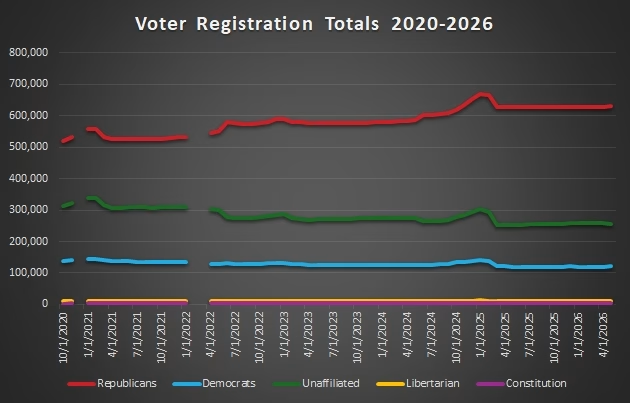
Between May and June 2024, GOP registrations grew from 585,977 to 600,794, an increase of nearly 15,000 voters. Democratic registrations also increased slightly, from 125,635 to 125,818. Meanwhile, the number of unaffiliated voters fell from 288,940 to 274,301.
The same pattern appeared during the 2022 primary. Republican registrations increased from 550,873 to 578,628, while Democratic registrations slightly increased from 129,758 to 129,987. Once again, however, unaffiliated registrations dropped sharply, this time from 300,005 to 276,656.
This makes sense. Members of other parties, including Democrats, must by law affiliate with the Republican Party ten weeks prior to the primary election. Unaffiliated voters, on the other hand, can request a Republican ballot at the polling place and, in doing so, affiliate with the GOP. It appears that most registered Democrats in Idaho are committed Democrats who vote in Democratic primaries and support Democratic candidates in the general election. Those who are ideologically left-wing but wish to influence Republican primaries generally remain unaffiliated until it is time to vote.
The 2024 presidential election demonstrates this dynamic well. President Trump received 605,246 votes in Idaho at a time when 653,334 voters were registered Republicans. Meanwhile, Kamala Harris received 274,972 votes despite there being only 138,788 registered Democrats. Assuming Harris received every Democratic vote, she would still have needed more than 130,000 votes from unaffiliated or Republican voters.
The biggest concern for conservative Republicans, however, is ideological progressives who register and remain registered as Republicans. It is well known among Republican campaign strategists that unaffiliated voters break heavily for Democratic candidates in the general election. But how many registered Republicans do the same? That question is difficult—but not impossible—to answer.
Since the Idaho Democratic Party still maintains an open primary, registered Republicans have the option of selecting a Democratic ballot in the May election. However, these progressive voters usually have little reason to do so because Democratic candidates often run unopposed.
District 6 presents an interesting case study. Encompassing Latah, Lewis, and part of Nez Perce counties, it is one of only a handful of districts in Idaho where the November general election is genuinely competitive. Democrats did not have contested legislative races there in either 2022 or 2024, while Republicans had competitive primaries in each of the past three election cycles.
In 2022, the highest Democratic primary vote total in the district was 1,828 in the Senate race, compared to 6,465 votes in the Republican Senate primary. In 2024, only 1,086 Democratic votes were cast in the District 6 Senate race, compared to 6,379 Republican primary votes.
In 2026, however, all three Democratic legislative seats in District 6 featured competitive primaries. Suddenly, left-wing voters registered as Republicans had a reason to participate in the Democratic primary instead. A total of 2,568 votes were cast in the District 6 Democratic Senate primary, compared to 8,049 in the Republican primary.
The chart below shows the relationship between Republican and Democratic votes in the District 6 Senate primaries of 2022, 2024, and 2026, excluding third-party ballots:
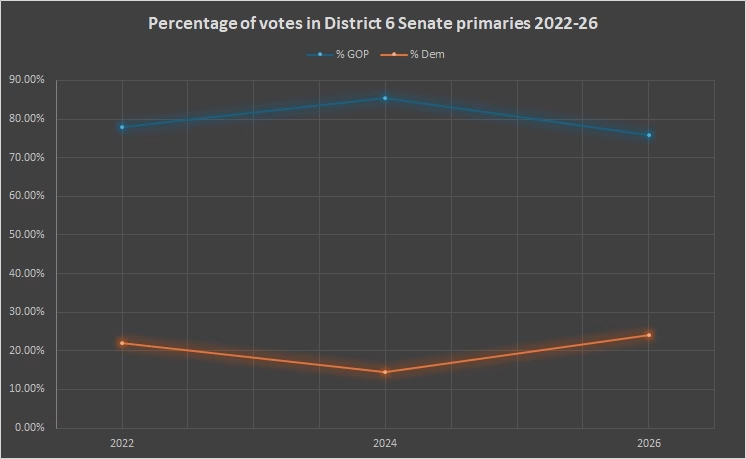
It seems clear, even from this one district, that competitive Democratic primaries are one way to ensure that ideological Democrats in Republican clothing stay out of the GOP primary. Yet outside of running obviously planted candidates, that is not something Republican strategists can easily control.
Crossover voting has been a concern in Idaho for more than a century. It is a rational response from left-wing voters and candidates who would otherwise have little influence over the political direction of the state. At the same time, it is equally rational for Republicans to seek ways to protect their primary elections. After all, the Green Bay Packers would be foolish to allow Chicago Bears fans a voice in choosing their draft picks.
Is there something more conservative Republicans can do to ensure GOP nominees reflect conservative ideals? Should the party consider transitioning to a caucus, convention, or some other method of selecting candidates? I will examine those questions in greater depth as we approach the Idaho GOP State Convention later this month.
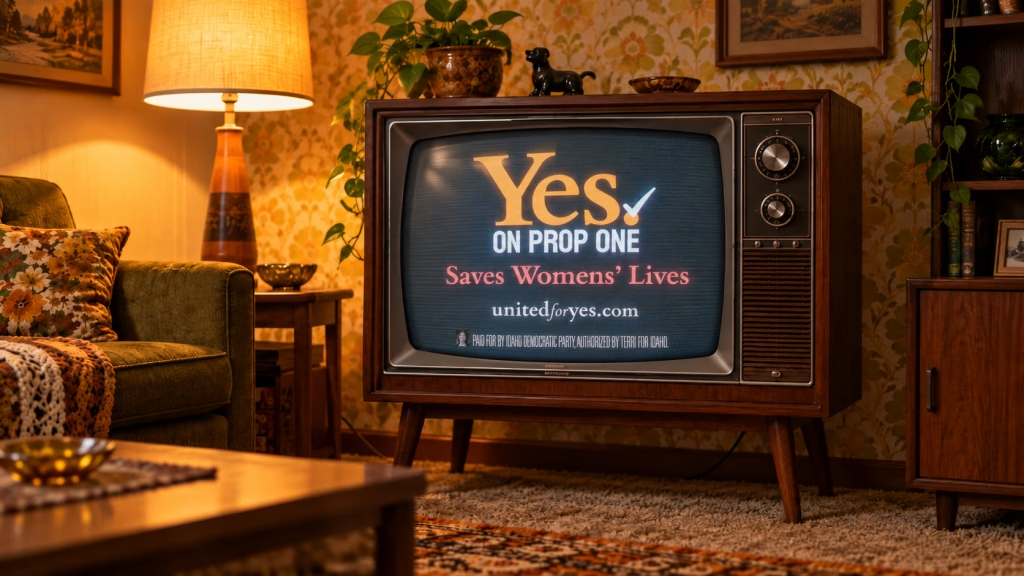
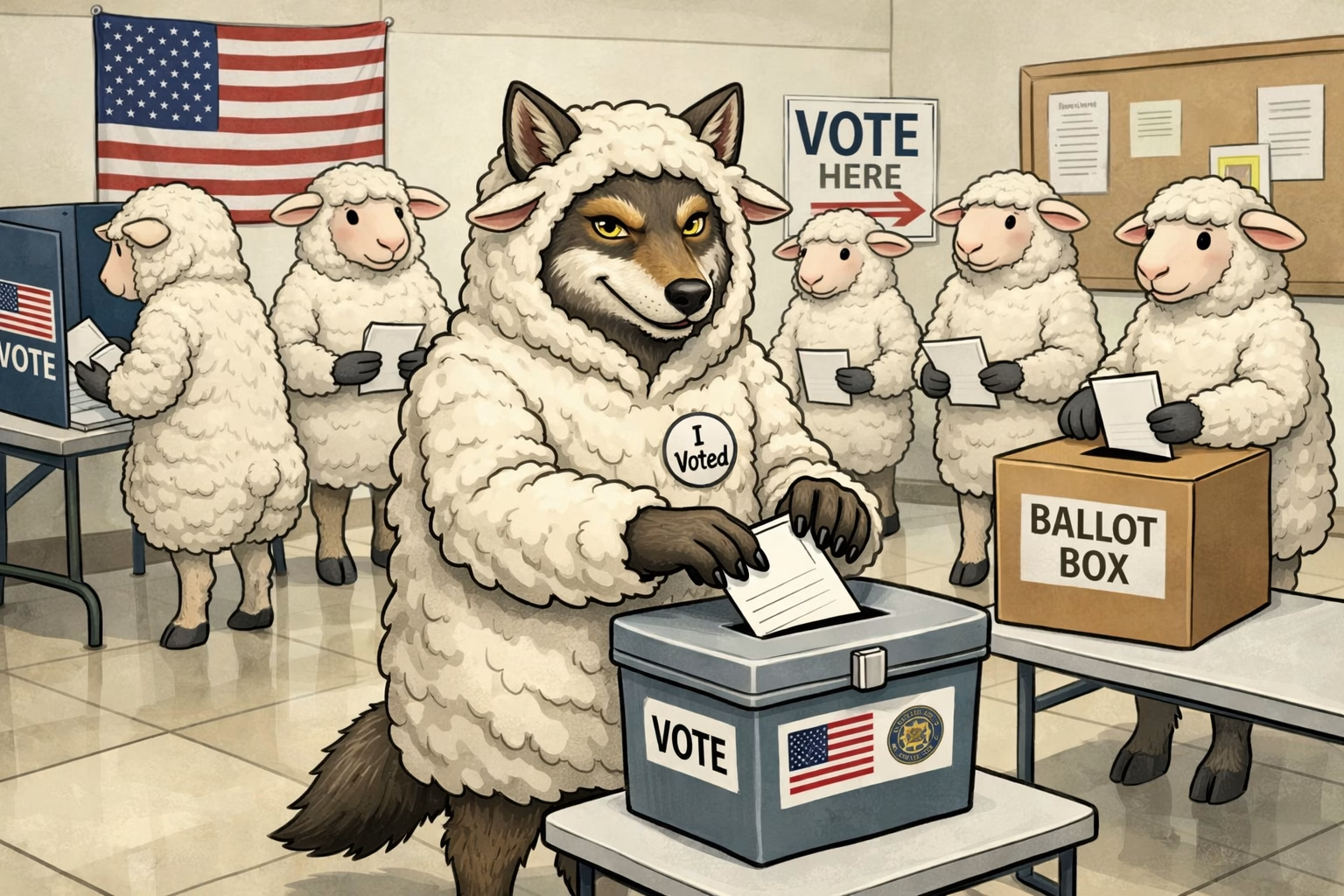
Feature image created with Microsoft Copilot.
The Gem State Chronicle delivers daily analysis, op-eds, press releases, and Idaho Insider updates — free to your inbox.
Free newsletter · Unsubscribe anytime · View on Substack

About Brian Almon
Brian Almon is the Editor of the Gem State Chronicle. He also serves as Chairman of the District 14 Republican Party and is a trustee of the Eagle Public Library Board. He lives with his wife and six children in Eagle.