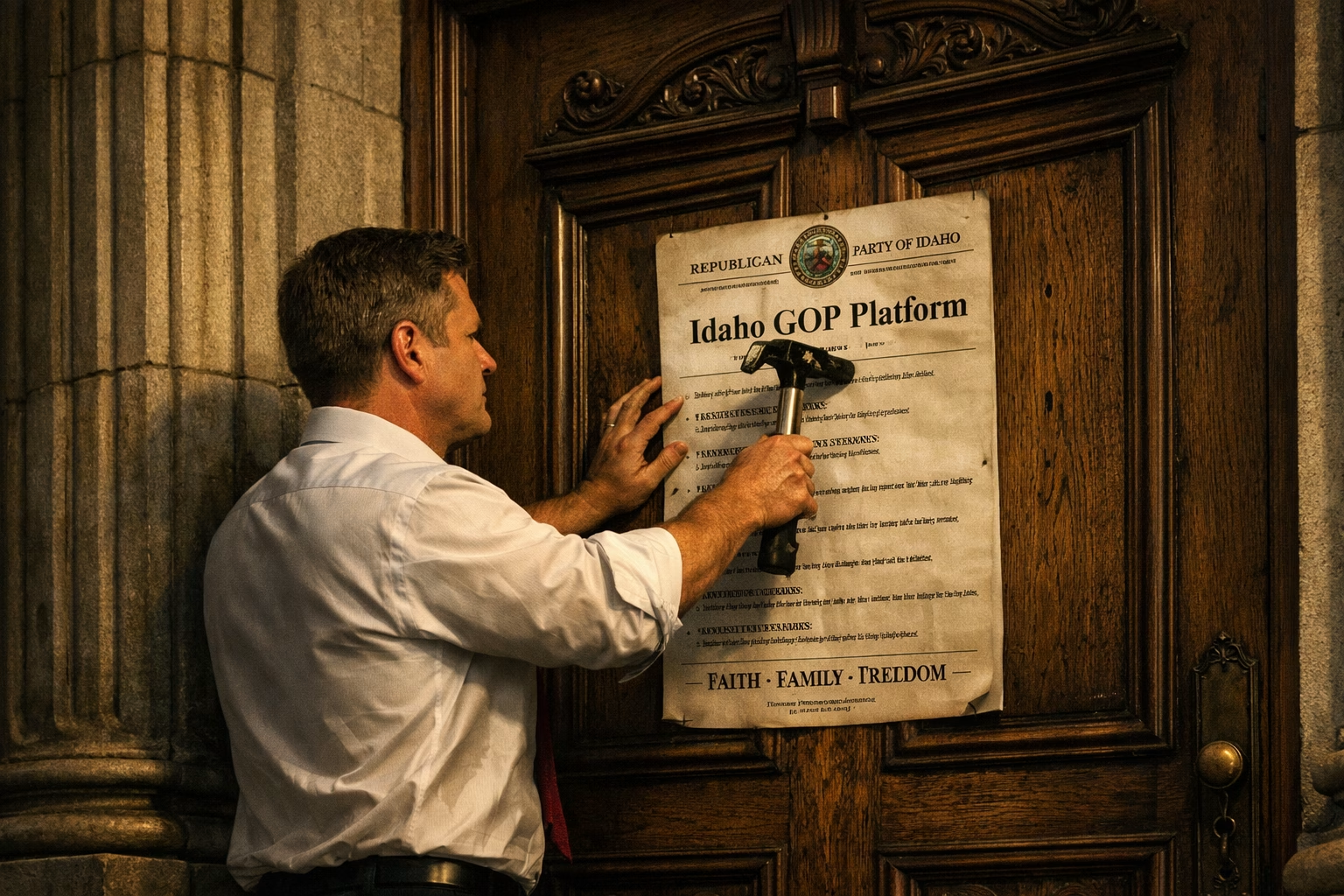
For nearly as long as the United States has existed as a nation, political parties have presented their positions through a platform.
The original Republican platform was short and simple. It reaffirmed the truth and supremacy of the Declaration of Independence and the Constitution and called for Congress to halt the spread of slavery (and polygamy) into new territories. It also demanded the immediate admittance of Kansas as a free state as well as improvements in railroads and other national infrastructure.
The very first platform of the Idaho Republican Party was drafted in 1864, shortly after Congress created the Idaho Territory. It too was short and sweet, declaring support for President Abraham Lincoln’s reelection and his prosecution of the Civil War. It also called on Congress to refrain from taxing mining claims, the primary industry of Idaho at the time.
Since the 19th century, platforms have grown larger and more complex as parties seek to provide answers to every political question. The Idaho GOP adopts a platform every two years at its state convention, incorporating additions and changes brought by delegates and deliberated and voted upon by the body as a whole. The current platform, adopted in Coeur d’Alene in June 2025, is twenty pages long and covers issues ranging from taxes and spending to private property and foreign policy.
I served as secretary for the Platform Committee at the 2024 State Convention and shared my thoughts on the planks debated that day. Having watched the debate over those new planks, I concluded that:
The platform can be a high level statement of philosophy, or it can be a strict metric, but it cannot be both at the same time, and that’s something we as Republicans need to figure out soon.
Many conservative activists see the Idaho GOP Platform as the absolute standard to which candidates and precinct committeemen should be held. Nevertheless, the final decision on who becomes the nominee of the Republican Party is made not by the document, but by the voters, most of whom aren’t concerned with platforms or purity tests. As I wrote last week, voters choose candidates for a variety of reasons, some of which do not seem rational to those of us immersed in the world of politics.
The rules of the Idaho Republican Party require the state chair to request that each federal, statewide, and legislative candidate read through the current platform and either affirm support for it or note any disagreements. In my role with the Idaho GOP, I was tasked with placing those responses on the website for voters to examine, which meant I had the opportunity to read through every single one. It’s a shame that some candidates, especially those I would characterize as eastern Idaho moderates, declined to participate, because I think this is a valuable way to engage in discourse regarding the positions in the platform. I have a great deal of respect for those who took the time to note their disagreements and explain why.
With the primary election over, the Idaho Republican Party now has a slate of voter-supported candidates heading into the general election. New PCs are also preparing to elect delegates to next month’s state convention in Meridian, where additions, modifications, or deletions to the platform will be debated. Out of that convention will come a new platform, perhaps with only small changes, or perhaps something very different entirely. Delegates will begin submitting proposals following this weekend’s reorganization meetings, at which point we’ll have the opportunity to discuss them.
Today, however, I want to present the culmination of some work I’ve been doing over the past few weeks. I copied the current platform into a Google Doc, cleaned up the formatting to make it easier to read and navigate, and annotated it with disagreements from the candidates who won their primary elections last week. After all, these are the men and women chosen by voters to carry the Republican banner into November, so I think it’s worthwhile to consider their thoughts.
I also exported a PDF copy of the annotated platform:
If a candidate submitted a note or disagreement, I attempted to copy it verbatim. In some cases, candidates simply noted disagreements without explanation. For those instances, I added their name under the respective section.
I noticed a few interesting things while working on this project. By far, the three most controversial planks are the platform’s demand to repeal the 17th Amendment, which requires the direct election of U.S. senators; the platform’s call for a return to the gold standard; and the platform’s strict position on abolishing abortion.
Seventeen candidates, including Sen. Jim Risch, Gov. Brad Little, and Congressman Mike Simpson, noted their opposition to repealing the 17th Amendment. While I understand the populist argument for the direct election of senators, I believe the amendment was a mistake that severely diminished the power of the states to influence the federal government. Earlier this year, proponents of an Article V Convention argued that such a convention was necessary to bring the states back into the discussion, but that ship sailed in 1913.
Nevertheless, I don’t see repeal of the 17th Amendment happening anytime soon. Is this something that should remain in the Idaho GOP Platform if it could sow needless division? Are the seventeen candidates who disagree with this plank somehow not true Republicans?
Thirteen candidates disagreed with the idea of returning to the gold standard. Rep. Barbara Ehardt did not disagree with the plank, but noted that she has been a proponent of greater investment in gold and silver. Again, is this a realistic position that necessitates a plank in the platform? These two items arose from the libertarian infusion into the GOP following Ron Paul’s presidential campaigns. While I believe that movement was a necessary course correction for a Republican Party that had grown too corporatist, too globalist, and too statist, we should still ask whether these ideas are worth including in the platform, especially if we are going to use the platform as a litmus test for true Republicanism.
Finally, twelve Republican candidates noted their disagreements with the platform’s position on abortion. I remember the fierce debate at the 2022 state convention in Twin Falls when this version of the plank was introduced. Dobbs v. Jackson Women’s Health Organization, which overturned Roe v. Wade and allowed states to once again ban abortion, had been issued mere weeks before the convention opened, meaning this was no longer an academic issue. Idaho’s abortion bans were now in effect, and the differences between complete abolition and maintaining exceptions suddenly mattered.
Most of the candidates who noted disagreements in this section affirmed their support for current Idaho law, which includes exceptions for terminating a pregnancy in cases of rape or incest or to save the life of the mother. Some, including incumbent representatives Grayson Stone and Doug Pickett, along with candidate Chance Requa, included the “health of the mother” as an exception they would like to see as well. Sen. Todd Lakey noted that he would support repealing the current ballot initiative should it pass this November, and I’ve spoken to other candidates who have said the same thing.
The issue of preborn life is obviously extremely important from a moral perspective. I personally support the current platform and believe it serves the purpose of laying out the ideal policy regarding abortion. If terminating a pregnancy means destroying an innocent human life, then how can we justify exceptions? Regarding the life-of-the-mother exception, I recall when once-and-future senator Scott Herndon debated the plank in Twin Falls, he pointed out that if the mother’s life is in danger, then actions taken to save her are not elective abortion, but triage, which always carries inherent risk as doctors attempt to save as many lives as possible.
Of course, this discussion exists around the margins of the issue. Nearly all abortions carried out in America are elective, performed as a form of birth control by irresponsible people. Idaho’s current law gets us 99% of the way there, and we should continue working to persuade voters that abortion pills and other such loopholes are wrong.
I believe that maintaining the plank regarding abortion is more important than maintaining the planks regarding the 17th Amendment and the gold standard. Why? Because in the wake of Dobbs, Idaho must have a policy regarding abortion. We cannot simply ignore the issue, so I believe it is appropriate for the Idaho GOP to hold a strong position on it. The 17th Amendment and the gold standard, by contrast, are not issues we can directly tackle as a state, and there is virtually no national political will to change those policies. As a result, those planks are largely academic.
Take some time to read through the annotated platform. You might be surprised by where certain candidates stand. It’s also interesting to note the areas where there was no disagreement at all. Nobody disagreed with the platform’s stance against social justice indoctrination in public schools, its call for lower taxes, its support for agriculture and the family farm, the need for increased water storage, or the protection of natural resources for multiple uses.
Of course, several candidates declined to participate in this conversation, so who knows what they really believe. Nevertheless, I believe this document lays the groundwork for productive discussions about what kinds of policies we’d like to see enacted over the next few years. I hope it proves valuable as you meet your candidates over the summer, serve as delegates to the Idaho GOP state convention, and look ahead to the 2027 legislative session. Let’s figure out where we agree, where we disagree, and how we can move forward together.
The Gem State Chronicle delivers daily analysis, op-eds, press releases, and Idaho Insider updates — free to your inbox.
Free newsletter · Unsubscribe anytime · View on Substack

About Brian Almon
Brian Almon is the Editor of the Gem State Chronicle. He also serves as Chairman of the District 14 Republican Party and is a trustee of the Eagle Public Library Board. He lives with his wife and six children in Eagle.