By Chris Cargill | Originally published at Mountain States Policy Center
For the first time in its history, the city of Boise is proposing local spending exceeding $1 billion.
Think about that for a moment.
Idaho’s capital city, with fewer than a quarter-million residents, is now contemplating annual spending with a “b” in front of it.
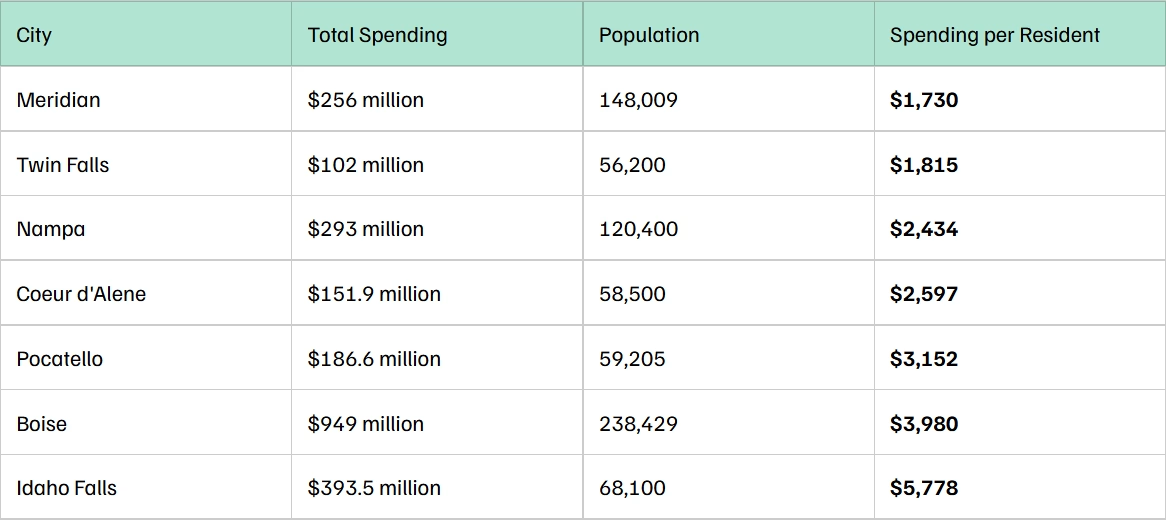
Last year’s spending was already enormous. Boise’s 2025 spending totaled approximately $949 million. With a population of roughly 238,000 people, that’s the equivalent of nearly $4,000 in city spending for every man, woman and child living there.
And Boise isn’t alone in raising an important question Idaho taxpayers don’t ask nearly often enough: How much government are we buying for our money?
Property taxes remain one of Idahoans’ biggest concerns. Yet most of the debate surrounding property taxes focuses on assessments, exemptions, credits and tax rates. Blame is often placed on state lawmakers, who have nothing to do with local rates.
We spend far less time examining what ultimately drives tax revenue in the first place: government spending.
A comparison of some of Idaho’s largest cities shows why that deserves more attention.
Take the total spending of Idaho’s seven largest cities and divide it by their populations. The differences are remarkable.
Start with Meridian and Boise.
They’re neighbors. Both are growing. Both are in the same state and operate under the same general legal environment.
Yet Meridian’s city spending works out to about $1,730 per resident, while Boise’s 2025 spending was nearly $4,000 per resident.
Then there’s Idaho Falls, where total city spending works out to roughly $5,778 per resident — more than three times the amount in Meridian.
Why? That’s not a rhetorical question. It’s a question taxpayers deserve to have answered.
There can be legitimate reasons for these differences. Municipal finances aren’t identical. Some cities operate utilities, airports or other enterprises within their spending plans. Capital projects can cause significant year-to-year fluctuations. Different cities provide different services.
A spending-per-resident calculation therefore isn’t a perfect measurement of government efficiency, and it shouldn’t be treated as a ranking of the “best” and “worst” Idaho cities.
But when one city’s spending per resident is three times another’s, shouldn’t taxpayers at least know why?
And when the state’s largest city crosses the $1 billion spending threshold for the first time, shouldn’t we be talking about the growth of local government at the same time we’re talking about property-tax relief?
One of the most persistent misconceptions about property taxes is that rising assessments are themselves responsible for rising tax bills.
Assessments matter, but they aren’t the whole story.
Idaho doesn’t have a statewide property tax. Property taxes are imposed locally to fund local governments, school districts and other taxing districts.
Ultimately, local spending matters.
If government wants to collect more property-tax revenue, taxpayers should be able to clearly see that decision, understand why officials are asking for more money and hold those officials accountable for it.
Instead, homeowners often receive a new assessment showing that their home’s value has increased dramatically and understandably conclude that the assessor “raised their taxes.”
That can obscure the far more important question: How much money is the taxing district collecting, and how much has that amount increased?
The assessor determines value. Elected officials determine how much government spends.
That’s why meaningful property-tax reform can’t simply shuffle the tax burden from one taxpayer to another or send state money back to offset local taxes. If spending continues to rise, the underlying pressure eventually returns.
We need to deal with the spending side of the equation.
Fortunately, Idaho doesn’t have to invent a new system. One promising reform is called Truth in Taxation.
Utah pioneered the concept in 1985, and versions of it have since been adopted in several other states.
The basic principle is straightforward: Rising property values shouldn’t automatically result in a windfall for government.
Under the Utah model, property-tax rates automatically adjust as existing property values change so that a taxing entity generally receives the same amount of property-tax revenue as the previous year, plus revenue associated with new growth.
A local government can still increase property-tax revenue. But if officials want to collect more, they have to say so publicly.
That means notification, disclosure and a public hearing so taxpayers can see that their local government is proposing to increase the amount of property-tax revenue it collects.
That’s a significant improvement over a system in which taxpayers can easily blame rising assessments without understanding the spending and revenue decisions occurring on the other side of the equation.
Idaho lawmakers considered exactly this idea in 2025.
House Bill 369 would have required local taxing districts proposing tax increases to publish notices and send property owners a “Notice of Proposed Tax Increase” containing information intended to make the tax increase and the process more transparent.
That idea deserves another look.
Truth in Taxation doesn’t prohibit a city from spending more money. It doesn’t prevent communities from choosing higher levels of service. And it doesn’t impose the same spending level on Boise, Meridian, Nampa or Idaho Falls.
It simply forces the conversation into the open.
If local officials believe taxpayers should provide significantly more revenue, they should be willing to explain why.
Truth in Taxation should be accompanied by another reform: standardized local government spending transparency.
Every Idaho taxpayer should be able to see these stats in their local city budget documents:
- Total city spending per resident.
- Governmental spending per resident, excluding enterprise funds.
- Property-tax revenue per resident.
- The percentage increase in spending over five and ten years.
- Population growth over those same periods.
- Inflation over those same periods.
- How those figures compare with similar Idaho cities.
Transparent Idaho is a terrific source for much of this information.
But imagine opening your city’s annual property-tax notice and seeing that city spending has increased 35% over five years while population plus inflation increased 20%.
That doesn’t necessarily mean the additional spending is unjustified. It does mean elected officials should explain the difference.
Conversely, if spending has grown more slowly than population and inflation, local officials ought to get credit for that too.
Transparency cuts both ways.
Idaho policymakers have worked for years to provide property-tax relief. Those efforts are understandable and often welcome.
But there is a fundamental limitation to any property-tax relief program that doesn’t address spending.
Government services cost money.
If Idaho shifts taxes from homeowners to businesses, somebody still pays.
If lawmakers increase an exemption, somebody still pays. If the state sends money to local governments to buy down property taxes, taxpayers are still paying — just through a different level of government.
And if local spending continues growing faster than taxpayers’ ability to pay, we’ll be back at the Capitol a few years from now looking for another solution.
That’s why Boise’s billion-dollar spending plan should be more than a headline about the capital city.
It should prompt a broader conversation throughout Idaho. Why does one city spend $1,700 per resident while another spends nearly $5,800?
How fast have those numbers grown? What services account for the difference? Are taxpayers receiving better outcomes in higher-spending cities?
And when a local government wants property owners to provide more revenue, shouldn’t those property owners receive a clear notice telling them exactly how much more government intends to collect and why?
None of these questions assumes that increased government spending is inherently bad.
They assume something much simpler: Taxpayers have a right to know what their government costs.
Before Idaho’s next property-tax debate becomes another argument about assessments, exemptions and tax shifts, let’s put government spending and transparency on the table too.
Boise crossing the $1 billion mark gives us a good place to start.
The Gem State Chronicle delivers daily analysis, op-eds, press releases, and Idaho Insider updates — free to your inbox.
Free newsletter · Unsubscribe anytime · View on Substack

About Chris Cargill
Chris Cargill is the President & CEO of Mountain States Policy Center, an independent free-market research organization based in Idaho. Online at mountainstatespolicy.org.