There was a tempest in a teapot on Twitter this week, as a few conservative-identifying academics took aim at Christopher Rufo, denouncing him as a charlatan and a problem for the right. One of them, Kevin Vallier, characterized Rufo as the “chief culprit on the new right in reducing trust and increasing polarization.” This attitude—that anyone whose work provokes the left should be shunned—was once more prevalent on the right before the Age of Trump, but there are still a few holdouts fighting a war for decency above all.
Adrian Vermeule responded to Vallier’s accusation yesterday:
I think there’s a misunderstanding of these types and their incessant carping about @christopherrufo. It’s not that, deep down, they want the university to be better than it is, but are afraid to do anything about it. Rather it’s that they have carved out a minor niche within the liberal university by serving as a police force against the growth of any substantive views to their right. Happily, the barriers have broken down.
I reposted it because I think Vermeule is absolutely correct. There are activists and academics on the right who have grown comfortable being what Sam Francis called “beautiful losers.” They’ve adopted a mindset that the left is not only ascendant, but that it always will be, and that the best we can do is play the role of the Washington Generals to the left’s Harlem Globetrotters: put on a good show, then go out for drinks together when it’s done.
Watching the Supreme Court overturn Roe v. Wade a few years ago was bittersweet for some pro-life organizations. Sure, it was the culmination of half a century of activism—the very achievement they had been pitching to donors for decades. But now what will they do? The battle has shifted to the states, where the fight for hearts and minds is even harder.
Christopher Rufo has done what many in the conservative sphere consider unforgivable: he actually won. He pushed the issue of DEI all the way up to the Trump administration, and now it’s being dismantled throughout society. He helped force the resignation of Harvard’s president following antisemitic statements and a long record of academic plagiarism. He hasn’t just been sitting in an ivory tower decrying the state of society while resisting any attempt to fix it, as so many who are ostensibly on our side tend to do.
I think there are two equal and opposite errors at work here. Some on the right have internalized the worldview that leftist beliefs are high-status, and they’re afraid of being identified with the vulgar, blue-collar peasants who unironically fly Trump flags on their lawns. Idaho’s moderate Republican faction often behaves this way, seeming much more comfortable in the company of the teachers’ union, Planned Parenthood, or the ACLU than with grassroots conservative organizations.
On the other side of the coin, some activists have adopted a belief that conservatives will always be the underdogs, the dissidents, the Rebel Alliance versus the evil Galactic Empire. This faction doesn’t know how to win, because winning, to them, is by definition selling out to the establishment. The moment conservatives gain enough power to actually govern, these dissidents redefine terms in a way that resets them to the status quo of being eternal rebels. They’re more comfortable as perpetual losers, where speaking truth to power is the only necessary action and results don’t matter.
Both sides have lost sight of the point of engaging in politics: to create a societal structure that allows people to thrive and be free. It’s not a debating society, a theoretical exercise, or a movie that ends when the credits roll.
I saw another post on Twitter responding to the Rufo tempest by a fellow named Pincher Martin:
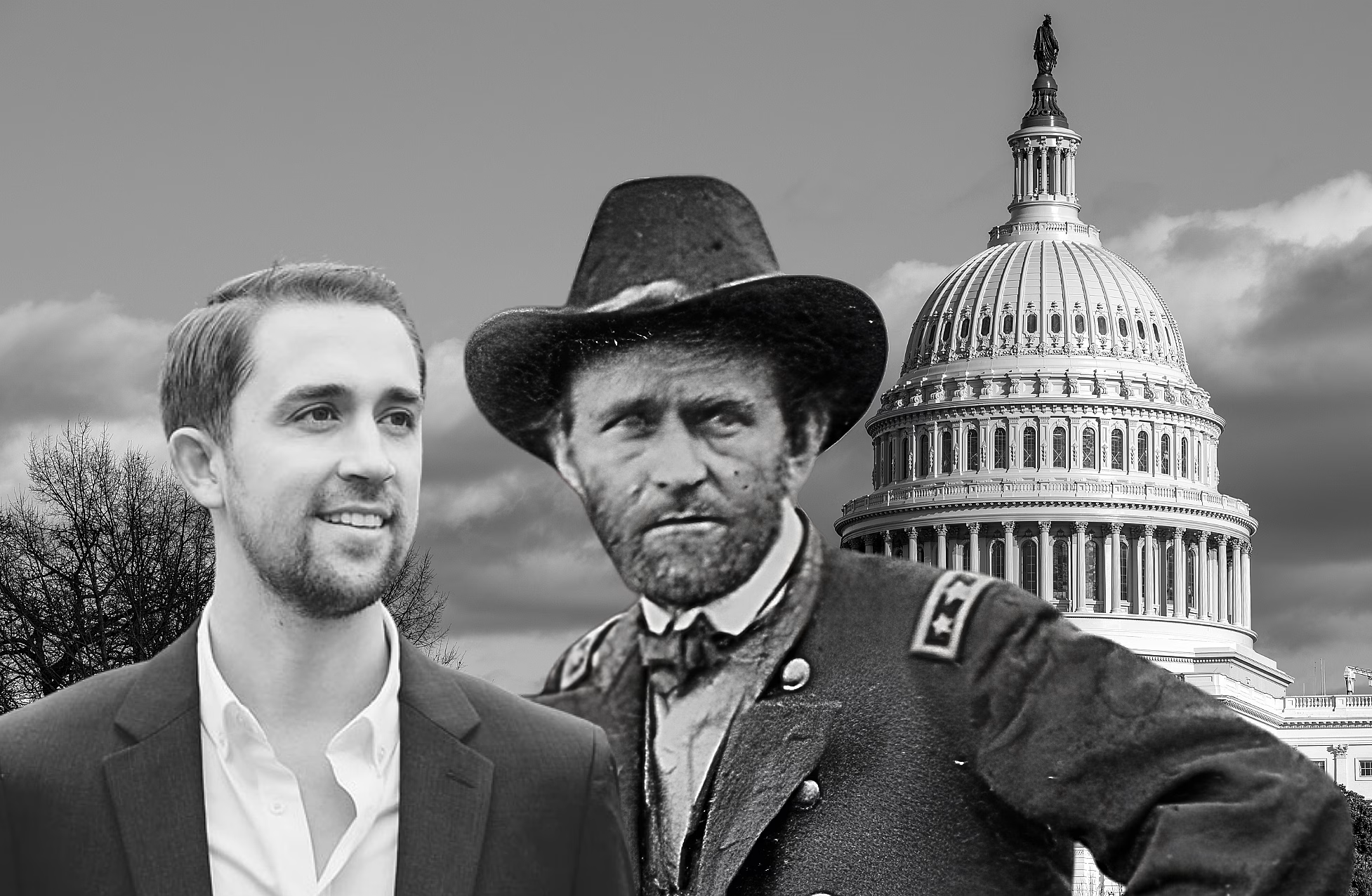
My attitude toward Rufo is very much like Lincoln’s toward Grant.
“I can’t spare this man; he fights.”
Every previous conservative activist was like McClelland [sic]. They wanted everything to be perfect, the stars aligned, and money – plenty of money – before they would risk the troops. Even then, they wouldn’t risk them.
Rufo just goes out there on a shoestring, armed with a good idea, and gets things done. Universities buckle. State governments quake. Things get done.
Turns out that if you are really interested in doing something good for your country, you can just go do something good for your country. You don’t need to start a think tank, get sixty votes in the Senate and spend an entire generation telling lies to your own voters at every election about how “this time, it’s really different.”
The comparison to Ulysses Grant is apt, I believe. He was uncouth, unkempt, and carried a lifetime of failure into the Civil War. Yet that conflict allowed him to flourish and gave President Lincoln the man he needed to win. Imagine if Lincoln had listened to those who disapproved of Grant because he didn’t fit in at Washington cocktail parties.
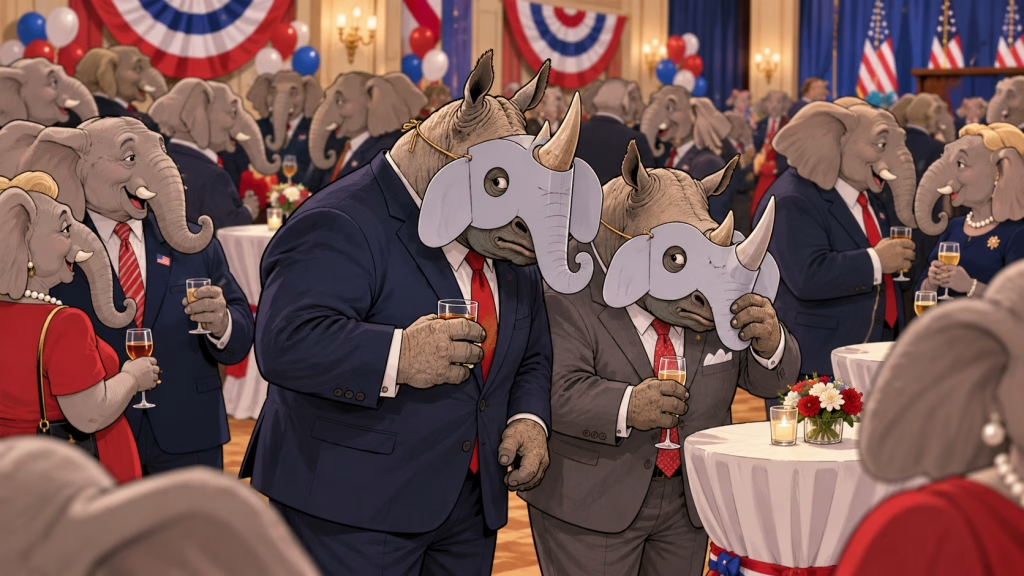
The right’s willingness to give the left a heckler’s veto has long been a major handicap. Consider the knee-jerk reactions of polite-society conservatives to events like the photo of Nicholas Sandmann at the March for Life, or Kyle Rittenhouse defending himself against leftist thugs. Consider how Republicans reacted in the final month of the 2016 presidential election when the Access Hollywood tape surfaced. Congressman Mike Simpson, Sen. Mike Crapo, then-Rep. Ron Nate, and many others demanded that Trump withdraw from the race, even though such a late change would have ensured Hillary Clinton’s victory. Despite the very real threat to liberty that a Clinton administration posed, these Republicans preferred that to a candidate who had used crude language in private.
Raúl Labrador, then a congressman and now our attorney general, was one of the few who understood the assignment. He recognized that, whatever one thought of Donald Trump personally, a Hillary Clinton presidency posed a greater risk:
After meeting Trump along with other House and Senate Republicans in July, Labrador said, “I’m not a huge fan.” In mid-October Labrador told the Idaho Statesman, “I had to choose between two what I consider to be not very good choices.” But Labrador also issued a written statement, saying, “Right now Hillary Clinton is a greater threat to our national well-being than Donald Trump.”
I’m sure that most of the pearl-clutching Republicans have since come around on Trump in the past decade, but you don’t get extra points for hindsight. Credit goes to those whose instincts were correct in the moment.
What we need is a conservative movement full of people with sound instincts—people willing to support the fighters within our ranks rather than cast them out the first time a leftist raises an eyebrow. Just as Lincoln needed Grant, and Eisenhower needed Patton, we need people like Christopher Rufo, people who are not content to write endless think pieces about an ideal world, but who are willing to fight to save the one we have.
That fight is messy. Being in it makes it harder to maintain the ideological purity and polished manners that some on the right seem to prioritize. Theodore Roosevelt said it best more than a century ago:
It is not the critic who counts; not the man who points out how the strong man stumbles, or where the doer of deeds could have done them better. The credit belongs to the man who is actually in the arena, whose face is marred by dust and sweat and blood; who strives valiantly; who errs, who comes short again and again, because there is no effort without error and shortcoming; but who does actually strive to do the deeds; who knows great enthusiasms, the great devotions; who spends himself in a worthy cause; who at the best knows in the end the triumph of high achievement, and who at the worst, if he fails, at least fails while daring greatly, so that his place shall never be with those cold and timid souls who neither know victory nor defeat.
The Gem State Chronicle delivers daily analysis, op-eds, press releases, and Idaho Insider updates — free to your inbox.
Free newsletter · Unsubscribe anytime · View on Substack

About Brian Almon
Brian Almon is the Editor of the Gem State Chronicle. He also serves as Chairman of the District 14 Republican Party and is a trustee of the Eagle Public Library Board. He lives with his wife and six children in Eagle.