By Tim Oren
And that’s a wrap! The final roll calls are in, so it’s time to finalize the maps, looks at some key votes, and prepare for retrospectives and the Next Big Thing: The Primaries.
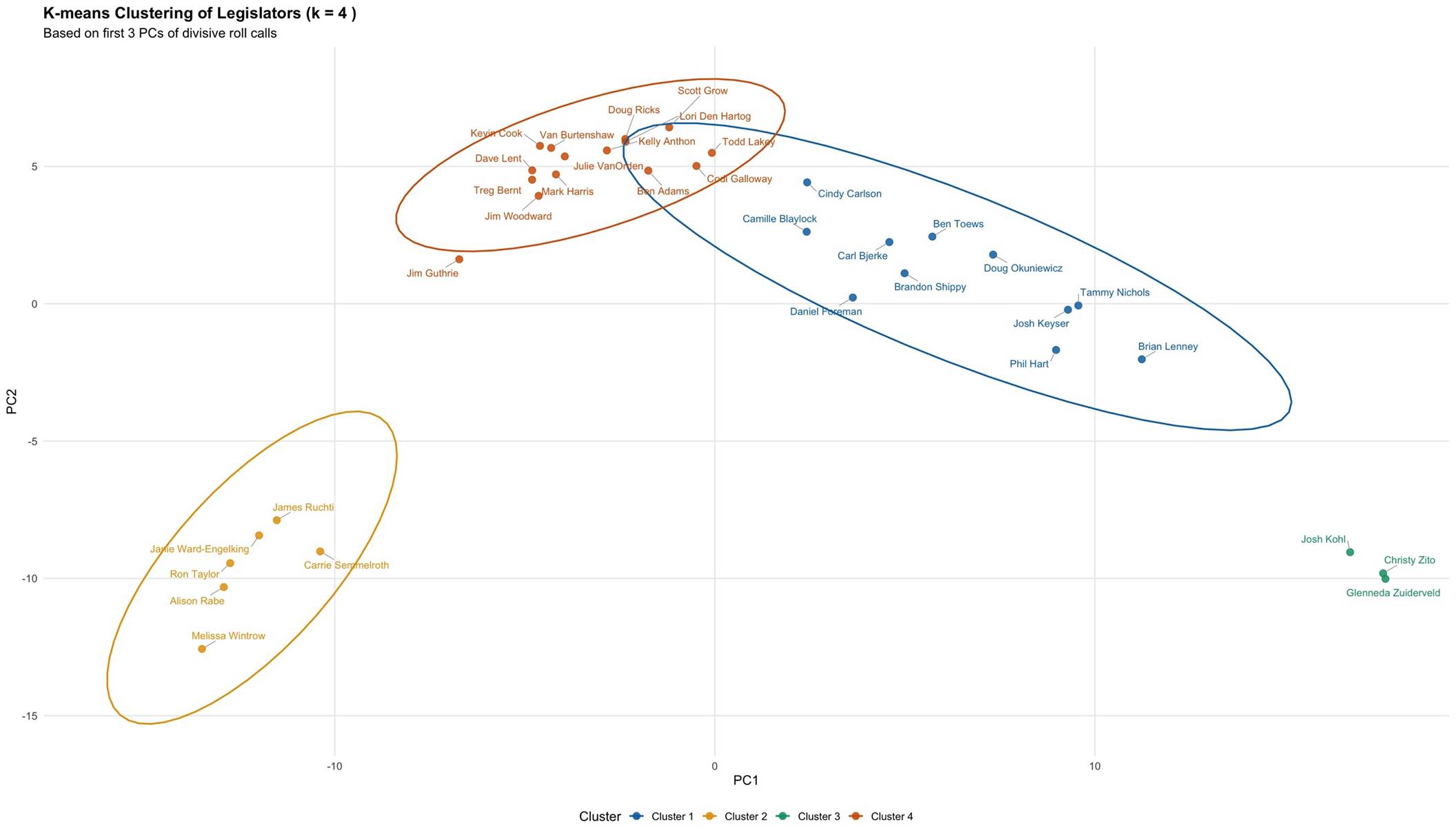
Here’s the final Senate map:
And the House. Note that the Gang of 8 has now merged back into the usual Small Government cluster:
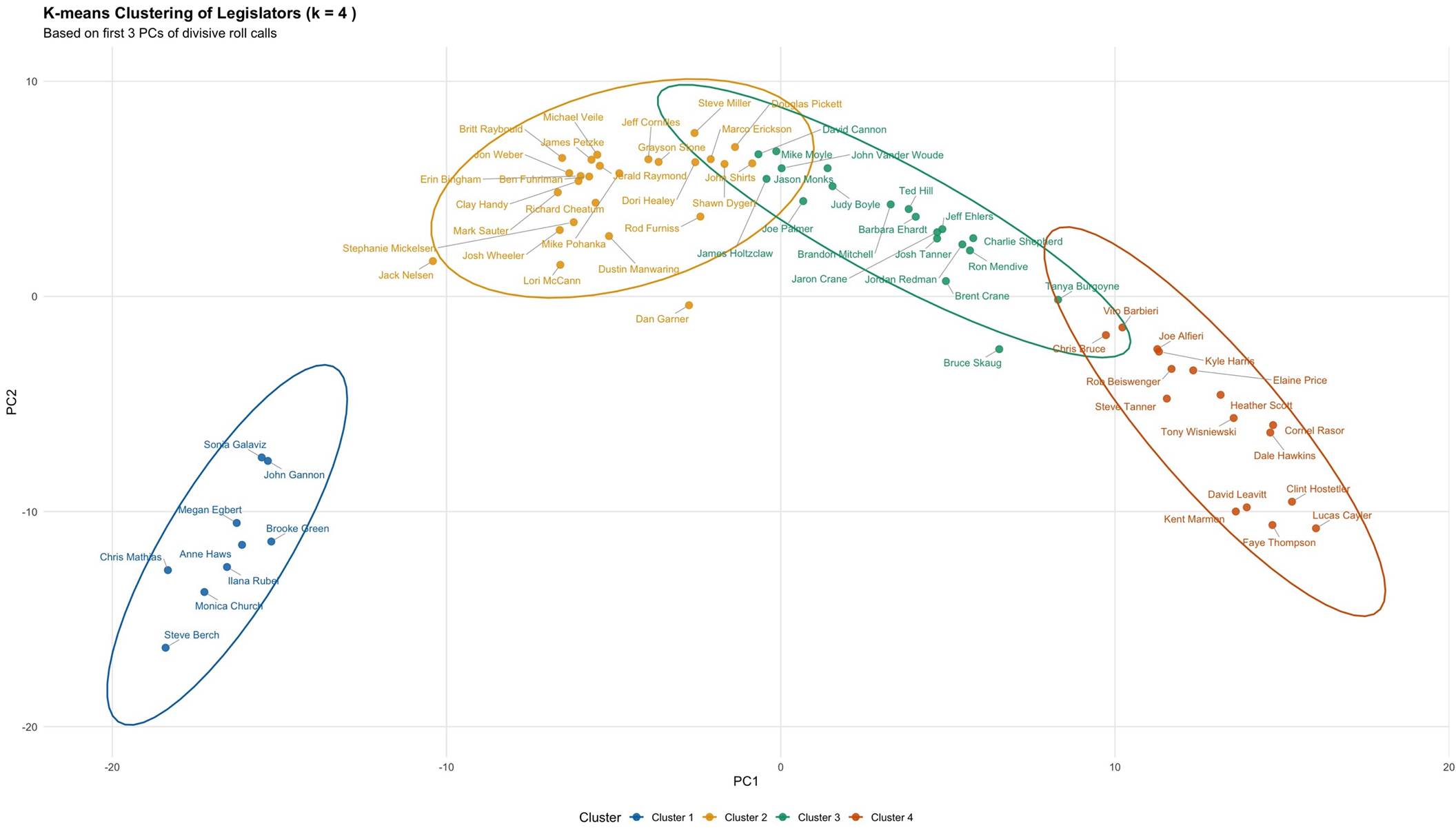
One of the ideas behind this project was that the pattern of voting alliances is fairly consistent from session to session. To judge, compare the map from this year, just above, and this from 2025 sine die, run on exactly the same code:
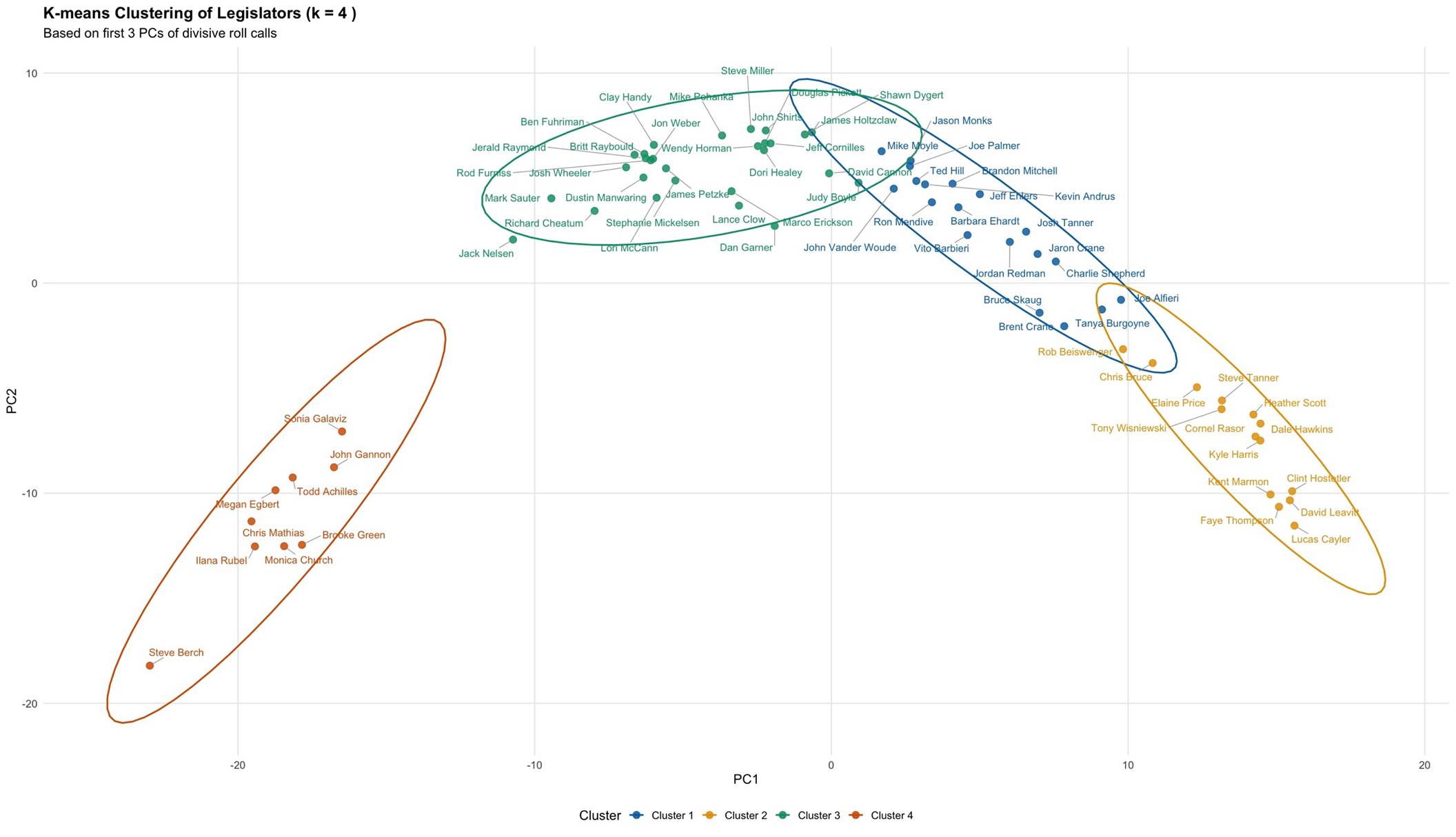
Plus ça change… But, while the overall patterns stay, there are always some exceptions – legislators whose alliances change from session to session. By next week, I’ll have time to look for those who might have changed their stripes, as well as dig into which roll calls made the most difference in defining the voting groups – they aren’t always the ones that get the press and excitement.
For this week, I’ll focus again on the most divisive issue of the session: illegal immigration. The Senate, through a combination of procedural skullduggery, insider conspiracy, or incompetence – take your pick – avoided going on record with a floor vote with any migrant-adjacent measure. Not so the House, that had four measures with a bearing on illegal immigration come to a full floor vote: H659, H660, H700 and H704.
That’s four opportunities for House members to show their positions and for me to look for emerging patterns. My first stab at it proved interesting: I simply added up the number of ‘ayes’ on those measure from both House members for each district, and laid the results out on an Idaho map:
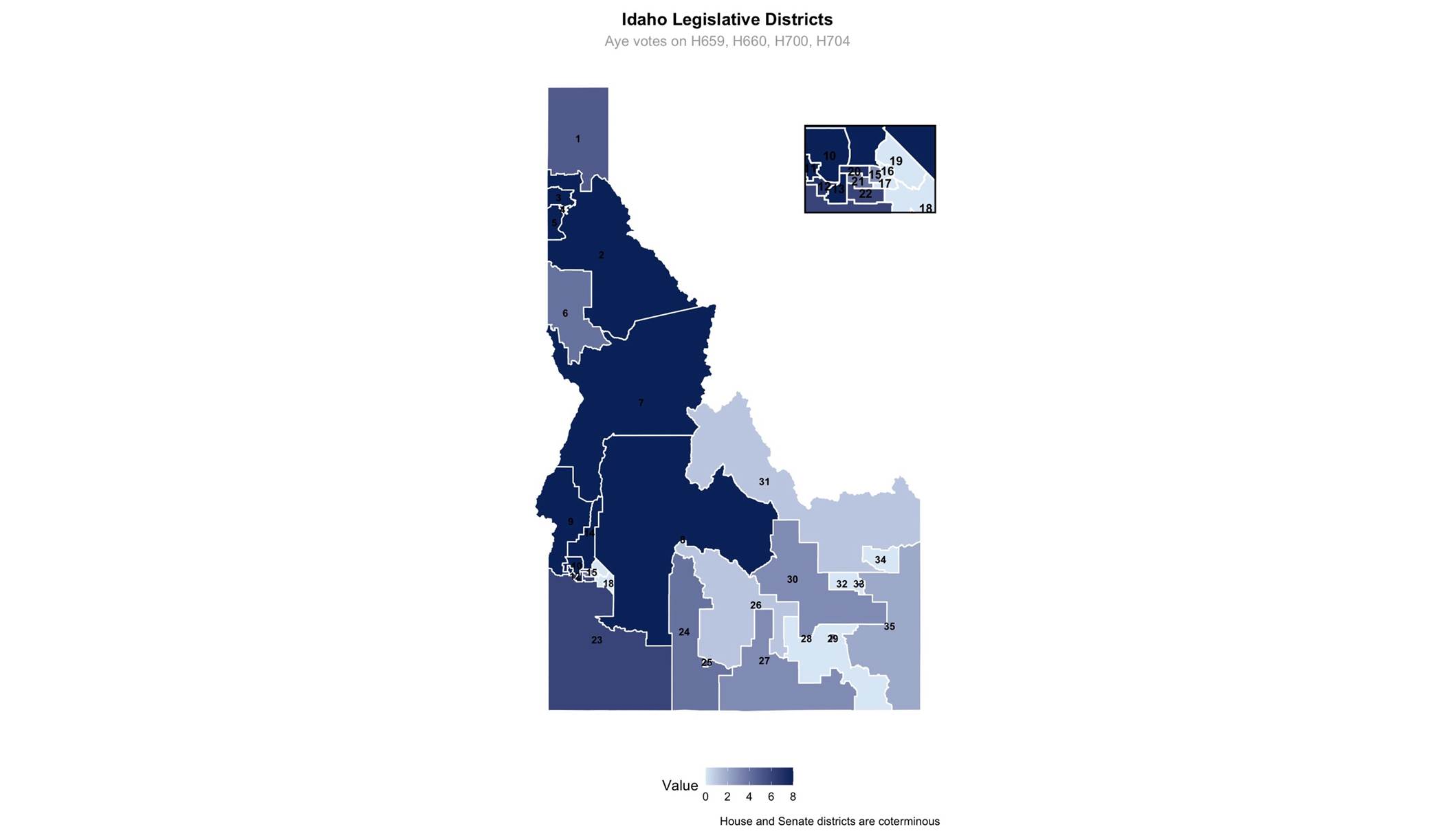
That’s a rather striking result from such a simple test! What do you suppose might be behind the obvious geographic pattern?
My next attempt was an examination of campaign contributions. I’ve mentioned here and on my personal X account that I’ve been working on analyzing patterns of political donations. For comparison’s sake, I compiled lists of those House members who had voted ‘aye’ on all four of the bills mentioned above, and those who recorded no ayes. Those lists are:
Four ‘ayes’: Cornel Rasor, Heather Scott, Dale Hawkins, Vito Barbieri, Jordan Redman, Joe Alfieri, Elaine Price, Ron Mendive, Tony Wisniewski, Brandon Mitchell, Kyle Harris, Charlie Shepherd, Rob Beiswenger, Faye Thompson, John Shirts, Judy Boyle, Mike Moyle, Bruce Skaug, Kent Marmon, Lucas Cayler, Jaron Crane, Brent Crane, Steve Tanner, Ted Hill, Josh Tanner, James Holtzclaw, Jeff Ehlers, Jason Monks, Chris Bruce, Clint Hostetler, David Leavitt, Tanya Burgoyne, Barbara Ehardt
No ‘ayes’: Lori McCann, James Petzke, Steve Miller, Jack Nelsen, Richard Cheatum, Dan Garner, Dustin Manwaring, Jerald Raymond, Stephanie Mickelsen, Erin Bingham, Jon Weber, Britt Raybould
I then totaled up the donations to those lists from various interest groups of campaign contributors. I’ll have more to say about this process in upcoming posts, but for now see the Afterword. Those totals went into something called a Sankey diagram, great for showing energy or cash flows:
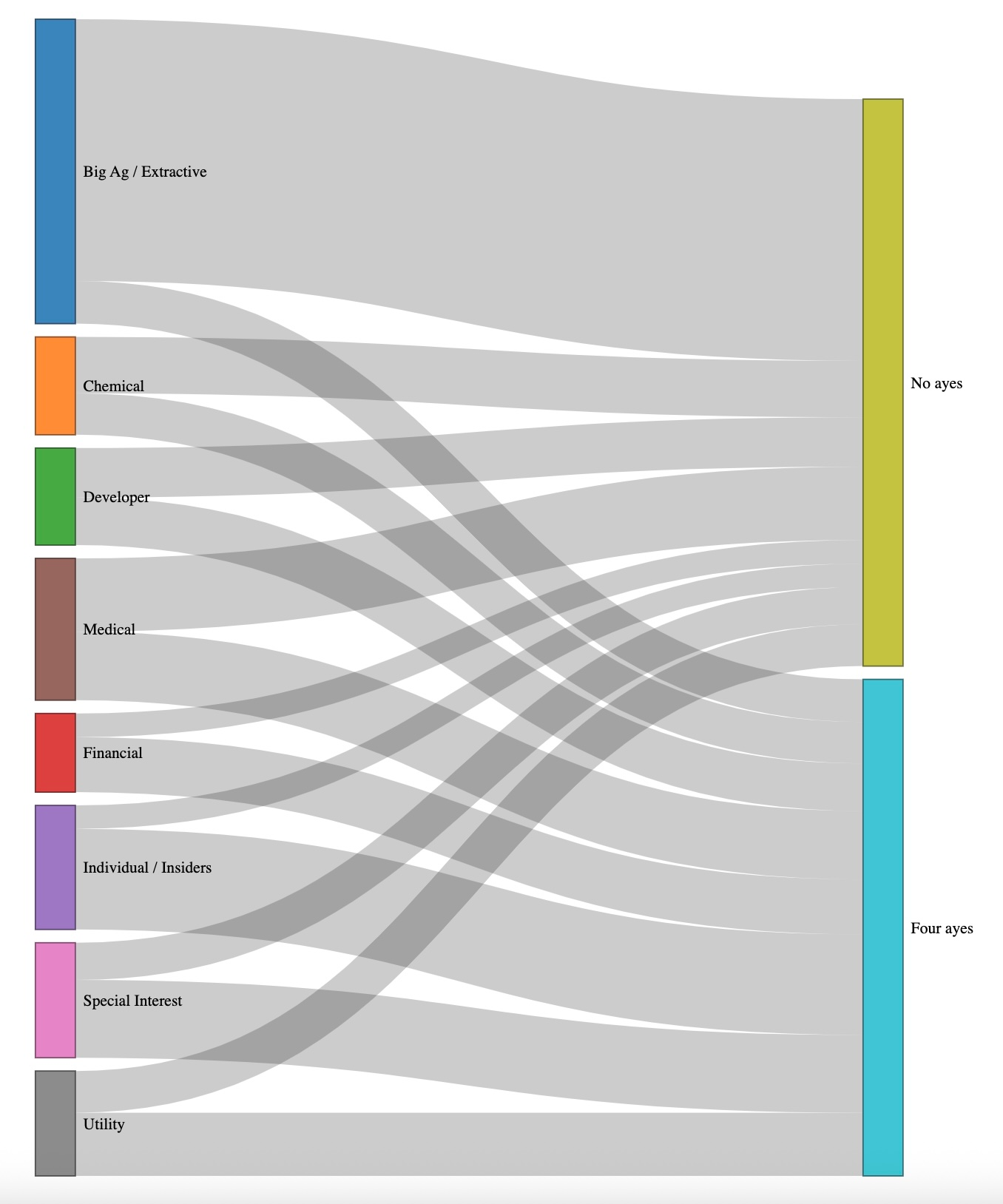
Given the differing numbers of the four/no ‘ayes’ groups, the flows here have been normalized, that is, they are $/candidate from that donor group, rather than absolute dollars. What’s to note here: The flows from the ‘Big Ag & Extractive’ group (see afterword) go overwhelmingly to the ‘No ayes’ group that opposed any form of illegal immigration control or even monitoring. The contributions from Individuals go preponderantly to the ‘4 Ayes’ group of legislators. At least some of ‘big ag’ proudly state that they use illegals – it appears they are putting their money where their mouth is.
This is a good point to say that this series will continue for a while, while shifting theme to the upcoming primaries, in particular trying to make sense of the contributions, endorsements and scorecards that will be ongoing. Next week will have some retrospectives on the session, but begin examining overall primary patterns, as well as digging into key races. As a kick off, here’s a heat map of Idaho, showing the total of donations to date for all three Republican primary races in each district:
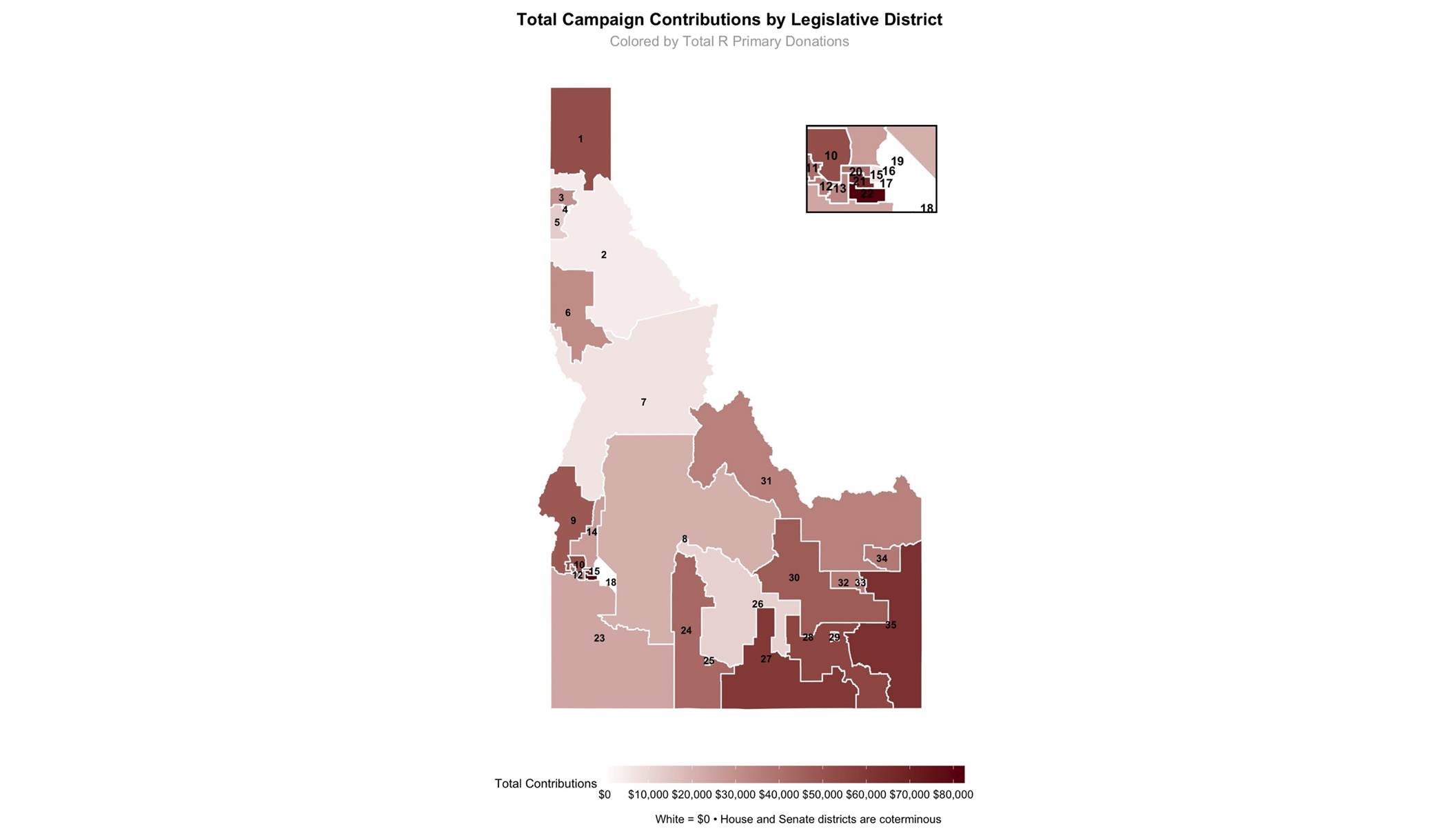
The hot races just jump out at you. Laying that down next to the immigration vote map is also rather interesting, I find.
Afterword
My campaign contribution analysis is based on larger donors. The threshold is currently set at 4 or more donations for a total value of $500 or more to Republican legislative primary candidates, directly rather than to PACs. Any entity – family, corporate and/or PAC that makes 4 or more contributions is necessarily playing outside their home districts, so their donations are subjects for strategic analysis.
In most cases, I’ll be lumping donations together by interest group. Those groups I’m compiling manually as the campaign progresses, and will be the topic of a future article. The group featured in this post, titled ‘Big Ag & Extractive’, currently consists of:
- Clearwater Paper
- Delamar Mining
- Idaho Cattle PAC
- Idaho Dairy PAC
- Idaho Loggers
- Larsen Farms
- Mickelsen Farms
- Perpetua
- Simplot
- Stimson Lumber
- Sugar Beet Growers
Most of those names stand for multiple entities under common control and/or a number of accidental or obfuscating variants of their name(s).
Total contributions per candidate, including the smaller donors, can be found from the Idaho Secretary of State Sunshine website. Rather than duplicating that work, I’ll instead use the ratio of ‘big dog’ donations (as above) to small donors as a key indicator of candidate support.
The Gem State Chronicle delivers daily analysis, op-eds, press releases, and Idaho Insider updates — free to your inbox.
Free newsletter · Unsubscribe anytime · View on Substack

About Tim Oren
Tim Oren retired to Idaho after a 30 year career in Silicon Valley. Here he gardens, home-brews, teaches kids to shoot, and has applied his well-aged statistics degree to subjects such as educational funding and results, Idaho legislative race targeting, and now legislators' voting patterns. He is a contributor to the Idaho Freedom Foundation and a number of Idaho candidates.