On the eve of the 2026 Idaho GOP State Convention, some delegates have been discussing bold plans to change the way the party nominates candidates for the general election. Frustrated by primary losses in the Magic Valley and a seeming inability of conservative candidates to break through in eastern Idaho, activists have been searching for answers—both to the cause of this situation and for potential solutions.
Former Blaine County GOP chair and co-founder of the Idaho Freedom Foundation Heather Lauer has come out in support of a caucus system, which she says will reduce crossover voting by Democrats in the Idaho GOP primary:
This debate is not just about process. In much of Idaho, Republican primaries effectively determine who governs the state. Property taxes, government spending, immigration, education reform, regulatory policy, and countless other issues are ultimately shaped by who wins Republican nominations.
I have become increasingly convinced that the long-term solution is not winning every short-term political fight. The long-term solution is electing a Legislature willing to pursue meaningful conservative reforms and fundamentally change the direction of the state.
We are unlikely to consistently elect that Legislature under a system where Republican candidates can be nominated by progressive activists.
Former state senator Brandon Durst launched his campaign for first vice chair of the Idaho Republican Party at this week’s convention on a pledge to change the way Republican candidates are nominated:
Durst has outlined two core priorities for his candidacy: enforcing existing party affiliation and deadline rules — through federal litigation if necessary — and working with the State Central Committee to adopt a new nomination method for federal and statewide offices that closes the door on outside interference once and for all.
Idaho GOP chairwoman Dorothy Moon wrote last week that she is prepared to lead a caucus should the party decide to go in that direction:
If the Idaho GOP decides to return to a caucus or convention system for choosing its nominees, that is its right, and as chair it will be my duty to carry it out. It certainly wouldn’t be my first rodeo. Remember when the Idaho Legislature “accidentally” eliminated the March presidential primary a couple of years ago? My team and I had to scramble to ensure Idaho Republicans would still have a meaningful voice in selecting our presidential nominee.
Not all are in favor of such a change. As I was writing this article, I received a mailer warning against switching to a caucus. It did not disclose who paid for it, but the permit number on the mailer matches that on fliers sent by the Gem State Conservatives during the 2024 primary. It appears to have been sent to convention delegates, the master list of which was made available to declared officer candidates.
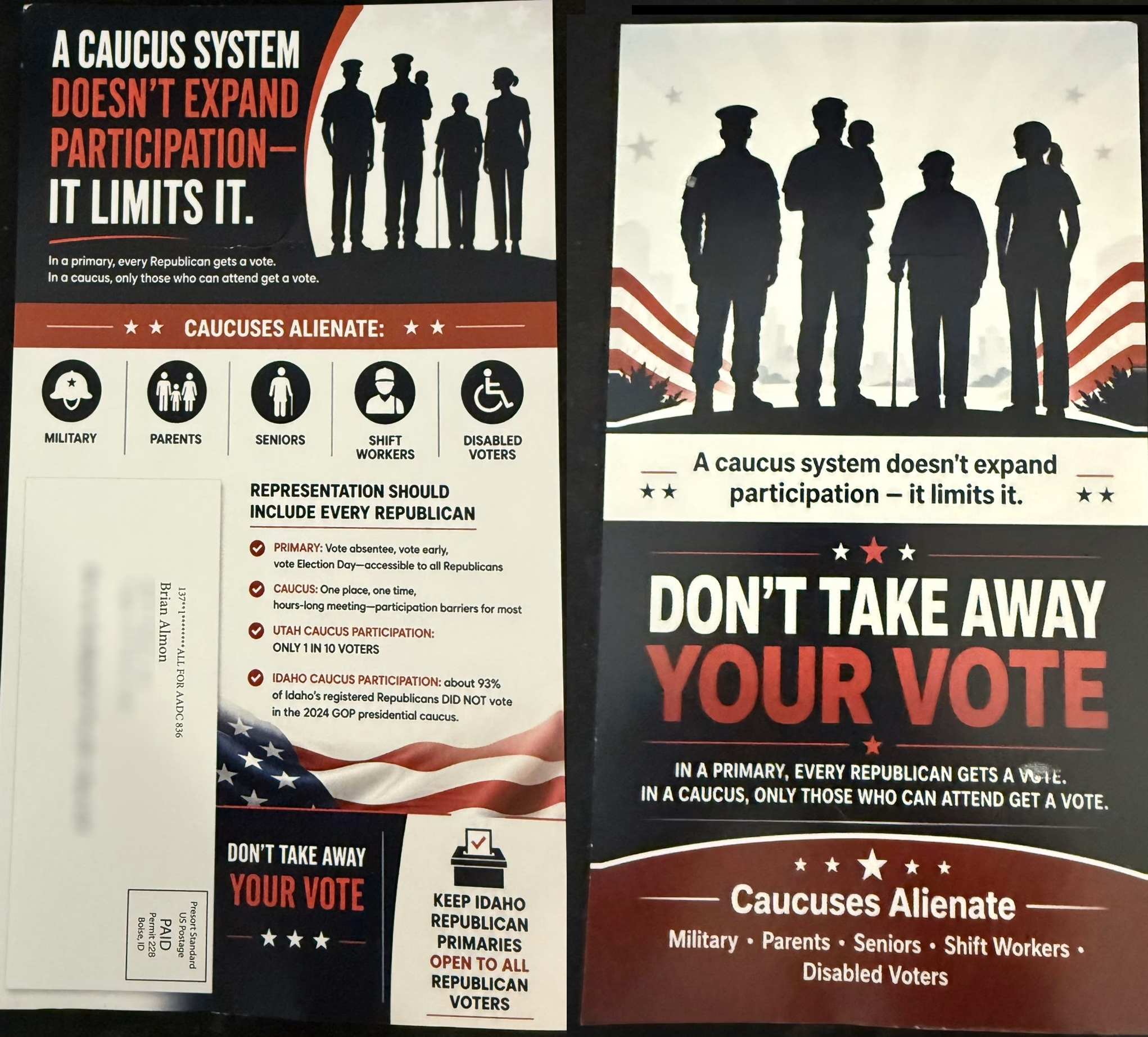
Mailing fliers like this isn’t cheap, so somebody clearly feels very strongly about the issue.
The Idaho GOP has been struggling with the crossover issue for more than a century. I recently wrote about various attempts to mitigate the ability of Democrats or those who lean in that direction to influence the Republican primary:
The Idaho Republican Party has long been concerned about crossover voting. Dr. Matthew May’s dissertation on the history and effects of primary elections in Idaho reports that Republicans took issue with the direct primary as far back as the early 1900s due to fears that Democrats would influence the selection of Republican nominees. In 2007, the Idaho Republican State Central Committee voted in favor of a rule calling for a closed primary, along with a court challenge should the Legislature fail to respond during the following session.
I brought the issue up to Secretary of State Phil McGrane, and he suggested that the motivation of any faction to change election systems stems from a desire to win more than they currently are:
Last week, Rufo & Lomez examined the Los Angeles mayoral election, in which Spencer Pratt’s position in a potential runoff evaporated as mail-in ballots came in over the week following Election Day. The entire first half of this episode is worth watching, as they conclude that there are no neutral election systems, and that any system will necessarily advantage one group over another:
In his dissertation on the history of the Idaho primary election, Dr. Matthew May pointed out two competing directives when it comes to holding elections. I paraphrased it this way:
The state, as the neutral arbiter of elections, believes participation is the highest priority, while the party, as a private coalition of activists working toward particular policy goals, believes ideology is more important. In other words, the government wants more people to participate regardless of their views, while parties want their collective views to prevail.
Elections officials such as Secretary McGrane want to maximize turnout, which necessarily includes citizens who have zero civic engagement and little idea of what they’re voting on. On the other hand, party activists like Lauer and Durst want to ensure that Republican nominees are selected by engaged Republican voters who believe in Republican values. Personally, I don’t believe turnout is the end-all, be-all of voting. I’d rather have 25% turnout in which those who vote have deeply considered the issues on their ballot than 75% in which people vote randomly, or simply based on which sign or mailer they happened to see most recently. Nevertheless, the importance of the right to vote (notwithstanding most people deciding not to exercise it) remains a core principle of the American experience.
The issue at hand is legitimacy. Do nominees have legitimacy because of high turnout, or because of majority support from highly engaged, ideologically motivated voters? Rufo and Lomez are correct that there are no neutral systems, which means that policy must take a position.
The question, then, is a caucus the solution?
I don’t have a glib yes-or-no answer. On the one hand, as a political junkie I think a caucus would be great fun. What could be more exciting than gathering with your community, talking politics, debating the candidates and the issues, and winning support for your cause through sheer strength of oratory? Even a hybrid system, like the firehouse caucus the Idaho GOP hosted to nominate its presidential candidate in 2024, was a great time. I was a caucus captain for my precinct and welcomed hundreds of voters to Seven Oaks Elementary School in Eagle, where we had refreshments, chatted about politics, watched videos from the two remaining candidates, cast our ballots, and then watched Rep. Ted Hill and Eagle Council Member Mary May count the votes.
There are two questions to consider regarding switching to a caucus system:
- Is it feasible?
- Will it accomplish what our goals?
Both Lauer and Durst answer the first question in the affirmative, though both recognize it would be a tough hill to climb. Durst says he is prepared to engage in litigation to accomplish it, while Lauer wrote:
Moving Idaho toward a caucus system will not happen overnight. Idaho Republican Party rules would need to change, and Idaho law would eventually need to change as well. It will require organization, resources, and dedicated volunteers.
There will also be resistance, including from Republicans who believe the problem is overstated or impossible to fix (as well as Republican elected officials who have benefited from crossover voting).
But difficult does not mean impossible.
Idaho Republicans should at least be willing to begin the conversation now rather than waiting until confidence in the primary system erodes even further.
I’m not a lawyer, so accept my take with a grain of salt. As I see it, the party could change its rules to require a caucus to select its nominees for the general election. However, state law still says that the winners of the May primary appear on the November general election ballot. This would create a legal dilemma, and I’m not sure the party would win that battle in court. The next step would be to pressure the Legislature to change the law, but every lawmaker in that body was elected under the current system, so getting a majority to vote to change it seems unlikely.
Should this issue come up for debate, those who want to maintain the status quo will surely present public opinion polling showing a vast majority of voters want to maintain a primary. Americans have an almost mythological belief in the franchise. Despite primary election turnout only reaching 30% this year, many more will defend mechanisms that make it easier for more people to vote, even when they do not personally participate.
Of course, a caucus doesn’t disenfranchise anybody, but it does make voting slightly less convenient, which to some is the same thing. During the 2024 Idaho GOP presidential nomination caucus, several people complained to me that it was not nearly as convenient as voting in a primary, which has early and mail-in options. When I explained that waiting until May to vote for a presidential nominee would be pointless, since the race would be over by then, most didn’t care. They just wanted to vote.
I’m not arguing against a caucus here, rather I am simply doing my best to present the potential arguments as strongly as possible. Before embarking on such an audacious course, we must take seriously the hurdles ahead.
The answer to the second question is even more difficult, because it’s impossible to perfectly predict the future. I suspect, however, that should all the challenges listed above be defeated and the Idaho GOP is able to adopt a caucus as its nominating procedure, political players would change the way they play the game. After Notre Dame used the relatively new concept of the forward pass to upset heavily favored Army in 1913, every other team quickly adopted the same strategy, and football once again reached parity. When the Oakland Athletics began using “sabermetrics” to evaluate players in the early 2000s, they briefly had a competitive advantage, but soon every other team started doing the same thing.
Even if conservatives are able to gain a brief advantage by switching to a caucus, the same big players that engage in elections today will start playing by the new rules. The same PACs and lobby groups that spent millions of dollars influencing this year’s primary will adapt, spending just as much money to influence the outcome of a caucus instead. Iowa famously uses a caucus system to select its presidential nominees, and in 2024 alone Republican candidates and organizations spent more than $100 million to influence the outcome.
Money and influence will flow to wherever the power is, simple as.
In the end, I don’t have a pat answer. I think the idea of a caucus is intriguing, but I recognize it faces many challenges. I also wonder if we have room to improve our engagement in the existing primary. Have we reached every engaged conservative Republican in the state already, or can we further increase turnout of informed voters? Are there candidates we could support who might inspire voters in a way past candidates have not? Is it simply a question of cash—increasing donations to conservative candidates and PACs, and being smarter about where that money is allocated?
Above all, we must keep our true goal in sight: electing candidates who share our values and our legislative priorities. Whatever system can best accomplish that, with a reasonable cost in time and resources, is worth our support. I look forward to the debate at the convention this weekend.
Feature image created with Grok.
The Gem State Chronicle delivers daily analysis, op-eds, press releases, and Idaho Insider updates — free to your inbox.
Free newsletter · Unsubscribe anytime · View on Substack

About Brian Almon
Brian Almon is the Editor of the Gem State Chronicle. He also serves as Chairman of the District 14 Republican Party and is a trustee of the Eagle Public Library Board. He lives with his wife and six children in Eagle.