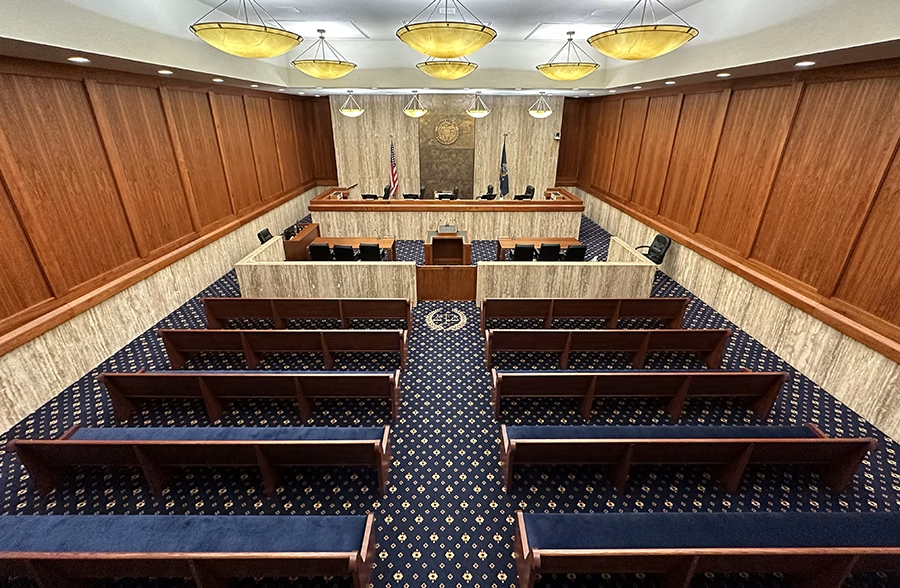
This morning, Gov. Brad Little announced his selection of Ada County District Judge Jason Scott to succeed retiring Supreme Court Justice Richard Bevan, effective October 30. Scott has spent the past 12 years as a district judge in Idaho’s Fourth Judicial District, which includes Ada and Valley counties. Prior to that, Scott earned a degree in accounting from Idaho State University and a law degree from Duke University. He clerked for U.S. District Judge Lynn Winmill before spending seven years with the Boise law firm Hawley Troxell.
Scott was one of three names submitted to Gov. Little by the Judicial Council, along with Leslie Hayes, a judge in the Office of Administrative Hearings, and Cynthia Yee-Wallace, a fellow judge in Idaho’s Fourth Judicial District.
Judge Scott has made several impactful rulings during his tenure as a district judge. Last year, he heard Adkins v. State of Idaho, in which a group of women and doctors asserted that Idaho’s abortion ban was unconstitutionally restrictive regarding a physician’s determination of when an abortion might be necessary to save the life of the mother. He ruled in favor of the plaintiffs on the medical question, stating that Idaho law allowed doctors to perform an abortion if there was a non-negligible risk of death, but upheld the law on the constitutional question.
The opinion suggests that Judge Scott applied a careful reading of Idaho’s traditional laws regarding abortion—the practice was prohibited in the Idaho Territory—as well as the precedent set by the Idaho Supreme Court in Planned Parenthood v. State of Idaho, which upheld our state’s abortion bans. That opinion was written by Justice Robyn Brody, who was elected chief justice by her colleagues last week.
In early 2024, Judge Scott ruled against Attorney General Raúl Labrador’s claim that the State Board of Education had violated Idaho’s open meetings laws regarding the proposal for the University of Idaho to buy the University of Phoenix for more than $500 million. The Supreme Court later remanded the case, overruling Scott’s decision, but the purchase fell through before a final determination could be made.
Judge Scott’s decisions seem to show a pattern of threading the needle—deciding cases on narrow procedural grounds rather than making sweeping legal statements. In 2020, Scott ruled that Kanye West could remain on Idaho’s presidential ballot as an independent, rejecting arguments from the Idaho Democratic Party that he should be disallowed because he was registered as a Republican in Wyoming. In 2025, Scott dismissed a lawsuit by the Oneida School District regarding a change in school funding options. In 2024, Scott ruled against a Meridian woman who was cited by the city for living in a tiny home in a manner that violated the city’s zoning ordinances.
Judge Scott will be sworn in as a justice of the Idaho Supreme Court effective October 30, 2026, and will be up for reelection in 2030. As the incumbent, it is not likely that he will face a challenger. Whatever one’s opinion of Judge Scott himself, the fact is that Gov. Little was given a choice of three names out of the more than 2,000 Idahoans who meet the criteria to serve as a Supreme Court justice, and his selection is likely to remain on the court until he decides to retire. Idaho voters don’t have much of a say in the matter.
Several Idaho lawmakers have called for reform of the judicial appointment process over the past few years. Sen. Brian Lenney wrote in 2025 that the Judicial Council, which submits a list of names to the governor for appointment, is the “gatekeeper” of the process and demanded its abolition. Sen. Phil Hart introduced legislation in the 2026 session to disallow judges who retire before the end of their term from assuming senior status, as well as another bill that would prohibit judges appointed to fill a vacancy from standing for the next regular election. Neither made it to the Senate floor.
Nevertheless, calls for reform are growing. I’ll take a look at our options in a future piece.
Feature image is a file photo from East Idaho News.
The Gem State Chronicle delivers daily analysis, op-eds, press releases, and Idaho Insider updates — free to your inbox.
Free newsletter · Unsubscribe anytime · View on Substack

About Brian Almon
Brian Almon is the Editor of the Gem State Chronicle. He also serves as Chairman of the District 14 Republican Party and is a trustee of the Eagle Public Library Board. He lives with his wife and six children in Eagle.