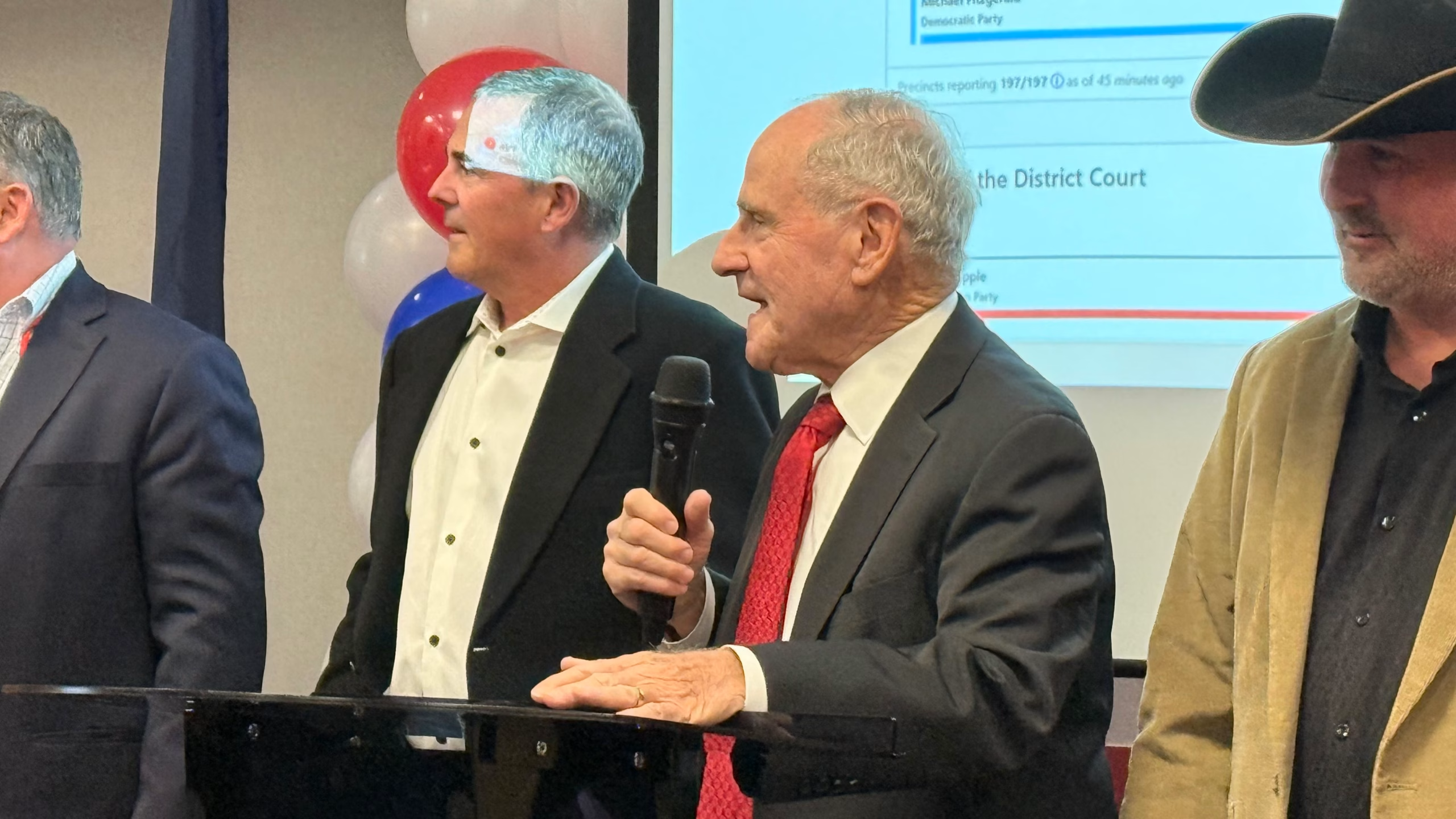
Last night at the Idaho GOP watch party in Meridian, as candidates and volunteers processed the impact of the nationwide blue wave, Sen. Jim Risch took the podium following his reelection. He acknowledged the changed situation in Washington, D.C., and said that he and the rest of Idaho’s congressional delegation would continue to fight for our state even in the minority. Turning to local issues, however, he stated emphatically that “Idaho is still Idaho.”
In the midst of a once-in-a-generation blue wave that saw Republicans lose not only the House and the Senate, but the entire Texas state government, as well as governorships and Senate seats in Ohio, Kansas, Georgia, and even South Carolina and Mississippi, Idaho stood strong. We soundly defeated Proposition 1, succeeding where Ohio and Kansas failed in recent years to keep abortion out of our state. We maintained our Republican supermajority, despite losing seats in the battleground regions of west Boise, Blaine County, and Pocatello. We won all three federal races and all seven statewide races.
The live results page I put together at the last minute worked like a charm—I personally used it throughout the night on both my laptop and mobile phone to monitor the situation. All screenshots are from the Chronicle’s live results page.
The national landscape looks very different this morning than it did this time yesterday, but Idaho remains Idaho. Here are a few things to celebrate this morning:
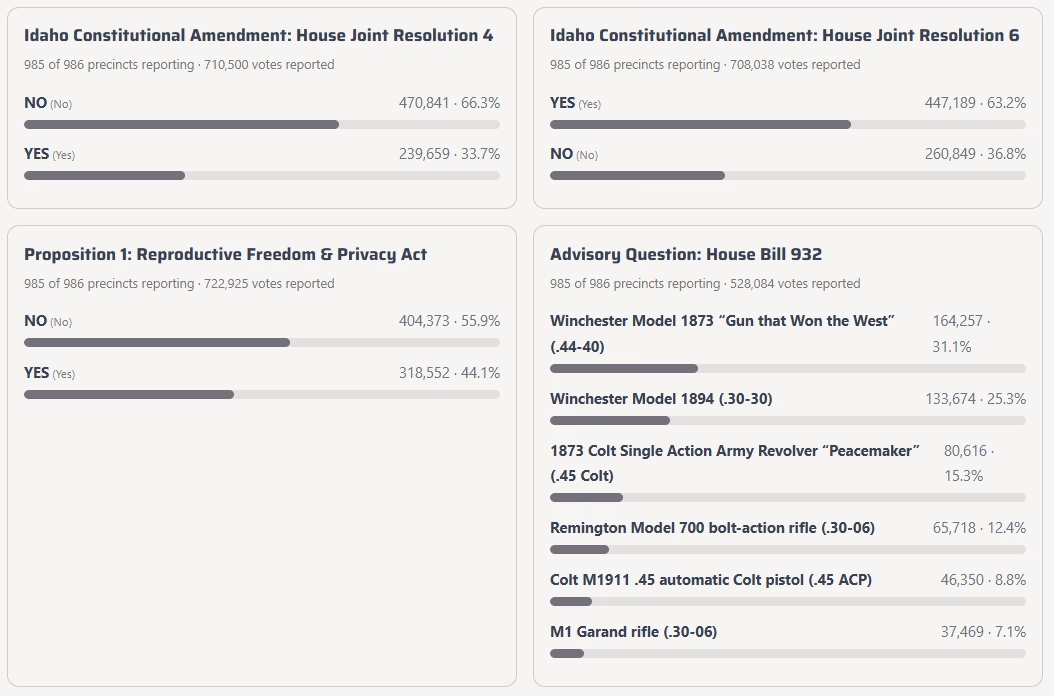
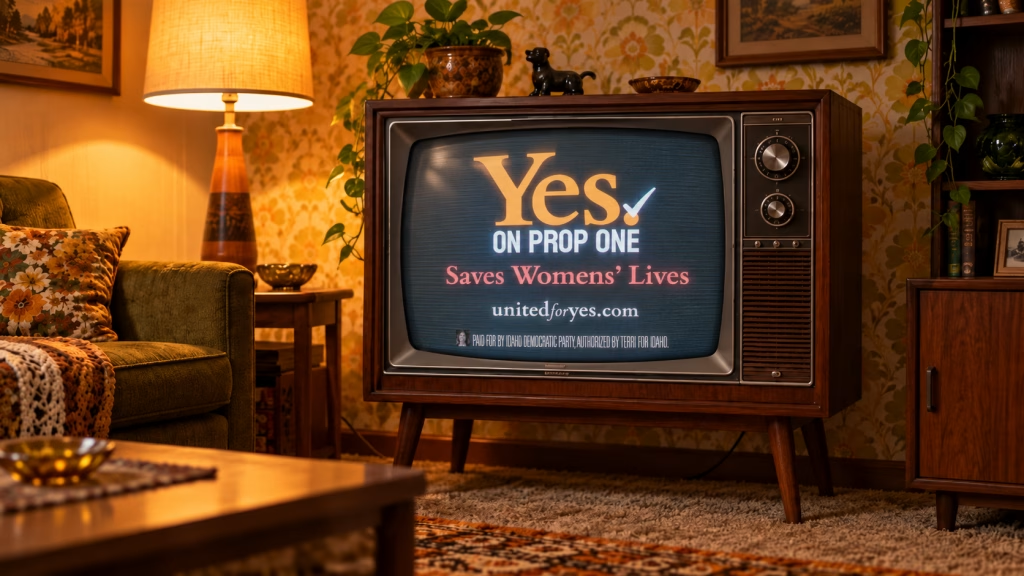
Defeating Prop 1 was the biggest victory of the night. Idahoans United for Women and Families, the committee behind the initiative, raised about $6 million to legalize abortion in Idaho, and they failed. They even collaborated with the Idaho Democratic Party and gubernatorial candidate Terri Pickens to get half off campaign ads, and still failed. While Prop 1 likely drove Democratic turnout in blue and purple districts, which almost certainly played a part in Democrats gaining six legislative seats, it also drove turnout in red districts, as Idahoans turned out to protect life in our state.
They say success has a thousand fathers, and it’s true. Defeating Prop 1 took a lot of work from a lot of committed people, including but not limited to the Idaho GOP, the Too Extreme For Idaho PAC, the White Rose Resistance, the Idaho Family Policy Center, Idaho Chooses Life, the LDS Church, the Catholic Church, and countless other individuals and groups. Republicans, conservatives, and Christians of all stripes came together to fight for a shared goal, and we succeeded.
As of this writing, Prop 1 had received a total of 722,925 votes statewide, compared to only 710,006 in the Senate race and 712,825 in the race for governor. That means around 10,000 more votes were cast on Prop 1 than in either of those races. The Democratic and independent candidates for governor received 284,747 votes, compared to 318,552 in favor of Prop 1. The Libertarian and Constitution Party candidates in that race won 20,996 votes. The question is: how many Republicans who voted for Gov. Little also voted in favor of Prop 1? It could not have been too many. More analysis is necessary, but it seems plausible that Prop 1 votes are heavily correlated with partisan affiliation.
While some loosening of our pro-life laws might have some support, even among Republicans, Prop 1 was written in such an extreme way that it ultimately made very few inroads into Idaho’s conservative electorate. The job of the Idaho GOP and the other organizations fighting to defeat it was to shine the light of truth on the text of the initiative and show voters how extreme it really was, and they succeeded.
Watch for moderate Republicans to bring legislation to loosen our abortion ban this session, and be ready to shut them down by reminding them that a majority of Idahoans just voted to maintain the status quo.
HJR6 passed comfortably, so now our state constitution will state that English is our official language. The Winchester 1873, which I voted for, is now our state gun. Until I was at the polling place yesterday, I didn’t understand why it was running so high in the betting markets—it turns out that putting “Gun that Won the West” on the ballot probably made a big difference.
HJR4, which would remove drug legalization from the citizen initiative process, went down by a two-to-one margin. I was talking to a legislator last night who said the better play would have been to simply pass a constitutional amendment banning marijuana rather than restricting drug legalization to the Legislature alone. Even though the initiative process has been used solely to push bigger government and left-wing policies for the past decade, many conservatives still clung to the idea that it is a fundamental right that our Legislature has no business meddling with.
I personally disagree, as I wrote last month, but the morning after an election is the time to recognize where people are rather than pontificate about where they should be.
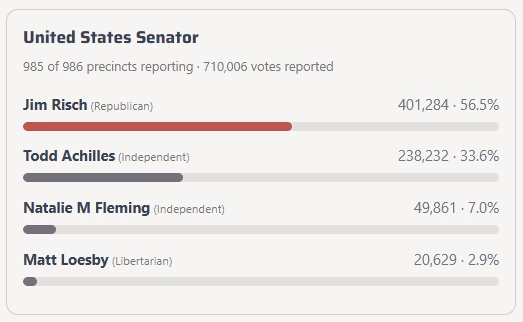
The independent campaign by former Democratic state legislator Todd Achilles gained a lot of attention this year, but the results speak for themselves. Despite raising nearly $2 million, despite all the signs, mailers, and text messages, Achilles ended up in essentially the same place as Paulette Jordan in 2020. Sen. Risch dropped below 60% for the first time since 2008, but still won by a very comfortable margin.
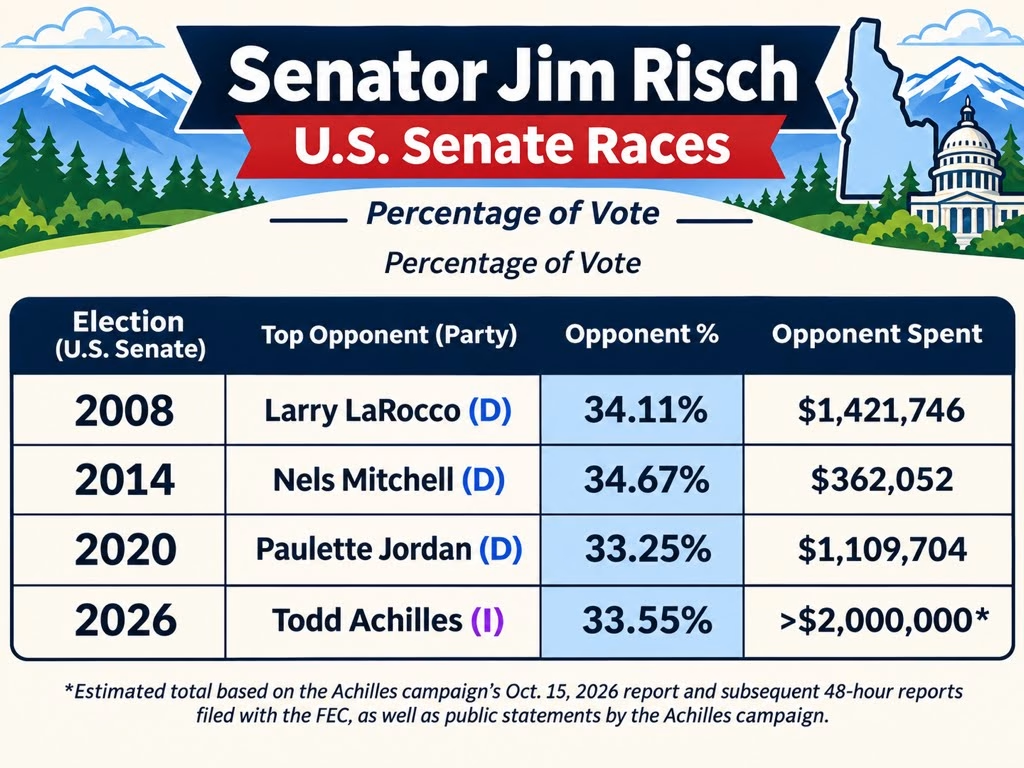
Earlier this year I highlighted the Democratic strategy of running supposed independent candidates for the U.S. Senate and pushing their own nominees to drop out. It worked in Idaho, Nebraska, and South Dakota, while in Montana the Democrat remained in the race. Republicans won all four of these races, despite the blue wave. Hopefully, that spells the end of such an underhanded tactic.
Nevertheless, I think Achilles comes out of this campaign stronger than ever. Whether he remains an independent or returns to the Democratic Party, he’s now the most recognizable name in Idaho’s center-left ecosystem. Achilles won Ada County by 2.8%, receiving more votes than Risch and even Gov. Little. He would likely have a good chance of winning a county race or returning to the Legislature. The bigger prize is Idaho’s expected third congressional district following the 2030 census. If the borders of that district are drawn to include all of Boise and the surrounding area, then someone like Achilles is well positioned to win that seat.
I’ll have more to say about our upcoming redistricting in the near future. It’s a hugely important issue that will be debated in next year’s legislative session.
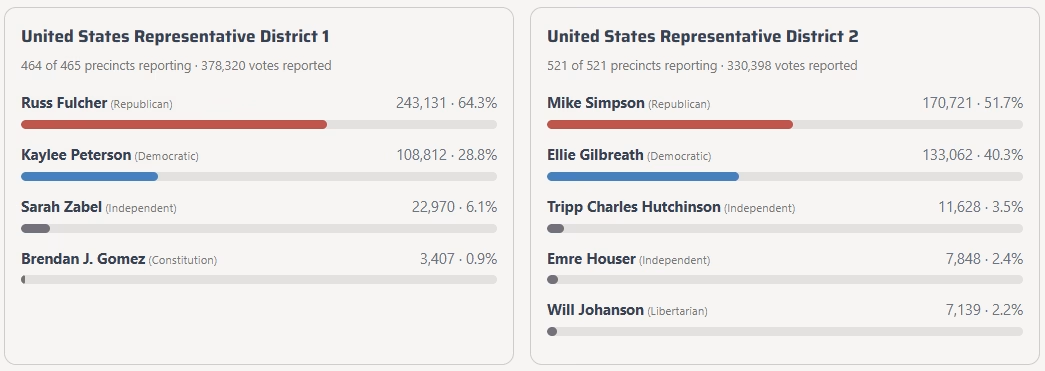
No surprises in the congressional races. Half of Ellie Gilbreath’s total came from Ada County alone, where she outpaced Congressman Simpson by a 26-point margin. Early votes showed her leading until the eastern Idaho precincts started reporting their Election Day votes. Congressman Fulcher remains incredibly popular in his district, easily brushing aside Kaylee Peterson’s third attempt to dethrone him. Peterson won 26.3% in 2022, 25.4% in 2024, and 28.8% this year—a personal record, but still a 36-point defeat. Voters in Idaho’s First Congressional District remain overwhelmingly conservative and Republican.
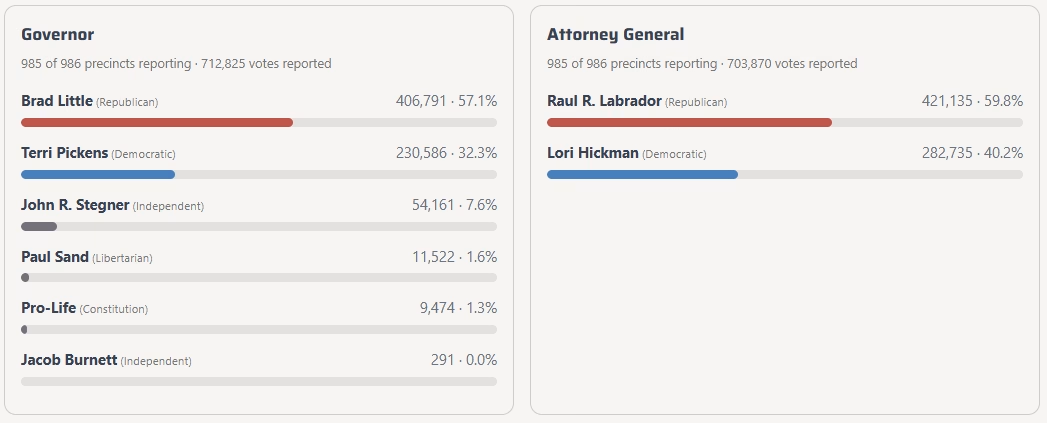
Republicans easily held all seven statewide offices as well. Gov. Brad Little had the lowest vote total, but also faced the most opponents. Both Terri Pickens and John Stegner fall to Little’s left, but failed to pull the governor below 50%. Pickens improved on Stephen Heidt’s 20.3% from 2022, but fell short of Paulette Jordan’s mark of 38.2% from 2018. For his part, Little has now won three gubernatorial races with 59.8%, 60.5%, and 57.1% of the vote, respectively.
Democrats and turncoat Republicans threw everything they had at Attorney General Raúl Labrador this year, but he still won reelection with 59.8% of the vote, just under his mark of 62.6% in 2022. Despite former Attorney General Lawrence Wasden endorsing the Democrat, Labrador still won solidly, outpacing the no votes on Prop 1.
As with the Senate race, Ada County showed that it remains a battleground between the red and blue factions. Both Little and Labrador struggled in Ada County, with the governor taking first place with a plurality of 45.8%, while Labrador’s only received 46.5%. While both won about the same number of votes, the additional candidates for governor split the anti-incumbent vote, while Labrador lost the county to Lori Hickman.
Of the seven statewide officers, Secretary of State Phil McGrane achieved the highest vote total, defeating his Democratic opponent by more than a two-to-one margin. His 472,310 votes as of this writing represent the highest vote total in the state.
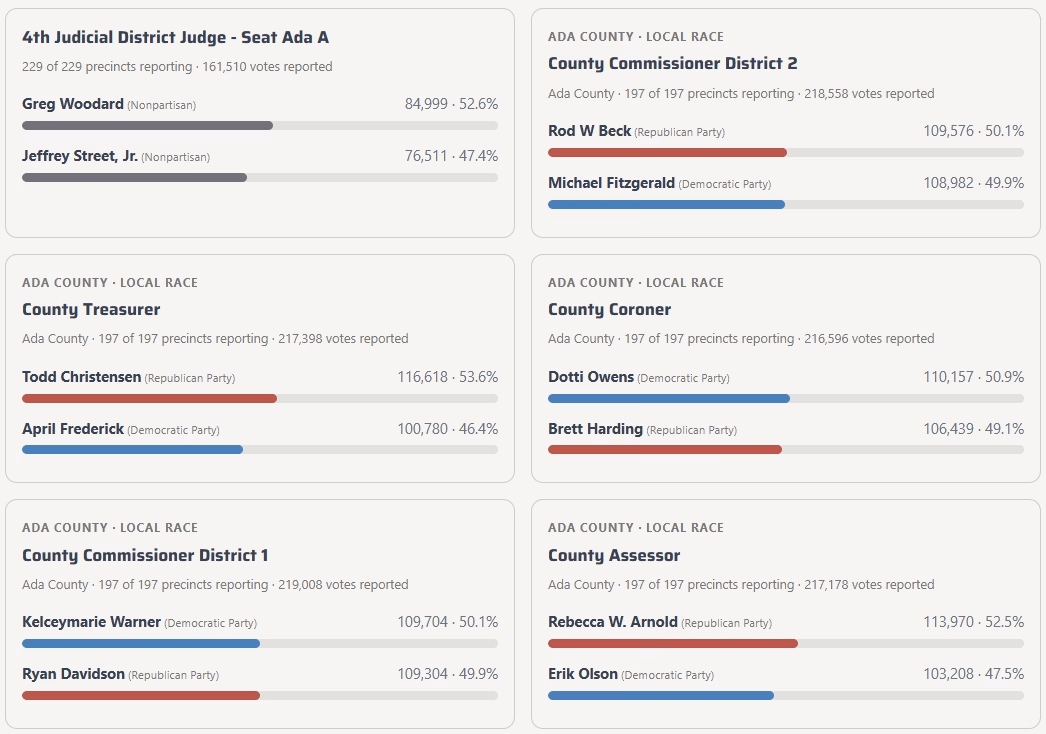
Ada County saw mixed results. Commissioner Rod Beck held his seat by fewer than 600 votes, while Commissioner Ryan Davidson fell to Democrat Kelceymarie Warner by a mere 400. Former Coroner Dotti Owens regained the seat she lost in 2022, narrowly defeating current Deputy Coroner Brett Harding. That’s a tough loss—Harding was incredibly well-qualified for the job.
The two most liberal candidates won seats on the Ada County Highway District board of commissioners, and it wasn’t close. ACHD races become partisan in two years, which should help. People say that roads aren’t partisan, but ideology matters here. Liberals tend to emphasize bicycles and pedestrians, while conservatives recognize that most people don’t like being stuck in traffic.
One bright spot was the Fourth Judicial District judge race. Jeffrey Street had eight times the money of his opponent, Greg Woodard, and broad support from fellow lawyers. He took the time to campaign in the rural counties of the Fourth District, winning support from conservatives despite the fact that he signed the petition to legalize abortion and has numerous connections to Democratic and liberal figures. Nevertheless, Woodard somehow won all four counties in the district, and will move from Attorney General Raúl Labrador’s office to the Fourth District bench.
That brings us to the Legislature. The Idaho GOP lost six seats—five in the House and one in the Senate—across Legislative Districts 15, 26, and 29. Each of those districts previously had two Republicans and one Democrat, and now all three are completely blue. Republicans lost Reps. Dori Healey, Mike Pohanka, and Dustin Manwaring—casualties of the blue wave and increased turnout due to Prop 1. This means there are no split districts in the entire state—there are seven Democratic districts and twenty-eight Republican districts.
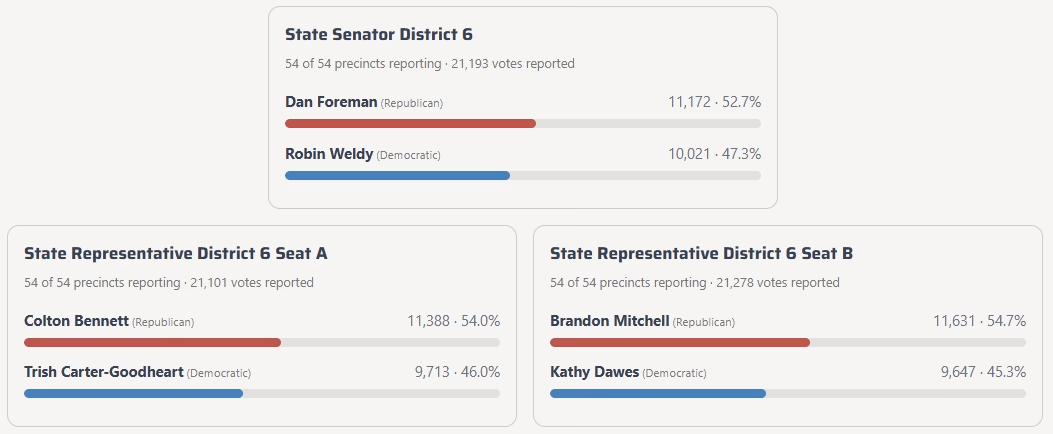
However, the bright spot is surely Legislative District 6. The college town of Moscow is a blue dot in an otherwise red region, but conservatives have been making gains in the district as well. A month ago, Sean Dolan at Idaho Ed News suggested that demographic change had potentially moved LD6 into the red column. Despite the nationwide blue wave, Republicans turned out solidly for Sen. Dan Foreman, Rep. Brandon Mitchell, and newcomer Colton Bennett, completing a GOP sweep.
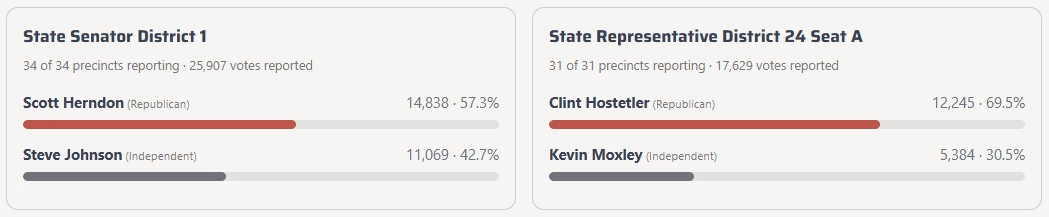
Several Republican candidates faced their own miniature Todd Achilles—left-wingers running as independents. Scott Herndon solidly defeated Steve Johnson, who ran the same play in Herndon’s first general election in 2022. Clint Hostetler defeated Kevin Moxley, despite Moxley’s support from agricultural organizations and PACs.
I used ChatGPT to create a graph ranking each district from most red to most blue, based on an average of the vote percentages of the three winning candidates in each. Unopposed candidates throw off the math somewhat, but on the other hand, if a candidate is unopposed, that surely speaks to the partisan strength of that district.
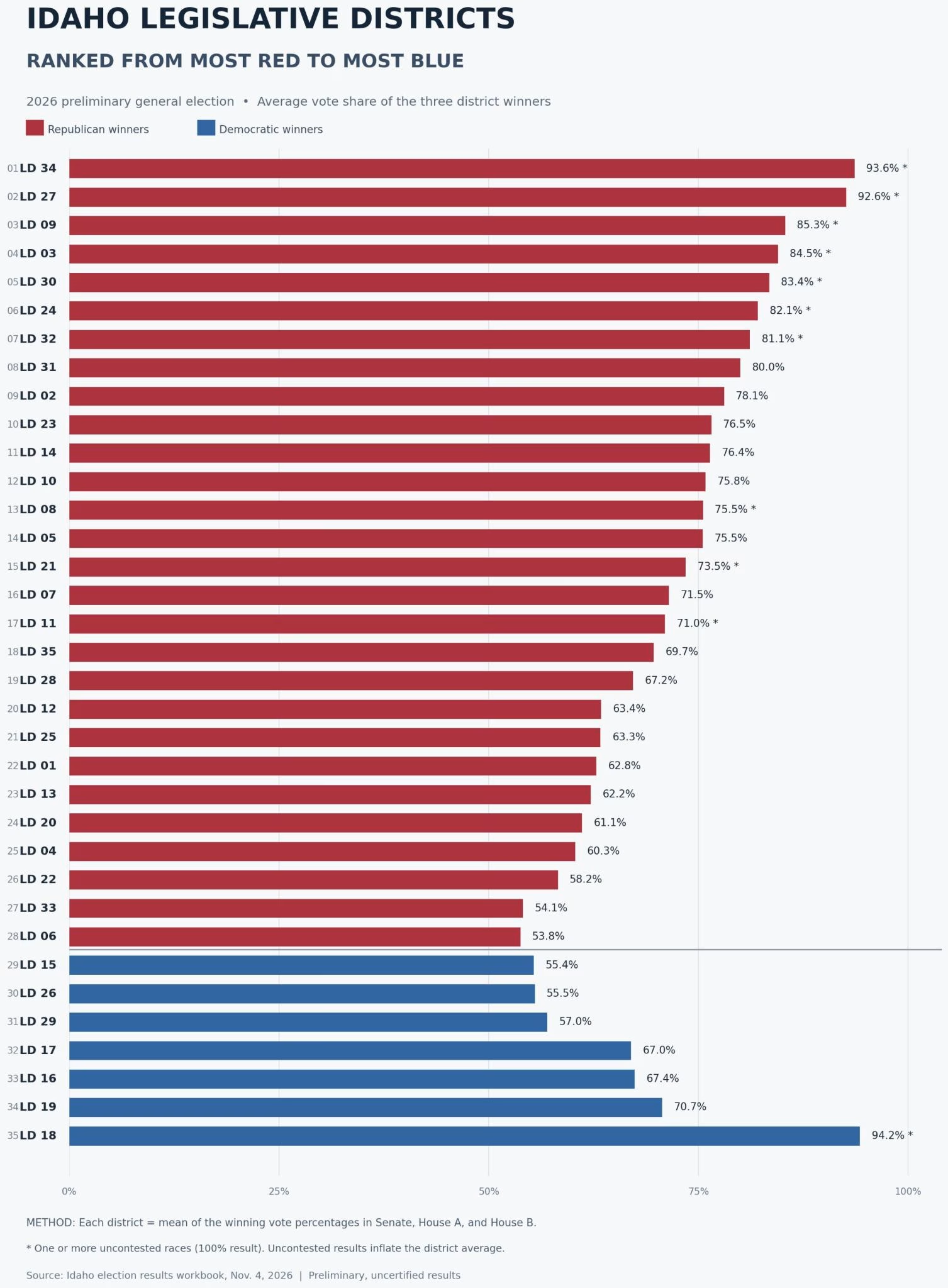
Note that the three battleground districts that flipped blue are all under 60% for Democrats, while three Republican districts are under 60% as well. LD6 is trending more red, but I would point to LD33 as an area of concern for the Idaho GOP. Idaho Falls has been trending more ideologically liberal—will it be the next battleground for Idaho Democrats?
Yesterday’s legislative election results match those of 2018, when the House split between 56 Republicans and 14 Democrats, and the Senate split between 28 Republicans and 7 Democrats, so it’s not unprecedented. It will mean some shuffling of committees and could have implications for leadership elections, but Republicans still maintain a supermajority in both chambers. I’ll have more in-depth analysis of what to expect from the upcoming legislative session soon.
In the end, I believe Sen. Risch is absolutely right: Idaho is still Idaho. But we cannot rest on our laurels if we want to keep it that way. What happened last night in Texas shows how quickly we can lose our state if we’re not careful. I’ll have more analysis in the days and weeks to come, along with practical steps you can take to keep your government moving in the right direction. For now, let’s take a deep breath, touch some grass, and hug our families. Defeating Prop 1 was a major victory, and we shouldn’t let anything else that happened take away from that. I believe Idaho is set to play a leading role in saving our country, and it’s up to us to be ready.
Feature image created with ChatGPT, based on a photograph taken by the editor.
The Gem State Chronicle delivers daily analysis, op-eds, press releases, and Idaho Insider updates — free to your inbox.
Free newsletter · Unsubscribe anytime · View on Substack

About Brian Almon
Brian Almon is the Editor of the Gem State Chronicle. He also serves as Chairman of the District 14 Republican Party and is a trustee of the Eagle Public Library Board. He lives with his wife and six children in Eagle.