Two months ago I wrote about the paradox of our republican system of government:
At the most basic level, lawmakers represent their constituents. At another level, they must work together to form majority coalitions to implement policy. Sometimes those two things conflict. Conservative activist from the Treasure Valley like me, for example, might look at the way eastern Idaho legislators vote and decide it’s time for a change and donate money to challengers running against incumbents. However, all the money in the world won’t make a difference if those challengers can’t win over the voters in their own district.
A style or argument that works in District 2 might not work in District 12, probably won’t in District 22, and surely won’t in District 32. Yet representatives from each of those districts, and all the rest in between, have equal standing in the Idaho Legislature. Those of us taking the long view face the difficult task of building a coalition from representatives and senators across 35 very distinct districts. It requires hard work, patience, and the wisdom to know when to compromise and when to hold the line.
This paradox gains another wrinkle when you consider that executive branch officers, including Gov. Brad Little, as well as other legislators, each have their own priorities that require building a Legislature capable of achieving them. It’s perfectly rational to expect legislators and executive officers to put their thumbs on the scales of legislative campaigns in hopes of building a coalition that suits them. Back in 2023, I wrote about how a PAC connected to the governor was spending big money against three senators in Canyon County—Tammy Nichols, Brian Lenney, and Chris Trakel:
So let’s connect some dots. Big corporations donated hundreds of thousands of dollars to the Idaho Inaugural Committee, also known as the Friends of Brad Little PAC. This PAC shares the same treasurer as Governor Little’s campaign, and received donations from members of his family. After the inauguration, the PAC delivered half a million dollars to the Idaho Victory Fund, which over the last year and a half has donated $340,000 to the Idaho Liberty PAC, which is spending money attacking Senators Trakel, Nichols, and Lenney.
This is clearly a well-established practice in Idaho politics, so I was surprised to see several political figures take to the pages of the Idaho Statesman this week to complain that Rep. Jordan Redman was funding legislative challengers:
Redman’s approach to the primary isn’t sitting well with those incumbents the committee has opposed. Guthrie told the Statesman that he called House Speaker Mike Moyle, R-Star, to express his “frustration and dismay” over the move.
“I guess it’d be great to have that kind of money to just try to buy elections that way,” Guthrie said. “I think it’s bad enough when it’s out-of-state money coming in to try to influence an election. But this is a sitting legislator that’s meddling in races in the other body against an incumbent.
“I am just pretty disappointed in that.
According to Idaho Sunshine, Sen. Jim Guthrie has received more than $60,000 in contributions this year, less than one-third of which came from individuals. He also received $1,000 apiece from the campaign committees of Sens. Van Burtenshaw, Treg Bernt, and Gov. Little. In yesterday’s Daily Digest on Substack, I wrote about how many of us on the right see things through an ideological lens, which can make it difficult to understand the actions of those with different motivations:
Yesterday, five of the seven statewide constitutional officers—Gov. Brad Little, Lt. Gov. Scott Bedke, Secretary of State Phil McGrane, Controller Brandon Woolf, and Superintendent Debbie Critchfield—expressed support for Sen. Jim Guthrie. To me, and presumably to many of you as well, that is mind-boggling. Guthrie voted with Democrats on numerous important issues, including keeping men out of women’s restrooms and protecting children from being socially transitioned without parental notification. He also boasted on the Senate floor this year that he voted against hundreds of millions of dollars in tax cuts. Yet Republicans in the executive branch still want to see him reelected.
Why?
It doesn’t make sense from an ideological perspective. But if you take ideology out of the equation, there is a certain logic to it. Guthrie has been around a long time and has surely built relationships with many of these figures. They probably know they can count on him to do what they believe needs to be done—even taking the blame for holding bills they would rather not see reach the Senate floor. How many favors have been traded over the past decade?
I believe that blind spot works both ways. Sen. Guthrie has taken very public stands against many conservative priorities, yet he’s outraged that fellow legislators would want him replaced. In his world, longevity, favors, and political access matter more than trifles like ideology. Indeed, he issued a not-so-veiled threat against Redman in the Statesman:
“If I’m reelected, it doesn’t mean I’ll be vindictive or anything, but it certainly — you would probably hold that individual at arm’s length and be a little bit more cautious on legislation going forward, because the trust factor has been compromised,” he said.
Rep. Stephanie Mickelsen took the pearl-clutching hypocrisy to a new level, however:
Based on the candidates the committee supported and opposed, Mickelsen assessed that Redman was working to move the Republican-dominated Legislature further to the right — in a way that would send a “bad message” to lawmakers.
“I think what it says is, ‘If you don’t vote exactly the way we want you to, then the next election, the next go-round, we’re going to come after you,’ ” she said. “I think voters across the state ought to be really concerned.”
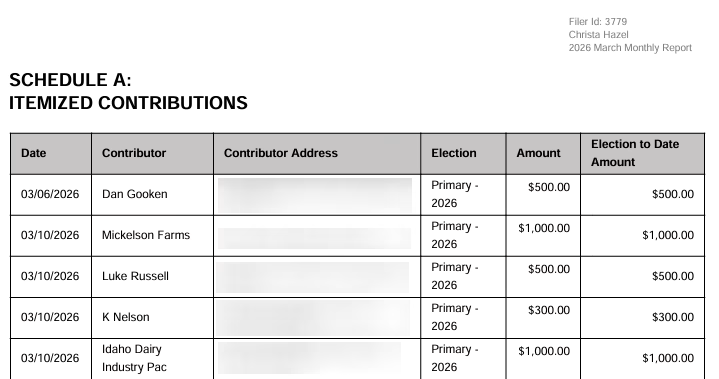
Mickelsen’s complaint might carry more weight if her family farm had not donated the maximum $1,000 contribution to Christa Hazel, a proud Biden/Harris supporter running against conservative Rep. Elaine Price.
Consider a relatively new PAC, Hometown Heroes. Its donors include other groups, such as the Way Back PAC, registered in Wyoming, as well as the Healthcare Matters PAC and the International Association of Firefighters. Sen. Burtenshaw donated $2,500 to the PAC last month. Hometown Heroes has run ads supporting both incumbent candidates and challengers, such as Michael Collins, who is running against Rep. Kyle Harris in District 7. Yet I don’t see Guthrie or Mickelsen complaining that Burtenshaw is targeting incumbent legislators.
The fact that Rep. Redman contributed $350,000 of his own money to his PAC has seriously rankled moderate Republicans and even Democrats. Lauren Necochea, chairwoman of the Idaho Democratic Party, complained on X that Redman was supporting “far-right extremists.”
What does it mean when Jim Guthrie, Stephanie Mickelsen, and Lauren Necochea are all pushing the exact same narrative?
On the contrary, Redman’s contribution brings welcome balance to the world of Idaho politics, which has long been dominated by big money on the left. Over the past two years, left-leaning PACs including Defend and Protect Idaho, Take Back Idaho, and the PAC for Public Lands have received hundreds of thousands of dollars from Democrats, progressive organizations, and even moderate Republicans. Moderates in the GOP are further boosted by wealthy groups like Idaho Victory Fund and Idaho Liberty PAC, which are adjacent to Gov. Little, and the Idaho Majority Club, which alone has received nearly a quarter of a million dollars.
There are big-money PACs on the right as well, but many of them, such as the American Federation for Children, are much more narrowly focused. Many of the PACs and organizations in the political machine pass money back and forth among themselves, as well as through LLCs, obscuring exactly where the money originated. Perhaps that is Jordan Redman’s biggest sin in the eyes of rattled Republicans: rather than hiding his money behind LLCs and various PACs, he simply came right out and put his name on it.
I’ve been saying for years that conservatives need to build a machine capable of rivaling the one that produced Gov. Little. Has that day finally come?
The governor’s machine has been playing this game for a long time, and now its beneficiaries are angry that conservatives are learning to play too. The days of operating with unbalanced scales are over. If conservatives want to build a Legislature that will protect our values, keep government limited, and preserve liberty for our posterity, then this is how we do it.
Feature image created with Grok.
The Gem State Chronicle delivers daily analysis, op-eds, press releases, and Idaho Insider updates — free to your inbox.
Free newsletter · Unsubscribe anytime · View on Substack

About Brian Almon
Brian Almon is the Editor of the Gem State Chronicle. He also serves as Chairman of the District 14 Republican Party and is a trustee of the Eagle Public Library Board. He lives with his wife and six children in Eagle.