Many of the county-level positions that appear on your election ballot are self-explanatory. The sheriff is our chief law enforcement officer, overseeing the sheriff’s office with a jail and a staff of deputies. County commissioners act as executives of county government, overseeing staff and crafting annual budgets. The treasurer handles the money, the assessor determines property values, and the prosecutor handles criminal justice.
But what exactly does the coroner do?
According to the website of the Ada County Coroner’s Office, its purpose as expressed in state law is the “investigation of death to determine the cause and manner of death, as well as locating and notifying the legal next of kin.” Perusing press releases gives one an idea of what the office handles. For example, earlier this month, personnel from the office were dispatched to Kuna, where they examined the body of a 76-year-old woman who was killed while driving an ATV. Also this month, the office identified an 18-year-old man who was killed in a motorcycle accident in Meridian.
It’s a somber job, but one that needs to be done.
The website also explains the role of the elected coroner itself:
The coroner is primarily responsible for medicolegal death investigations and the certification of the cause and manner of death for Ada County cases. The coroner also manages the daily operations of the office and all its divisions. This position requires extensive expertise and experience in management and office administration as well as a comprehensive knowledge and experience in investigations.
“Medicolegal death investigation” is a phrase I was unfamiliar with until I saw it appear on campaign signs earlier this month. The American Board of Medicolegal Death Investigators (ABMDI) defines the term:
The role of the medicolegal death investigator is to investigate any death that falls under the jurisdiction of the medical examiner or coroner, including all suspicious, violent, unexplained and unexpected deaths. The medicolegal death investigator is responsible for the dead person, whereas the local law enforcement jurisdiction is responsible for the scene. The medicolegal death investigator performs scene investigations emphasizing information developed from the decedent and determines the extent to which further investigation is necessary. Medicolegal death investigators should have a combination of education and skills encompassing areas of medicine and law.
Idaho Code § 31-2801A requires that county coroners be medicolegal death investigators. ABMDI provides registry and board certification in the field, but notes that there is no formal requirement regarding use of the phrase.
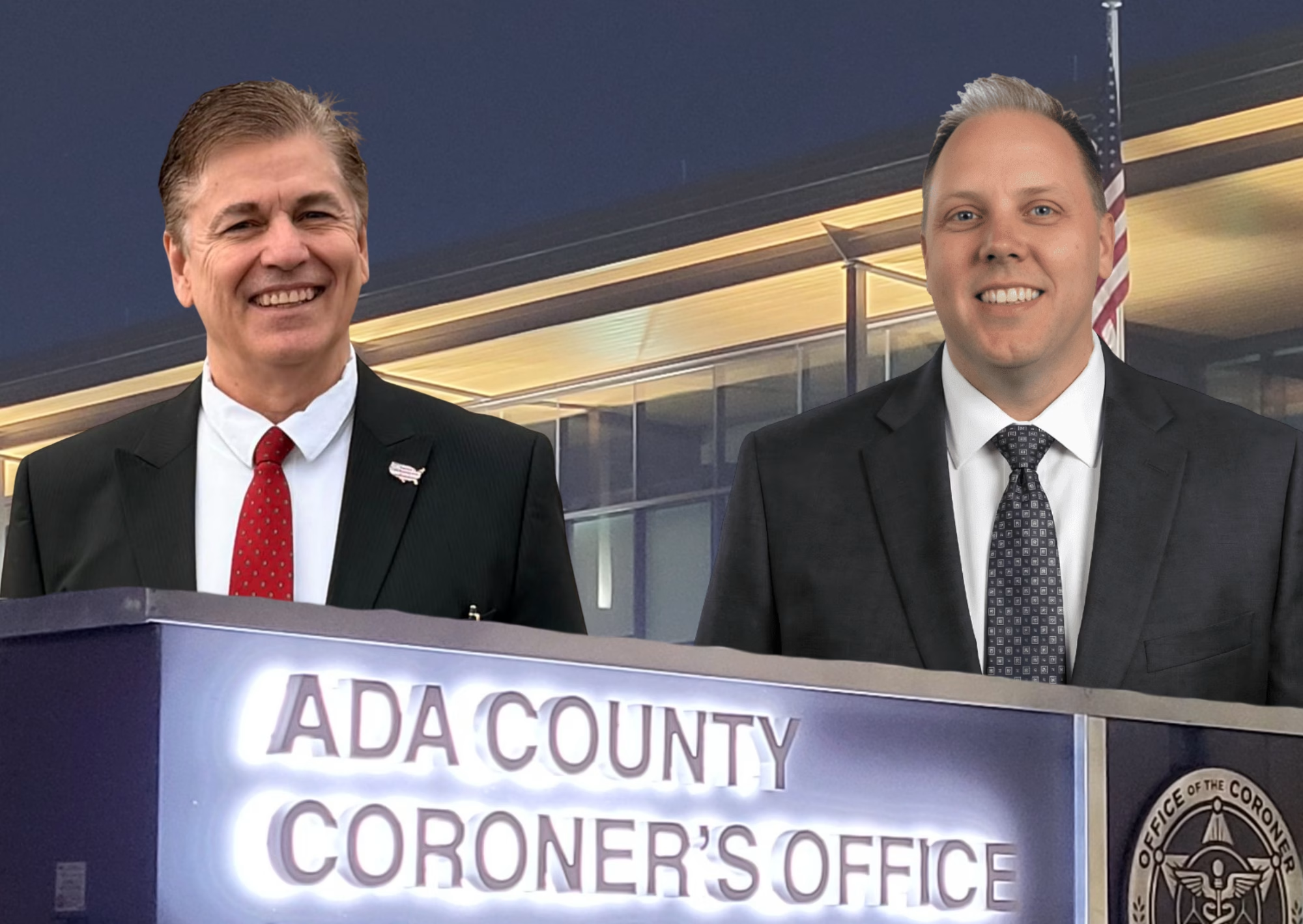
Both Republican candidates for Ada County Coroner, Chief Deputy Coroner Brett Harding and nonprofit CEO and political consultant Tim Flaherty, have used variations of the phrase in their campaign materials. I reached out to both for clarification via text message last Friday. Flaherty did not return my text, but sent a message to the Ada County GOP vetting committee explaining that he has completed a 40-hour training program through the Death Investigation Training Academy, but does not possess ABMDI certification.
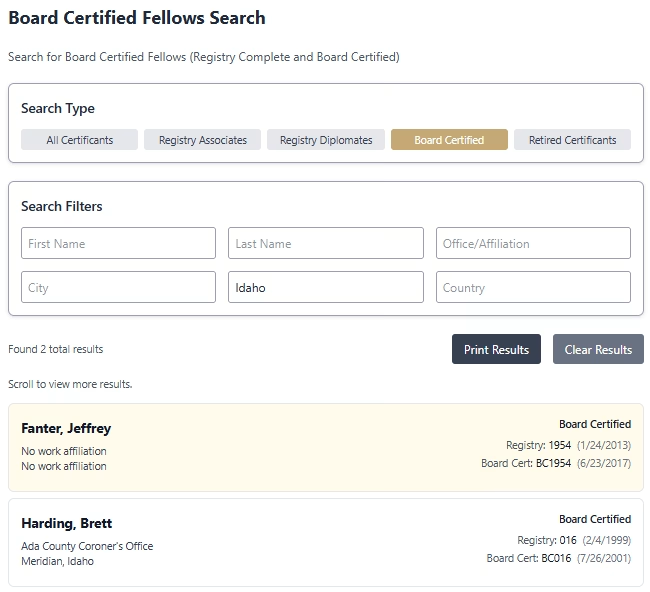
Harding returned my text with a 30-minute phone call in which he explained not only his qualifications, but his 33 years of experience in the coroner field. In addition to being the one of only two ABMDI board-certified medicolegal death investigator in the state of Idaho, Harding has a BA in criminology as well as an MBA, and has worked in morgues and autopsy suites.
The legal requirements to run for county coroner are surprisingly thin. Idaho Code § 34-622 establishes the county coroner as an elected position, with candidates required to be at least 21 years old, an American citizen, and a resident of the county for at least one year. Idaho Code § 31-2810 requires that elected coroners take 24 hours of continuing education each year.
Beyond those simple standards, it is up to voters to decide upon the qualifications of their candidates.
Running the coroner’s office also means setting budgets, managing personnel, and figuring out how to best meet the requirements of the law and the needs of the citizens. The coroner must be able to prioritize needs versus wants when it comes to allocating tax dollars, as well as figuring out how to recruit and retain highly qualified employees. According to Chief Deputy Harding, there is a nationwide shortage of forensic pathologists. He told me that Ada County is home to the only three in Idaho, which means his office is in a position to assist fellow coroners throughout the state, but remains in tough competition with other offices throughout the nation.
The two Republican candidates have approached the race from opposite directions.
Tim Flaherty emphasizes his experience outside the system. In addition to founding Astegos, which coordinates donations for other local nonprofits, Flaherty works as a political consultant and has run campaigns for many Ada County officials, including Sheriff Matt Clifford, Commissioners Rod Beck and Tom Dayley, and Prosecutor Jan Bennetts. His political work has led to endorsements from numerous local officials, including House Speaker Mike Moyle, Congressman Russ Fulcher, Rep. Josh Tanner, and Valley County Sheriff Kevin Copperi. Flaherty also serves on the Boise City/Ada County Housing Authority (BCACHA) board of commissioners.
I worked alongside Flaherty on Lynn Bradescu’s campaign for Boise City Council last fall and found him sociable, creative, and ambitious. He is open about his past, in which he spent 17 months in federal prison for wire fraud. In 2023, he sued the director of Boise nonprofit Catch Inc. for defamation related to his appointment to the BCACHA board, but a judge dismissed the suit.
On his website, Flaherty laid out four issues where he believes the current leadership is failing. He says families are waiting too long for answers and are burdened with high costs, the office conducts too few autopsies, and Idaho sees too many teen suicides. He believes he can fix those issues by hiring more personnel, reforming the budget, conducting more autopsies, and partnering with schools and nonprofits to expand outreach to combat suicides.
Brett Harding emphasizes his experience within the system. His three-decade career in the field of death investigations led him to Ada County, where he took the role of chief deputy to current Ada County Coroner Rich Riffle and instituted what he calls “strategic changes for the benefit of the office”.
In his conversation with me, Harding emphasized the toll that this work takes on people. Employees of the coroner’s office not only interact with the dead, they interact with those who survived, often at the worst moments of their lives. At the end of our talk, I asked him how he can possibly stay positive in such an environment. He told me that he and his team concentrate on making a difference in people’s lives by providing them with answers, and by doing good for the community by using those answers to prevent more deaths in the future.
Harding explained that the coroner interacts with other agencies—partnering with law enforcement to solve homicides, reporting unsafe products to the Consumer Product Safety Commission, and coordinating with public health officials in the event of a communicable disease outbreak.
While Flaherty touts endorsements from local elected officials, Harding’s are mostly from experts in the field—other county coroners, forensic pathologists, doctors, and national board members. Incumbent Ada County Coroner Rich Riffle, who is not running for reelection, has endorsed his chief deputy.
The office of coroner is deeply embedded in our history and tradition. Idaho Code § 31-2807, which has been part of our laws since before statehood, establishes that the coroner has the authority to act in place of the county sheriff should the need arise. At the same time, because of the highly technical nature of the job, many jurisdictions throughout the country are amending their laws to make the coroner an appointed rather than elected position.
Two years ago, Carolyn Komatsoulis, then with the Idaho Press, wrote an article about a report which claimed the entire coroner system is obsolete:
The coroner system is a “vestige of an older era before the rise of modern medicine,” according to the report. Idaho’s coroner system was created in 1864, but switching to a medical examiner system is “not feasible,” the report concluded.
Medical examiners are appointed, not elected — as coroners are — and are required to have medical qualifications. County and district medical examiners have similar roles to county coroners.
“The coroner system right now in Idaho, it lacks a lot,” Ada County Chief Deputy Coroner Brett Harding said told the Idaho Press.
Residents of Idaho retain the solemn duty of electing the man or woman who is entrusted with determining the official cause and manner of deaths in our counties, and it is a duty we should take seriously. It is up to voters to weigh management ability, outside perspective, and technical expertise as they cast their ballots for this important office.
Coroner is one of those unpleasant and difficult jobs that are nevertheless necessary for a functioning society. Idaho voters have the privilege and duty of electing our county coroners, and I hope this background is helpful as you go to the polls over the next month.
The Gem State Chronicle delivers daily analysis, op-eds, press releases, and Idaho Insider updates — free to your inbox.
Free newsletter · Unsubscribe anytime · View on Substack

About Brian Almon
Brian Almon is the Editor of the Gem State Chronicle. He also serves as Chairman of the District 14 Republican Party and is a trustee of the Eagle Public Library Board. He lives with his wife and six children in Eagle.