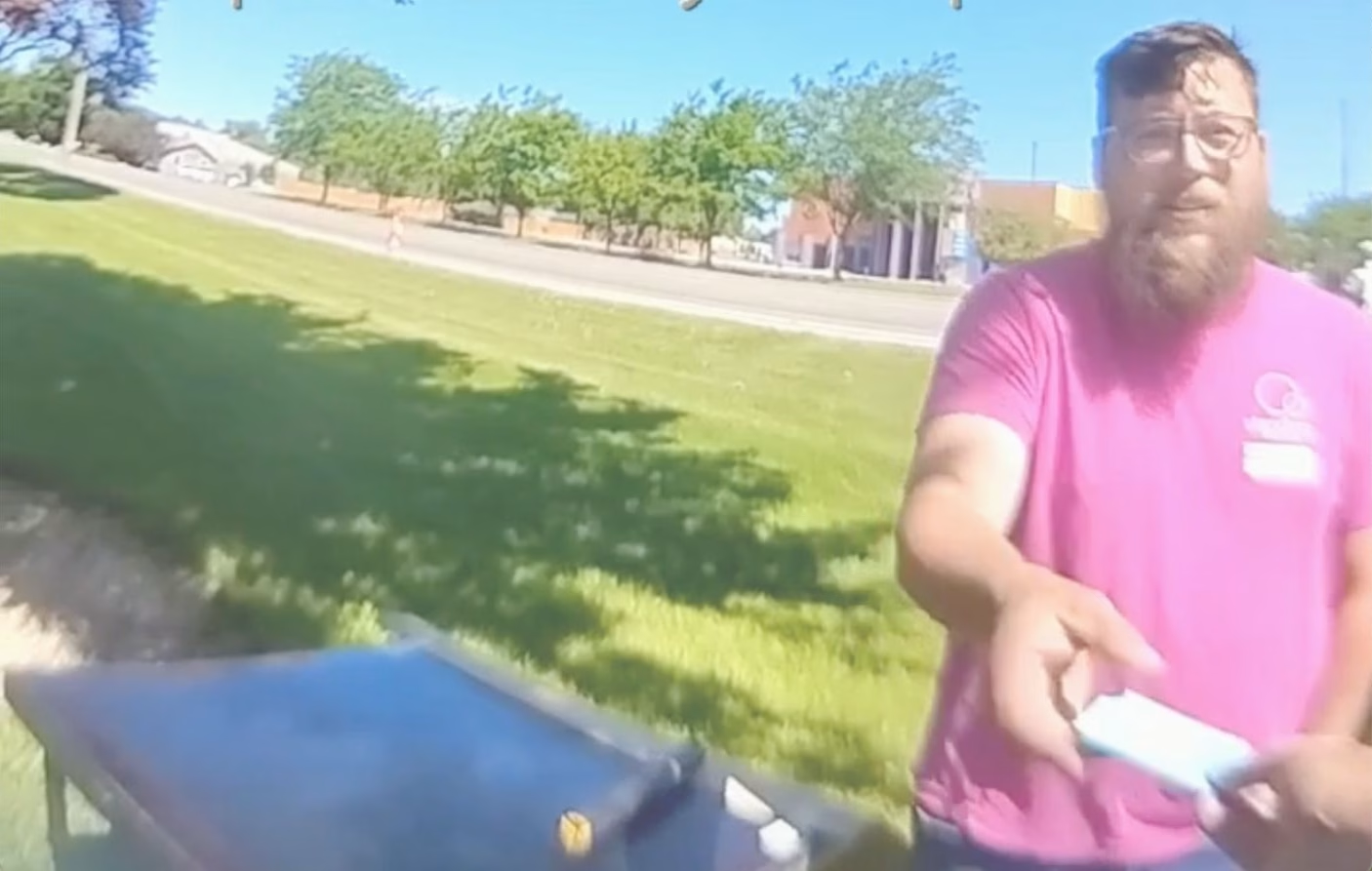
The Idaho Family Policy Center announced this morning that it is defending pro-life evangelist Titus Folks, who was cited for trespassing at Canyon County Pride at Lakeview Park in Nampa last June. According to Caleb Pirc, director of the IFPC Legal Center, Folks was in the process of setting up a table at the park when organizers demanded he leave and called the police. Folks moved his table across the street, but police still cited him for trespassing.
Pirc explained the situation in a video posted on Tuesday:
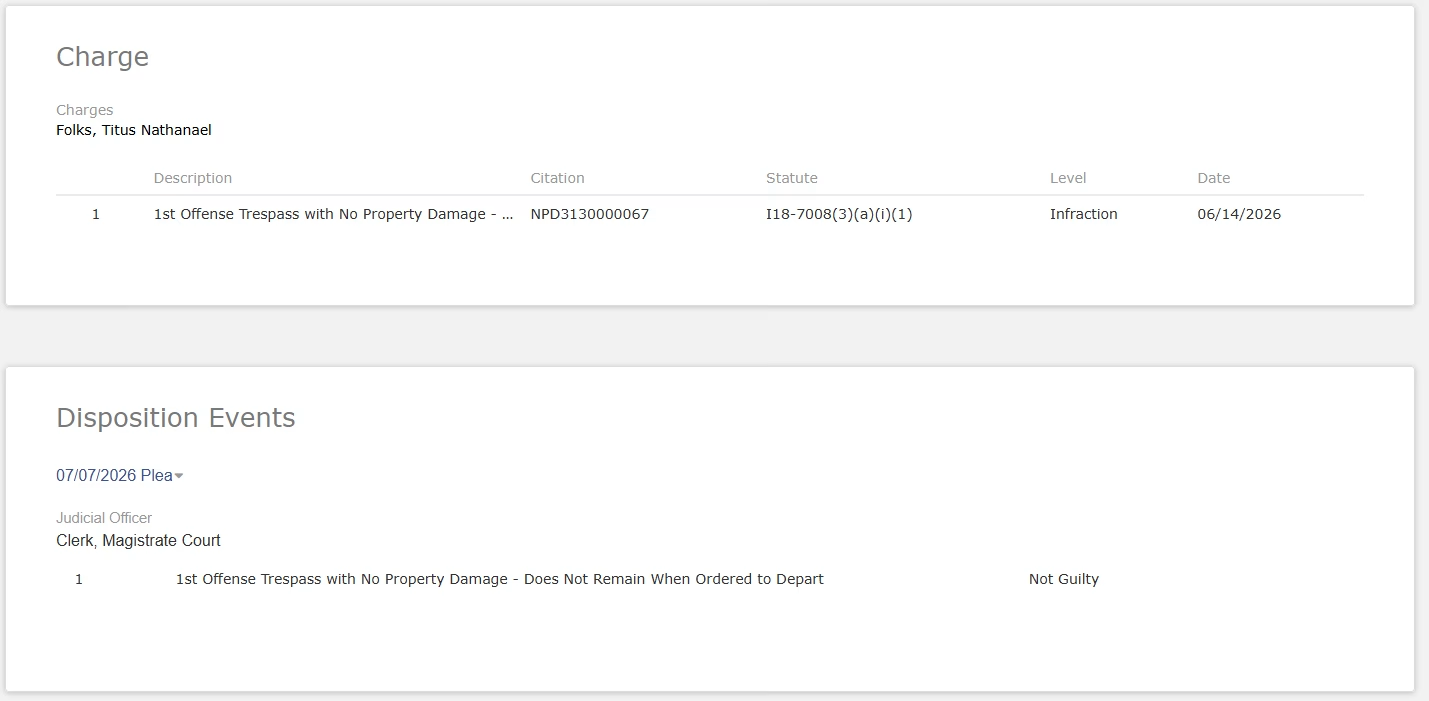
According to the iCourt Portal, Folks was charged in Canyon County Magistrate Court with a first-offense trespass, no property damage, having left when ordered, which carries a $300 fine:
Idaho code says that a person has committed criminal trespass when he “enters or remains on the real property of another without permission, knowing or with reason to know that his presence is not permitted.” It goes on to explain various circumstances under which criminal trespass can occur, such as a residence or place of business, a cultivated property, a fenced boundary of a private property, or a church or house of worship.
It’s unclear exactly how being at a city park that is open to the public constitutes trespassing. Nampa’s rules regarding use of city parks prohibit selling food or goods, camping, consuming alcohol, and driving vehicles on the grass, but do not explicitly prohibit evangelism. Nampa’s guidebook for reserving park facilities even explicitly states that organizers cannot prohibit anyone from using the park:
Nampa Parks and Recreation is a public agency and, therefore, exclusive use of a park facility cannot be granted. Public access to non-reservable park amenities such as playgrounds and splash pads must be maintained at all times. An event organizer may choose to restrict public access to an event, but may only restrict access to reserved facilities, such as picnic shelters.
More details will surely come out as this case progresses, including whether Folks was within the area designated for the pride event or without, and exactly how he responded when asked to leave. I’m not a lawyer, but I find the citation difficult to understand based on the facts currently available. The park was open to the public, the Pride event itself was open to the public, and Nampa’s own rules make clear that reserving a park facility does not give an event organizer exclusive control over the entire park. If Folks was in an area that remained open to the public and was not violating a lawful park rule or other condition of access, what legal authority existed to order him to leave?
The Idaho Supreme Court considered a related question in 2025 in State of Idaho v. Bundy. The court rejected Ammon Bundy’s argument that Idaho’s trespass statute applies only to private property, holding that it can apply to public property as well.
But the circumstances were substantially different. Bundy’s case arose from an incident at the Idaho Capitol in 2020. After a disturbance, then-Speaker Scott Bedke ordered the Lincoln Auditorium closed. Bundy refused to leave and was eventually removed by law enforcement. The Supreme Court upheld his trespass conviction.
Folks’ situation, at least according to the account provided by his attorneys, is quite different. He was in a public park, setting up a table, and left when he was asked to do so. The citation itself reflects that distinction: Idaho law provides a $300 infraction for a first offense when no property damage occurs and the defendant does not remain after being ordered to leave.
At a higher level, it is telling what pride organizers chose reject and what they chose to accept. A gaggle of satanists, mocking Folks, Charlie Kirk, and Christianity in general, was apparently acceptable—I’ve not heard that pride organizers asked them to leave. But a pro-life activist preaching the gospel was offensive to them.
Nearly four years ago, I attended the Boise Pride event on September 11 to see it firsthand. I noticed how the satanists were always mugging for the camera, just outside the main area, being as vulgar, rude and offensive as they could in order to provoke outrage in Christian conservatives:
The vile counter-protestors were definitely not the majority of festival-goers. I presume that these people show up to every controversial event, hoping to get attention and cause conservatives to clutch their pearls in shock. Most of them did not take part in the festival itself – they spent the entire day yelling at protestors. Yet their tactics worked – conservative media dutifully published their pictures and implied that they were the norm, which was clearly not the case.
This has two effects. First, it distracts conservatives from what is really going on. We breathlessly share pictures of satanists and say “this is what we oppose,” meanwhile the LGBTQ+ community simply dismisses our complaints, because they know that those people do not represent the community as a whole. Second, it serves as a shield for the activists themselves, who are spared from having to defend what is really going on beneath the surface.
Nevertheless, if the Canyon County Pride organizers saw fit to ask Titus Folks to leave, they could easily have asked the satanists to leave as well. They apparently chose to tolerate one form of offensive expression while rejecting another.
Why is that?
As Christians, we believe the Gospel of Christ is an offense to the world, and a necessary one. Yet that does not mean that those who are offended by it should be able to call upon law enforcement to evict the Gospel from a public park.
Just two years ago, Nampa’s first Pride event outraged much of the conservative community. A transgender-identifying man flashing his surgically augmented breasts led to changes in the law. Now, just two years later, Nampa police have cited a Christian evangelist for trespassing after Pride organizers objected to his presence at a public park.
What is going on in Nampa? In Idaho?
IFPC Legal Center director Caleb Pirc provided this exclusive comment to the Gem State Chronicle:
Nampa’s prosecution of Titus Folks for simply showing up to evangelize at a public park is unconstitutional and unjust. The First Amendment exists to protect the right of people like Titus to share the Gospel with their fellow man. We look forward to getting justice for him in this case.
Feature image is Titus Folks at Lakeview Park in Nampa on June 14, 2026, courtesy of Idaho Family Policy Center.
The Gem State Chronicle delivers daily analysis, op-eds, press releases, and Idaho Insider updates — free to your inbox.
Free newsletter · Unsubscribe anytime · View on Substack

About Brian Almon
Brian Almon is the Editor of the Gem State Chronicle. He also serves as Chairman of the District 14 Republican Party and is a trustee of the Eagle Public Library Board. He lives with his wife and six children in Eagle.