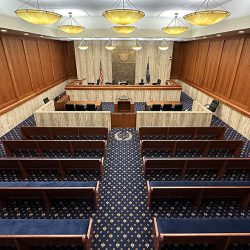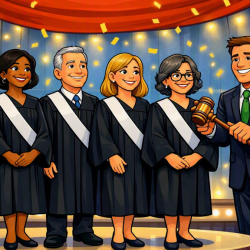
This morning, the Supreme Court ruled in Trump v. Slaughter that the President of the United States has the authority to fire federal bureaucrats, specifically commissioners of the Federal Trade Commission (FTC) without needing to establish cause. The decision overturns nearly a century of precedent rooted in Humphrey’s Executor v. United States (1935), a case that came to define the modern idea of “independent agencies.”
To understand the significance of today’s ruling, it is worth returning to that earlier case.
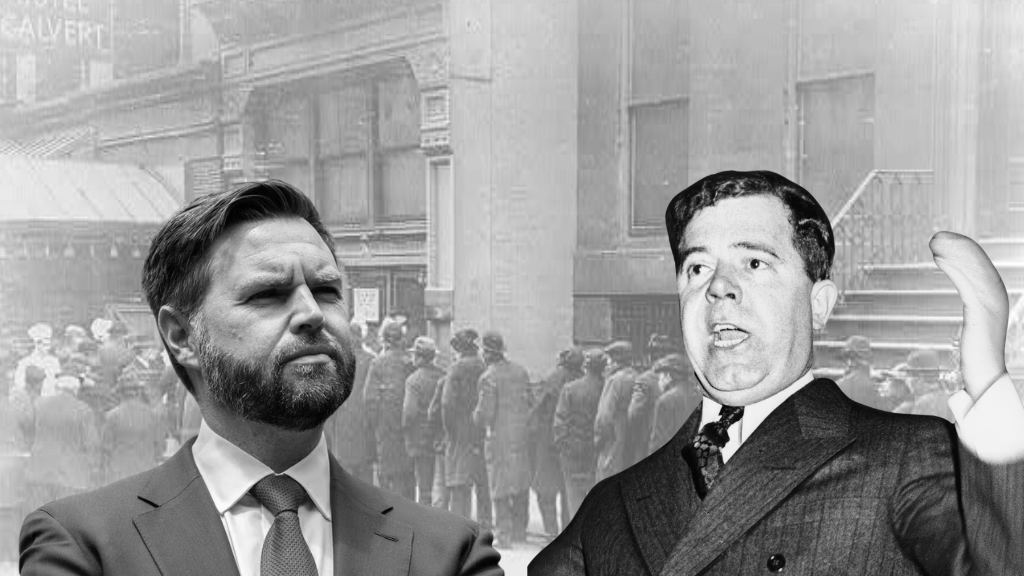
Humphrey’s Executor arose during the early New Deal period. William Humphrey, a Republican appointed to the Federal Trade Commission (FTC) under Presidents Calvin Coolidge and Herbert Hoover, found himself at odds with President Franklin Roosevelt’s economic agenda. Roosevelt requested his resignation in 1933, and when Humphrey refused, Roosevelt fired him anyway. The statute creating the FTC allowed commissioners to be removed only for “inefficiency, neglect of duty, or malfeasance in office.” Roosevelt did not claim any of these grounds—only that Humphrey’s continued service was incompatible with the administration’s direction.
Humphrey contended that Roosevelt lacked the authority to remove him for purely political reasons and continued reporting to work despite no longer receiving a paycheck. Though he died in 1934, his estate sued the federal government for back pay. In 1935, the Supreme Court ruled unanimously in Humphrey’s Executor v. United States that the President could not remove an FTC commissioner in violation of the statute. The Court held that because the agency exercised both “quasi-judicial” and “quasi-legislative” functions, it was functionally independent and insulated from political control.
That distinction became one of the foundational building blocks of the modern administrative state—the system of agencies and bureaucracies that we often call the “deep state” today.
In March of 2025, shortly after taking office for his second term, President Donald Trump tested the theory that Congress could restrict the President’s authority to remove officers of independent executive agencies. Trump fired two FTC commissioners, Rebecca Slaughter and Alvaro Bedoya, who subsequently sued. The D.C. District Court ruled in their favor, relying on the precedent set in Humphrey’s Executor. Today, Chief Justice John Roberts, writing for a 6–3 majority, reversed that decision and held that the President may remove FTC commissioners due to political disagreement.
This ruling was the culmination of years of decisions narrowing Humphrey’s Executor. As Chief Justice Roberts put it bluntly, “If anything more is left of Humphrey’s, we overrule it.”
During oral arguments last December, Justice Ketanji Brown Jackson expressed her concern regarding executive power: “Having a president come in and fire all the scientists, the doctors, and the economists and PhDs, and replacing them with loyalists and people who don’t know anything is actually not in the best interest of the citizens of the United States.” Jackson, perhaps unintentionally, clearly elucidated the core issue: has the United States grown too complex for a political leader to manage, meaning we must instead delegate executive power to unelected experts?
This was the question that FDR and the New Dealers answered in the affirmative. As the federal government grew in size and complexity, they believed it needed steady, continuous management by experts in each field, shielded from political concerns. After all, allowing a new president to simply walk in every four years and fire everyone in the FTC, USDA, or DOE would create chaos. Nothing could get done if nobody knew how long their own tenure would last. Better to shield the experts from the changing whims of the electorate. That was the theory, at least. Today, we call it technocracy—rule by experts.
Yet how does technocracy fit under our structure of government and the separation of powers? The Constitution established three branches of government: Congress as the legislative branch to create laws, the president as head of the executive branch to carry them out, and the Supreme Court at the top of the judicial branch to adjudicate disputes. Each branch is fully independent, yet bound by checks and balances to hold the others accountable. Ultimate power is derived from the people—as Thomas Jefferson explained in the Declaration of Independence, the branches derive their just powers from the consent of the governed. If we allow an unofficial “fourth branch” to develop—such as the FTC, the Federal Reserve, or any other government agency—to whom are they accountable?
This brings us to the heart of the question: from whence does authority come? Many of the debates at the Philadelphia Convention of 1787 centered around how the authority granted by the people should be distributed. Some delegates feared giving a single person too much power, drawing from their experience under King George III. Others, however, including Alexander Hamilton, feared the consequences of an executive that was too weak. The Court’s decision refers to the way colonial governors were often little more than chairmen of the board, tasked with carrying out legislative dictates without real authority of their own. Consider the position of prime minister in the United Kingdom, who is the head of government but remains part of the legislature. Keir Starmer is the prime minister by virtue of his leadership of the majority party in the House of Commons, rather than being independently elected to execute the laws of the land.
The Founders ultimately decided on a strong executive whose power was coequal with the legislature. The president and Congress have equal authority, with checks and balances ensuring that neither can permanently overrule the other. In deciding Trump v. Slaughter, the Supreme Court has reinstated the Founders’ position that the president really is the chief executive, and that Congress cannot tie his hands regarding most executive branch agencies.
Article II of the Constitution establishes that the president must faithfully execute the laws of the nation, which presupposes his ability to hire—and fire—deputies to assist him. In Federalist 47, James Madison argued that the American president differed from a king because his authority was limited to executing the law, without any legislative or judicial powers. In Federalist 72, Alexander Hamilton argued that presidential appointees were “assistants or deputies” who derived their authority solely from the president, who in turn derived his from the people. Chief Justice Roberts cited both writings in his decision today.
President Trump’s first term demonstrated the flaws inherent in technocracy. The American people, frustrated with the actions of their government, elected a man who promised to shake things up. Yet once in office, Trump found himself stymied by the administrative state itself, which was filled with men and women who were supposed to be his “assistants or deputies.” Trump’s first impeachment was instigated by intelligence agents and State Department bureaucrats who were outraged that the president was not following their lead on foreign policy. The idea that the president should have the final say over the positions and actions of the executive branch seemed ridiculous to career bureaucrats and their media apparatchiks.
Richard Nixon challenged the administrative state as well, and he ended up resigning over it. If you’ve only seen the Hollywood version of the story, you might think the Watergate scandal was solely about covering up a burglary. In reality, it involved deep-state actors who wanted revenge against Nixon for challenging their hegemony over the government. Recall that “Deep Throat”—the secret informant who led Bob Woodward and Carl Bernstein to the smoking gun in All the President’s Men—was revealed in 2005 to be Mark Felt, the former deputy director of the FBI who carried a personal grudge against Nixon for passing him over as J. Edgar Hoover’s successor.
Donald Trump, on the other hand, has managed to survive everything the deep state has thrown at him, and today’s Supreme Court ruling is yet another victory.
In Trump v. Slaughter, Chief Justice Roberts answered Justice Jackson’s claim that our country needs to be ruled by expert bureaucrats by explaining that such a system unconstitutionally shifts the separation of powers:
Placing the power to administer laws in officers who enjoy “freedom from Presidential oversight (and protection),” in other words, does not deliver us to a promised land of technocratic governance—it often results only in an “increased subservience to congressional direction.”
If the president is responsible for the execution of the law, then he must also retain authority over those who execute it on his behalf.
Congress has been attempting to restrain the executive branch for most of our nation’s history. In 1867, Congress passed the Tenure of Office Act, requiring the president to seek senatorial consent to remove an executive branch officer, mirroring the constitutional approval process required for appointments. The Act was passed during the bitter conflict between President Andrew Johnson and post-Civil War Radical Republicans over how to administer the defeated South. Johnson sought to test the Act’s constitutionality by firing Secretary of War Edwin Stanton. For this, he was impeached by the House of Representatives, though the Senate fell one vote short of removing him from office.
Congress attempted to constrain presidential executive power again in 1876 with a law stating that postmasters must receive senatorial consent for both appointment and removal. In 1920, President Woodrow Wilson fired Postmaster Frank Myers, who subsequently sued. In 1926, Chief Justice (and former President) William Howard Taft wrote a 6–3 decision in Myers v. United States stating that Congress lacked the power to restrict the president’s authority to fire postmasters. However, just nine years later, the Court would rule differently regarding the FTC in Humphrey’s Executor.
This debate is not confined to the halls of power in Washington, D.C. In the 2026 legislative session, similar questions were argued during debate over Idaho Senate Bill 1300. This bill would give our governor the authority to appoint directors for the Departments of Transportation, Fish & Game, and Parks & Recreation, rather than delegating that authority to unelected boards. Critics reacted fiercely, claiming it would violate the 1961 agreement establishing Harriman State Park, which required park service staff to be selected by merit alone:
One of the most discussed issues during the hearing was Harriman State Park. Railroad magnate Edward Harriman purchased the land in 1908, and his heirs donated it to the people of Idaho in 1961. The agreement signed by Gov. Bob Smylie included a clause that the Legislature would establish a “professionally staffed career Park Service whose personnel shall be chosen on the basis of merit alone, which shall be administered under merit system procedures for personnel administration.”
This agreement laid the foundation for the Idaho Department of Parks and Recreation. At Sen. Okuniewicz’s request, Legislative Services Office (LSO) legal analyst Elizabeth Bowen drafted an opinion concluding that S1300 would not violate it. The short answer, she wrote, is that:
There is no inherent conflict between S.B. 1300 and the conveyance instruments. While the conveyance instruments require the merit-based selection of department personnel, the selection process itself is left to the discretion of the Legislature. As long as the director is appointed on the basis of merit, the State is in compliance with the conveyance instruments.
However, several testifiers disagreed.
Charlie Lansche, a member of the Friends of Harriman State Park, said that his organization had already retained Cathy Silak of the Hawley Troxell law firm, who disagreed with Bowen’s position. He warned that proceeding with S1300 would lead to costly litigation—a not-so-veiled threat against the Legislature.
The questions raised by S1300 and Trump v. Slaughter speak directly to the nature of our republican system of government. If the people are truly sovereign, then decisions that affect us must be made as close to us as possible. Our chief executives—the president at the national level, the governor here in Idaho—are elected by the people. Therefore, our ability to hold them accountable depends entirely on their proximity to decision-making authority. Anyone appointed by the executive must be removable by the executive; otherwise, the entire notion of executive authority is a farce. If the president cannot fire an FTC commissioner because her political agenda runs contrary to his, then who is really running the FTC?
This greater question remains partially unresolved, however. At the same time the Court decided in Trump v. Slaughter that the president retains ultimate authority over political appointees at the FTC, Chief Justice Roberts also wrote a 5–4 decision in Trump v. Cook. That ruling held that the president cannot fire governors of the Federal Reserve Board without cause, despite President Trump’s contention that Lisa Cook’s alleged mortgage fraud made her unfit to serve. Roberts argued that the Fed, like previous iterations of America’s central banks, is indeed independent, despite the president’s responsibility for appointing its governors. That decision appears to be much narrower than Slaughter, as Roberts held that the issue was a necessity of due process for Cook rather than the firing itself.
Overall, our country is moving in the right direction. The administrative state that began taking root during the New Deal—the same apparatus that drove Richard Nixon from office and has been fighting President Trump for nearly ten years—is finally being brought to heel. This is good news for the future of our country and the liberty we have so long taken for granted.
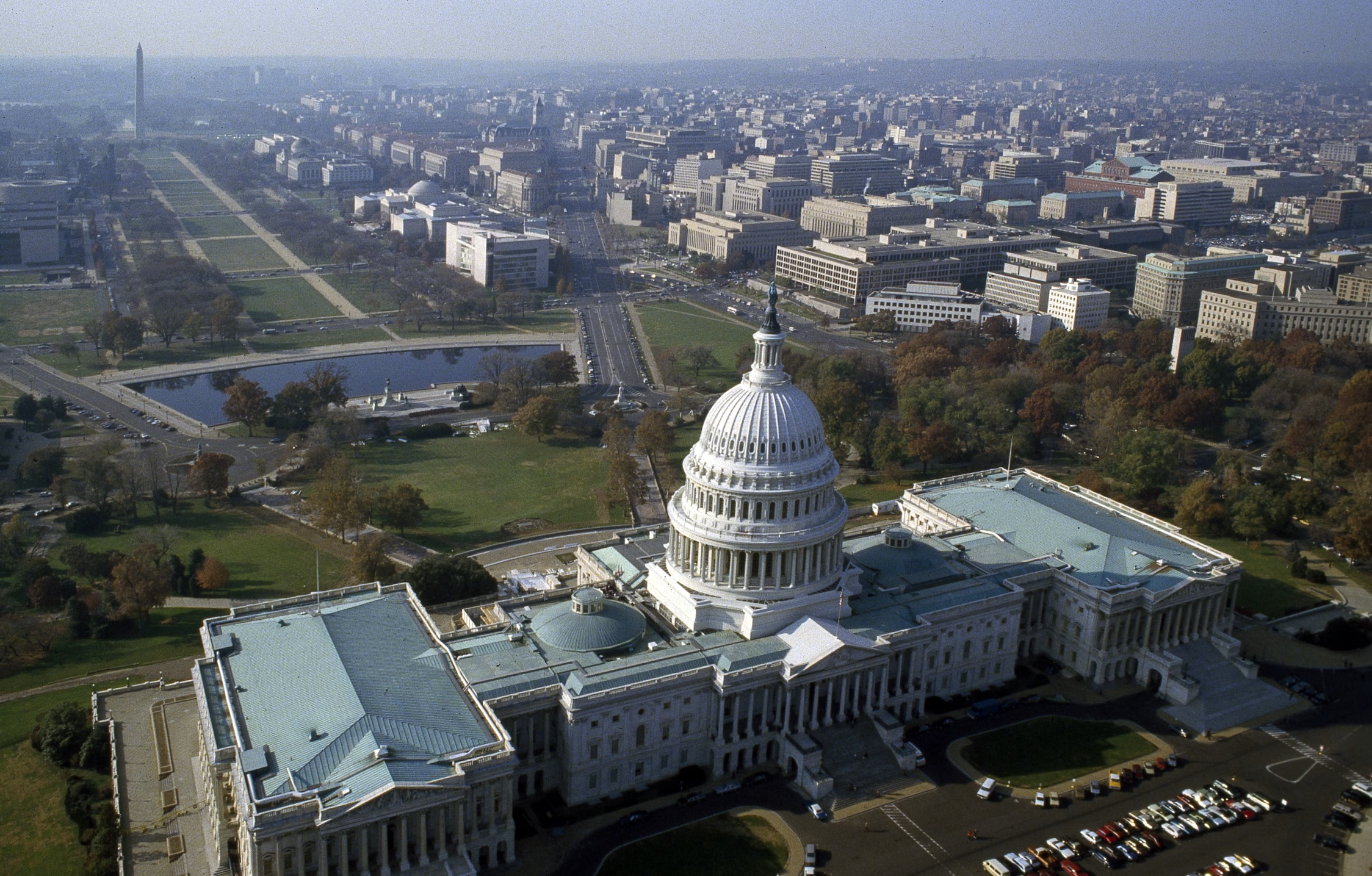
Feature image courtesy of the Carol M. Highsmith Archive at the Library of Congress.
The Gem State Chronicle delivers daily analysis, op-eds, press releases, and Idaho Insider updates — free to your inbox.
Free newsletter · Unsubscribe anytime · View on Substack

About Brian Almon
Brian Almon is the Editor of the Gem State Chronicle. He also serves as Chairman of the District 14 Republican Party and is a trustee of the Eagle Public Library Board. He lives with his wife and six children in Eagle.