What a weekend.
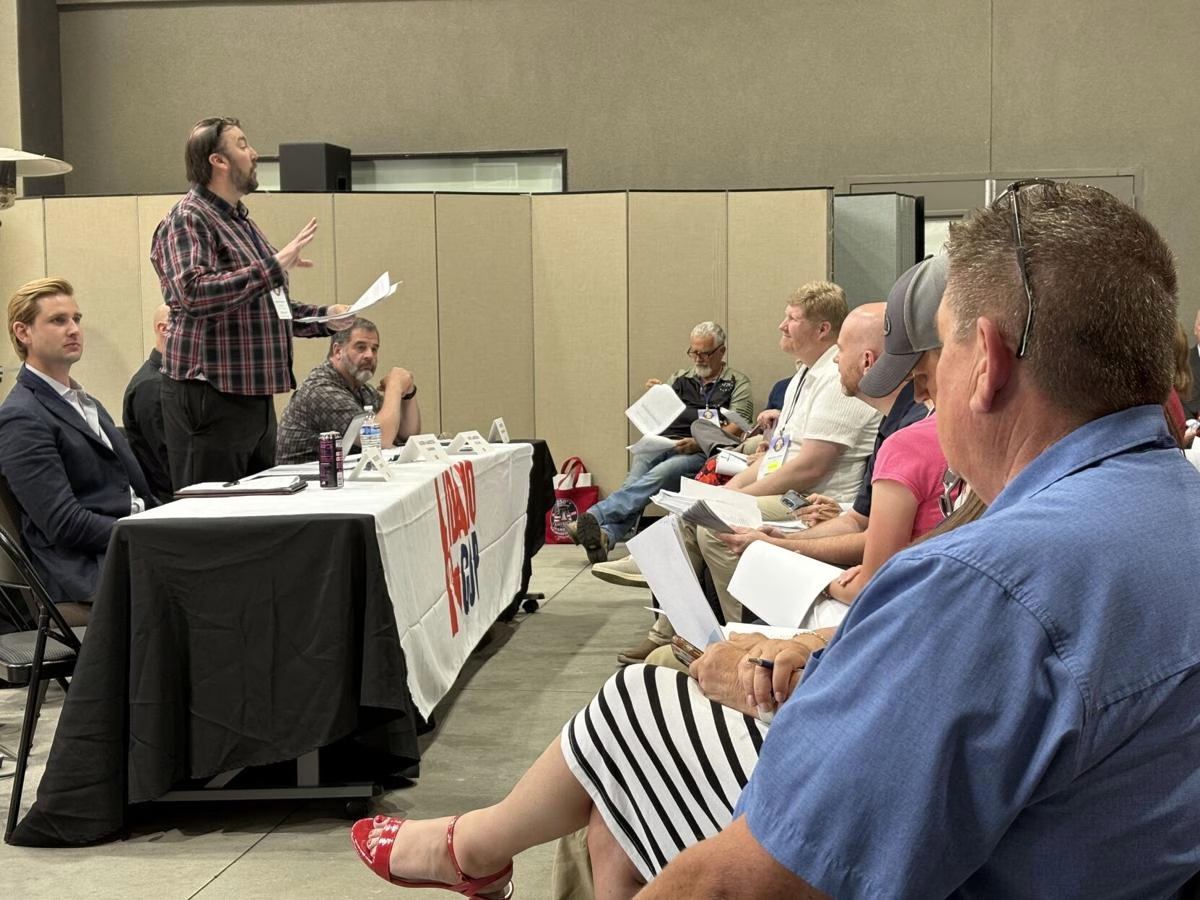
The 2026 Idaho GOP State Convention concluded on Saturday evening following three days packed with events, elections, discussion, and debate. As readers know, I proposed a refresh of the party platform that would shrink it from 20 pages of detailed policy positions into a two-page preamble followed by a short list of specific legislative priorities. It passed the Platform Committee on Thursday afternoon and had momentum heading into the general session of the convention.
To be honest, I wasn’t even sure my proposal would pass the committee. However, it soon took on a life of its own. Chairman Bjorn Handeen has spent considerable time studying the history of political platforms in general and the Idaho GOP Platform in particular, and he was enthusiastic about the proposal. We had a robust debate in committee not only about the nature of party platforms in general, but also about what specifically should be included in ours. Branden Durst made several thoughtful suggestions regarding the list of legislative priorities. For someone like me who enjoys discussions and debate, it was a great four hours.
By Friday evening, however, I could see that my proposal was being used as a weapon of division by a small but loud cadre of confrontational-politics enthusiasts. Greg Pruett resurrected his Idaho Second Amendment Alliance brand long enough to send an email blast to his subscribers accusing me of watering down the party’s position on gun rights, which was absurd, of course. The new proposal included the very words of the Second Amendment itself—”shall not be infringed”—but people will do anything for clicks these days. Ironically, just a few years ago Pruett was vice chair of the Constitution Party, whose platform plank on the Second Amendment consists of a single sentence.
Several delegates were preparing to dismantle the new platform on the floor Saturday morning, and I suspected that others were preparing to use it as a weapon against Chairwoman Dorothy Moon’s bid for reelection. I saw numerous comments suggesting that I was “destroying the platform” on her behalf, or on behalf of House Speaker Mike Moyle. That’s the sad thing about confrontational politics: eventually your positions are defined by nothing more than who you hate at any given moment.
To be clear, this proposal did not come from Dorothy Moon. Many months ago, I let her know I wanted to explore the idea, and she said that was fine, but I did not share the text of the proposal itself until after I had submitted it to be part of the platform packet at the convention. The accusation that Moyle was involved is even more absurd. To be equally clear: I did not have a single conversation with the speaker regarding this idea to streamline the platform.
All that said, the vast majority of the feedback I received was positive. Numerous delegates from all across the state came up to me during the convention and told me they thought it was a great idea and thanked me for doing it. Almost every elected official I spoke with was in favor of some sort of streamlining as well. Critics could say that’s because they don’t want to be held accountable, but I don’t think that’s the case. I believe those who have served in the Legislature and participated in the lawmaking process have a different perspective than those who argue in the ivory towers of conventions and social media.
At conventions, we tend to debate ideals—that is, how things should be in a perfect world. We discuss questions such as precisely when life begins, whether property taxes or income taxes should be eliminated—of both!—or whether government itself should be reduced by 99 percent. Legislators, however, must operate in the real world of coalition-building, committee hearings, floor votes, and political constraints. Turning principles into law requires more than simply writing them on paper. It is a difficult process that involves compromise, strategy, and the practical realities of governing.
As I said, however, by Friday night this idea, rather than being carefully discussed and debated, had turned into a cudgel against me, but even more so against Chairwoman Moon. I called her that night and suggested it might calm things down if I made the motion myself to withdraw the new proposal. She said that, should she win reelection, she would appoint a committee to examine ideas regarding the platform over the next two years, and I thought that would be a great idea.
I want people to know that withdrawing the proposal was my idea. I wasn’t cajoled into it. On Saturday morning, I worked out a plan with Brent Regan in which he would move to replace the platform committee report with the 2024 document adopted in Coeur d’Alene, and I would second the motion and explain why I was doing it. Based on the applause I heard when Regan made the motion—clearly less than half the room—I suspect the new platform might have won a majority on the floor. But at what cost?
Even if it had won, it would have taken several hours of debate and parliamentary procedures, leading to more hurt feelings and bad blood. The fact that both Sen. Christy Zito and Rep. Lucas Cayler mentioned the platform fight in their nominating speeches for Mark Fuller for state chair gave the game away. I suspect Fuller was counting on using anger over the platform to drive votes against Dorothy Moon, and I could not allow that to happen.
I said from the beginning that the purpose of this proposal was to start a conversation, and in that I have succeeded. I don’t have an ego attachment to this project that requires me to win at all costs and without delay. Having a committee discuss the issue slowly and transparently between now and the next convention is an excellent idea, and I think it is the ideal outcome from all of this.
I don’t even need to be on the committee—I’ve already started the conversation, after all—though I will consider serving if asked. I would like to see a few sitting legislators there to bring a realistic perspective of what the platform really means in practice; otherwise, it simply continues the problems of the ivory tower.
I believe much of the passionate debate over this issue involved people talking past each other. The core question is: What is the platform? Is it a long and detailed document explaining the minutiae of every policy position held by party grassroots activists? Or should it be a set of specific and actionable instructions to our elected officials?
I came away from the convention with the understanding that many engaged activists absolutely see it the first way. I appreciate the reasoned debate over this issue from several critics, including Nicolas Gatejen, Hari Heath, and Rep. Dale Hawkins. Those who simply used this as a weapon for clicks and outrage need not be named.
Contrary to disingenuous critics who claim I’m acting as the hatchet man for whichever figures they hate most, I’ve been thinking about this issue for a long time. Yesterday I was reviewing my convention recaps from 2022 and 2024 and found this snippet that I wrote following the Twin Falls convention four years ago:
Ideology matters. Every two years the Idaho Republican Party passes a platform that is supposed be the philosophical mission statement of the party. I get the sense that those in leadership do not take the platform seriously. In observing and interacting with several old guard Republican leaders such as Senator Chuck Winder and future Lt. Governor Scott Bedke, I got the impression that they see this whole affair as a sideshow to placate the rank and file. Do they read the platform and make an effort to hold to it? Or do they give it lip service and then go back to work with their wealthy donors and powerful lobbyists? Do the PCs who make up the various central committees of the Idaho Republican Party have a role to play in educating voters about the platform and holding our candidates and elected officials to it?
I still believe that most elected officials see the convention and the platform as a sideshow. It’s too long, too complex, and not relevant to what they see as their real legislative work. My goal here was not to water it down, but to make it matter—to take a dull instrument and make it sharper.
The concept of using the platform to hold elected officials accountable is, in many ways, a tautological mirage, because words don’t hold people accountable; people hold people accountable. If a central committee censures a politician using the platform as a guide, then voters must respond by rejecting that politician. That only happens if voters are on board in the first place.
Voters in District 6 rejected Rep. Lori McCann’s Senate bid not because they read all 20 pages of the platform and concluded she was out of step, but because they themselves held positions from which McCann had drifted. Conversely, voters in District 32 reelected Sen. Kevin Cook and Rep. Stephanie Mickelsen despite their censure because those legislators remained in step with their constituents. Voters throughout Idaho each have different ideas about what it means to be conservative, and they will only see the platform—assuming they even read it at all—as authoritative if it reflects what they already believe.
One interesting idea that numerous people brought up over the weekend was to have two documents: a longer platform containing all the specific positions we have now, along with a shorter list of legislative priorities for the upcoming session. That is something Branden Durst proposed at the 2024 convention, which was the moment I began thinking about how to make it possible.
If we had two documents, we could have the best of both worlds. Grassroots activists could have their long list of positions, with as much detail as they want, while legislators and candidates could have a much shorter and more specific list of priorities on which they could campaign and then be held accountable.
The danger of a legislative priority list is that it could become too vague. Just this morning, Tommy Payne at Current Revolt evaluated the legislative priorities that came out of the Republican Party of Texas state convention earlier this month and noted how many of them were too vague to be enforceable:
It’s a beautiful list. It’s also, with one exception, a list of feelings.
And that’s the scam. It’s the master key to every other scam in Texas. Get this one and you get all of it.
The Legislature makes laws. That’s the whole job. They’re wordsmiths. Lawyers, mostly. And like a chatbot, the only thing they produce is words on a page. In their world, language isn’t the most important thing, it’s the only thing.
So a priority written as a feeling can’t be measured. It can’t be failed. It never has to actually happen. The scam lives in the wording. It always does.
I still firmly believe that a smaller, sharper platform would benefit voters and candidates alike. I have also come to realize how important our current detailed policy document is to grassroots activists. I look forward to continuing the conversation over the next two years about how best to translate our values into policies that protect the liberties we enjoy here in Idaho.
Feature image by Royce McCandless, Idaho Press
The Gem State Chronicle delivers daily analysis, op-eds, press releases, and Idaho Insider updates — free to your inbox.
Free newsletter · Unsubscribe anytime · View on Substack

About Brian Almon
Brian Almon is the Editor of the Gem State Chronicle. He also serves as Chairman of the District 14 Republican Party and is a trustee of the Eagle Public Library Board. He lives with his wife and six children in Eagle.