Every six months, the Idaho Republican Party passes a series of resolutions—statements, essentially, calling for action or declaring a position. Those resolutions usually come from the State Central Committee, but every two years convention delegates issue their own as well. This year, delegates passed eighteen resolutions following debate in both the Resolutions Committee and on the floor during the general session.
Among the resolutions that did not pass were two calling on the Legislature to allow the Idaho GOP to select its precinct committeemen and general election nominees through a caucus rather than a state-run primary. Considering the amount of debate leading up to the convention, including an anonymous mailer sent to delegates the day before it began, I was surprised to see the idea fizzle out with barely a whimper in committee.
One resolution passed the committee but was voted down by delegates during the general session. Sen. Brian Lenney, serving as a Canyon County delegate, moved to strike Resolution 2026-11, which expressed support for Israel and President Trump’s actions in the Middle East. Lenney, along with Canyon County GOP Youth Chair Marco Fiorello, argued that the resolution went beyond the proper scope of the Idaho GOP. Lenney called it a “globalist foreign policy w/a conservative paint job.” A majority of delegates agreed, voting to remove the resolution from the report.
I’ll briefly go over the resolutions that passed:
- Resolution 2026-01, presented by Nampa council member and District 12 delegate Sebastian Griffin, expressed support for making municipal elections partisan. This has long been a priority for many Republican activists, including Chairwoman Dorothy Moon, so it is interesting that the resolution was brought forward by a sitting municipal elected official.
- Resolution 2026-02 was presented by District 17 delegate Matthew Jensen and condemns the practice of legislative committee chairs withholding bills from having committee hearings. This has obviously been a contentious issue over the past few years, with a lot of attention paid to Sen. Jim Guthrie, chairman of the Senate State Affairs Committee.
- Resolution 2026-04, presented by two Owyhee County delegates, addresses specific details regarding the way in which county commissioners can appoint replacements for county prosecutors midway through a term.
- Resolution 2026-05 calls upon our congressional delegation to pass the SAVE America Act, which would require photo ID for voting among other items related to election integrity. The bill has already passed the House but remains stuck in the Senate, with leadership seemingly unwilling to force a true filibuster attempt from the Democrats while several Republicans have already signaled opposition. Sen. Tammy Nichols, a Canyon County delegate, carried the resolution and says she intends to continue pursuing options to pressure Congress to get it done.
- Resolution 2026-06 opposes indemnification of private entities, and was presented by Gresham Bouma from District 6. It essentially demands that people or groups that are involved in things like mRNA vaccine development or pesticides must not have immunity from liability. Vaccine manufacturers have enjoyed immunity since the 1980s, while bills to give Bayer/Monsanto immunity from lawsuits related to products such as Roundup have been brought forth in Idaho and other states, thus far to no avail.
- Resolution 2026-07 opposes the recent rescheduling of marijuana as well as any attempt to legalize the drug in Idaho. It was brought by Paul Dye from Madison County.
- Resolution 2026-09, presented by Randy Rieken from District 12, calls for a Traditional American Family Values Month between Mother’s Day and Father’s Day.
- Resolution 2026-10, brought by Bruce Loertscher from Bonneville County, calls for our federal and state lawmakers to become familiar with the threat posed to our beef supply by the new world screwworm, which has been found crossing our southern border.
- Resolution 2026-12, brought by Karen Seibold from Lemhi County, opposes the radical abortion initiative that is likely to be on our November ballot.
- Resolution 2026-13, submitted by Mike Colson from Bonneville County, is a statement in support of nuclear energy research and development at the Idaho National Laboratory.
- Resolution 2026-14 demands local control over where wireless telecommunications equipment can be placed. It was presented by Grace Bauer from Bonner County.
- Resolution 2026-15 demands a vote of the people before a government entity can give away any property that is valued at higher than $500,000. This is a clear reaction to the conveyance of the Ford Idaho Center by the Nampa City Council to the College of Western Idaho. It was presented by Glen Rimbey from Canyon County.
- Resolution 2026-16, submitted by Brent Regan and presented by Jeff Populous, both of Kootenai County, calls for legislation against the secretary of state and county clerks from taking an active role in endorsing candidates in elections they oversee.
- Resolution 2026-17, presented by Vince Rhundaug from Idaho County, calls for restrictions on standing for elective office for people with certain criminal convictions. I assume this is a response to something specific but I’m not aware of the details.
- Resolution 2026-20, from Pete Moyer of Teton County, calls for an increase in the homeowner’s exemption for property taxes. The Resolutions Committee amended it to demand an eventual end to property taxes entirely, aligning with the position of a majority of the delegates in general session.
- Resolution 2026-21, also from Pete Moyer, calls for a two-thirds majority rather than a simple majority of votes to approve new taxing districts.
- Resolution 2026-22 from Kelly Ann Gomes of Cassia County calls for more training for precinct committeemen as well as a greater understanding by PCs of their responsibilities.
- Resolution 2026-23 was submitted by Rep. Barbara Ehardt, a delegate from District 33. It addresses an issue she has been discussing for a long time: the limits of local authority. Ehardt maintains that city or county governments should not necessarily make the final decisions on all issues, and that the state government must be able to step in to protect our constitutional rights.
These resolutions will remain available on the Idaho GOP website, and the party will forward them to the various stakeholders named in each one. Resolutions have no power in and of themselves, but they can be used by elected officials, party officers, activists, and voters to draw attention to important issues. If you care strongly about any of these issues, take them to your elected officials and start working on a plan of action. Words without action are worth no more than the paper they are printed on.
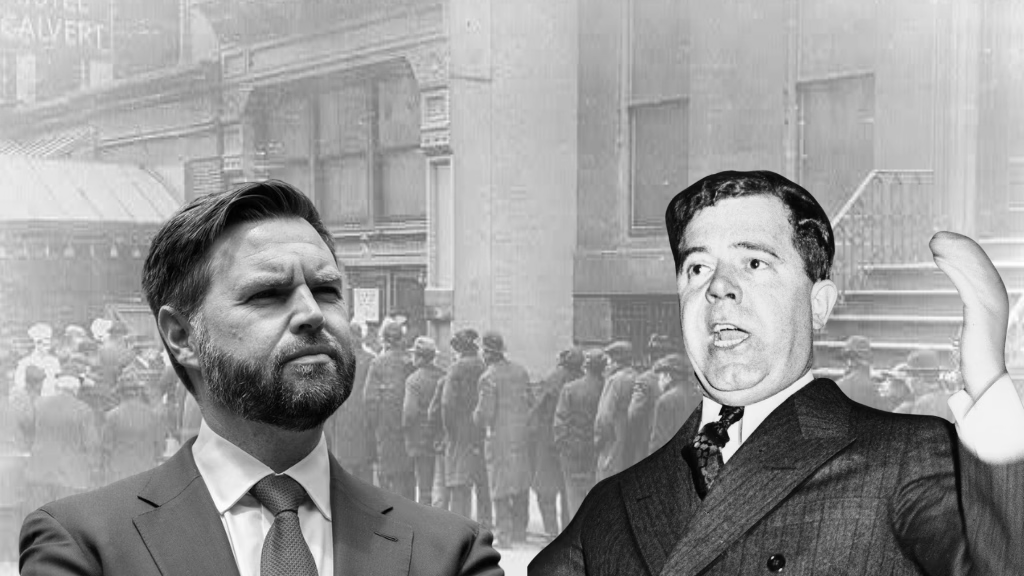
Feature image created with Microsoft Copilot.
The Gem State Chronicle delivers daily analysis, op-eds, press releases, and Idaho Insider updates — free to your inbox.
Free newsletter · Unsubscribe anytime · View on Substack

About Brian Almon
Brian Almon is the Editor of the Gem State Chronicle. He also serves as Chairman of the District 14 Republican Party and is a trustee of the Eagle Public Library Board. He lives with his wife and six children in Eagle.