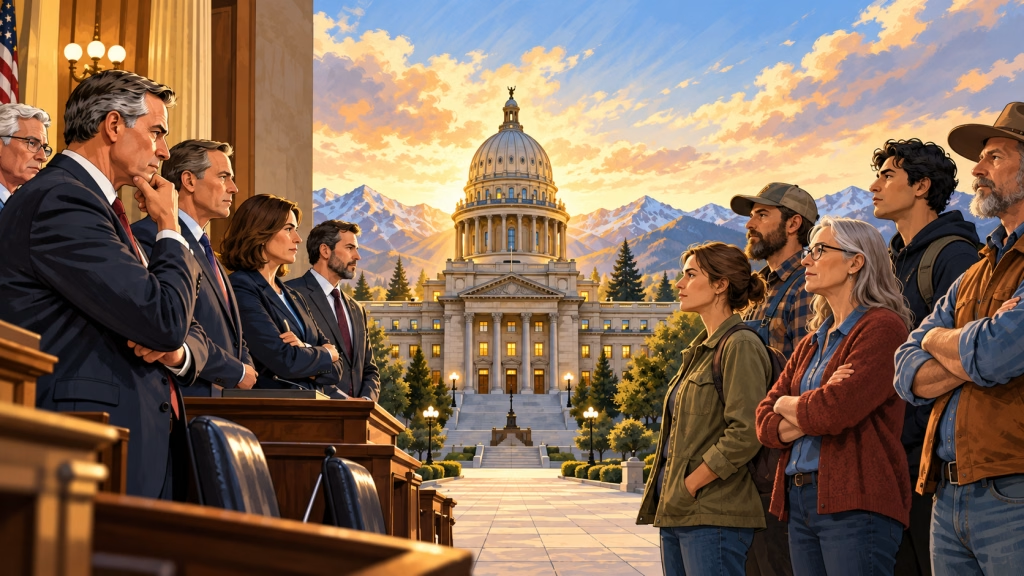
Idaho is a red state, for sure. We have cast our electoral votes for the Republican presidential candidate in every election since 1964. Right now, Republicans hold more than 85% of the seats in the Legislature. All seven statewide elected officials are Republicans and have been since 2002. The last Democrat to serve in our congressional delegation was defeated by Raúl Labrador in 2010. Today, nearly 62% of Idaho voters are affiliated with the GOP, compared to less than 12% who are proud Democrats.
Yet what engaged citizens really want to know is whether Idaho is truly a conservative state. If so, why have we failed to accomplish certain priorities demanded by conservative voters and activists, such as strong immigration enforcement and repealing Medicaid Expansion? If not, why are we plagued with moderate-to-liberal representation despite a conservative voter base? Do our elected officials accurately reflect the citizenry?
Greg Pruett of Honor Idaho, formerly the Idaho Second Amendment Alliance, recently penned an article that made the rounds in conservative circles in which he answered the initial question with a decisive “no.” He pointed to several factors to support his claim: legislative leadership blocking conservative bills, deference to liberal special interests, supposedly nonpartisan local governments pushing a leftward agenda, increased state spending, the dominance of state politics by left-wing PACs and lobbyists, and a primary system that elevates candidates who do not reflect the positions of their voters.
Read the whole thing and decide what you think. I’d like to examine the deeper questions raised by this ongoing discussion. Whenever a candidate, activist, or author makes claims about whether Idaho is conservative, we must first stop and ask how they are defining the word.
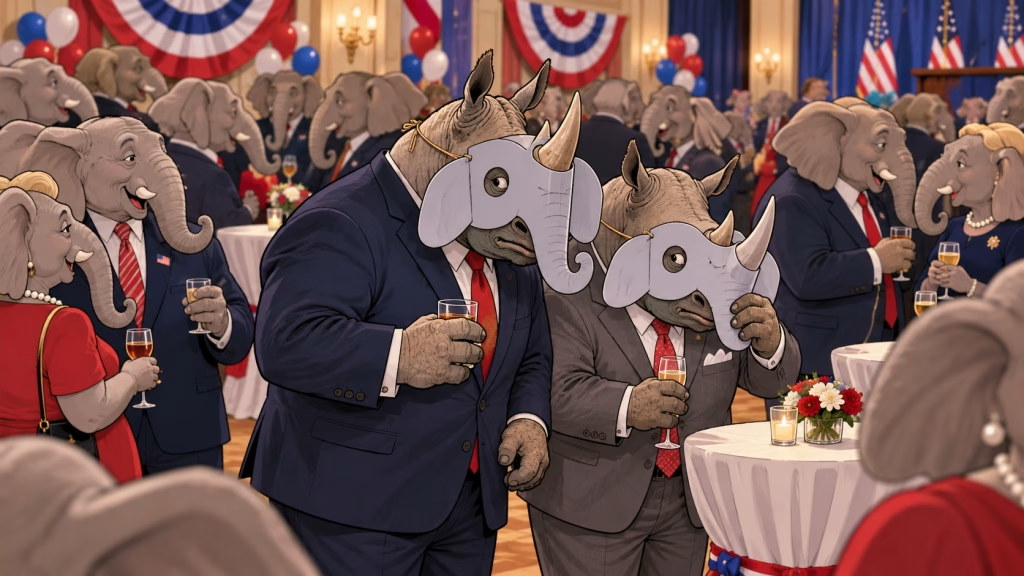
There are clear divisions within the Idaho Republican Party over ideology and the policies that flow from it. All sides have experienced frustration over the past few years when the Legislature or our statewide constitutional officers have not acted according to their preferred ideas. As I wrote last month, we all point fingers at each other—Panhandle Republicans say their colleagues out east are RINOs (Republicans in Name Only) who are basically Democrats, while those out east point back and call their intraparty opponents libertarians, extremists, and radicals. All sides believe they are the true inheritors of the conservative Republican legacy, and that the others are interlopers.
I have argued for a long time that the Republican Party has always been home to a wide range of ideological opinions. Back in the 1940s, followers of Sen. Bob Taft of Ohio wanted to scrap the New Deal, seeing it as government overreach, and accused Republicans who disagreed of essentially being RINOs. On the other hand, followers of Gov. Thomas Dewey of New York wanted to rein in the New Deal, believing that its popularity with voters made outright repeal impossible. They accused the Taftites of being radical extremists who would drive people away from the GOP.
The more things change, the more they stay the same.
At the heart of this debate is one overriding question: What does it mean to be a conservative? I’ve noticed that most people who set out to judge whether Idaho is a conservative state beg the question regarding that definition, assuming that their own set of personal policy positions is what it means to be conservative. For example, if you believe eliminating the sales tax on groceries should be our top priority, then our state’s failure to do so is prima facie evidence of our lack of conservative standing. Even if others argue that a grocery tax carveout is less conservative than it is populist, such arguments are dismissed as RINOism or progressivism. The definition thus becomes a tautology: conservatism is in the eye of the beholder.
Our current understanding of conservatism largely grew out of the right-wing reaction to Franklin Roosevelt’s New Deal. FDR created an overwhelmingly powerful governing coalition of progressives and populists, reshaping the federal government into one that involved itself in nearly every level of society. Conservatives—the root word here is to “conserve” something, remember—wanted to return to a time when government was less powerful and less involved in our daily lives. And, in many respects, we still do.
Yet there are at least three major schools of conservative thought in American political discourse.
First is classical liberalism, which many libertarians today claim as their intellectual heritage. It is rooted in individual liberty, limited government, low taxes, and a healthy skepticism of centralized authority. Classical liberals—not to be confused with modern liberals—seek to maximize personal freedom and minimize government interference in both economic and social matters.
Then there is a more traditionalist conservatism, which places greater weight on preserving inherited institutions such as family structures, churches, local organizations, schools, and cultural continuity. It is less focused on shrinking government in the abstract and more concerned with maintaining the social fabric of our communities.
Finally, there is pragmatic conservatism, which accepts a larger government so long as it maintains stability, economic opportunity, and law and order. Its adherents are often more willing to work through existing institutions than challenge them outright.
These traditions are not mutually exclusive, but they prioritize different outcomes. When activists assume only one of these frameworks is “real conservatism,” they are assuming the conclusion and making a philosophical claim.
Last month, I wrote about how Idaho is split politically. The west and north are generally closer to the classical liberal understanding of conservatism, while the south and east are more aligned with the traditionalist or pragmatic schools. One version of Idaho conservatism emphasizes independence, self-reliance, and maximum freedom from government control. The other emphasizes community stability, institutional continuity, and cooperation between public and private structures like schools, churches, and local economic networks. Both claim the mantle of true conservatism, and both see the other as wolves in sheep’s clothing attempting to move the Republican Party away from its proper foundation.
Yet there’s the rub: both of these groups overwhelmingly vote Republican, which means both are trying to grab the controls and steer the plane toward their preferred destination. It has become a zero-sum game: someone will win, and someone will lose.
But does that necessarily have to be the case?
Idaho does not fit neatly into either a “liberal” or a “hardline libertarian” category. It remains one of the more right-leaning states in the country, with a dominant Republican electorate and consistent support for conservative candidates in statewide and federal elections. At the same time, it has experienced significant population growth, rising state budgets, and increasing demand for public services driven largely by that growth.
Idaho has led the way in numerous areas over the last decade. In 2016, we became only the ninth state in the nation to adopt constitutional carry, a reform spearheaded by Greg Pruett and the Idaho Second Amendment Alliance. Today, 29 states do not require a permit to carry a concealed firearm.
In 2020, Idaho became the first state in the nation to prohibit men from competing on women’s sports teams. This measure, sponsored by Rep. Barbara Ehardt, is currently awaiting a decision by the United States Supreme Court. In 2023, Idaho banned the use of puberty blockers, cross-sex hormones, and mutilating transgender surgeries for minors.
Idaho was not the first state to adopt a school choice system in which money follows the student, but our Parental Choice Tax Credit looks to be a solid model that incorporates lessons learned from other states.
Over the last two years, Idaho has banned mask mandates, made ivermectin available over the counter, strengthened medical freedom for patients and conscience protections for providers, stopped taxpayer subsidies for teachers’ unions, ended mandatory DEI programs in higher education, reduced taxes across the board, made meaningful cuts in spending (even as Medicaid growth continued to increase the overall budget), and much more.
None of this means Idaho is perfect, nor does it mean we can rest on our laurels. We still have a great deal of work to do regarding immigration, entitlements, and reforming a subpar public school system. But overall, I think it is fair to say that Idaho is a conservative state. To argue otherwise requires comparing Idaho not to Florida, Texas, or any other red state, but to something that does not really exist: a Platonic ideal of what a perfect conservative state might look like.
Pruett’s argument ultimately rests on a simple claim: Idaho’s political system is not producing “true conservatism,” and therefore something is broken or compromised. But that conclusion depends entirely on the assumption that there is a single, authoritative definition of conservatism that can be used as a measuring stick. Once we question that assumption, the argument shifts dramatically.
I think it is more accurate to say that Idaho, despite being one of the more conservative states in the nation, faces the same debates and internal struggles that have existed within the American right for decades. Idaho politics is a battlefield of ideologies and strategies, but one in which the classical liberal interpretation of conservatism has been steadily gaining ground for much of the past decade.
Regarding that last point, It is worth remembering that the Idaho of the past was not a conservative-libertarian utopia. This is a state that sent Democrat Frank Church to the U.S. Senate for four terms, elected progressive Republican Bob Smylie governor three times, and supported figures like Cecil Andrus and Larry Echohawk within living memory. Glen Taylor, who won election to the Senate in 1944, was one of the most liberal men ever to serve in that body, eventually running alongside the quasi-socialist Henry Wallace on the Progressive Party ticket in 1948. It’s hard to argue that there was ever a time when Idaho was more conservative than today.
The real question is not whether Idaho is conservative or not, but which version of conservatism will define our future. Will we prioritize maximizing individual liberty, aggressively restraining government, and pursuing rapid structural change? Or will we instead prioritize institutional stability, incremental reform, and preserving community institutions?
And perhaps the most important question of all is this: Can advocates of these different traditions of conservatism coexist and govern together, or will they continue to treat one another as enemies in a fight to the political death?
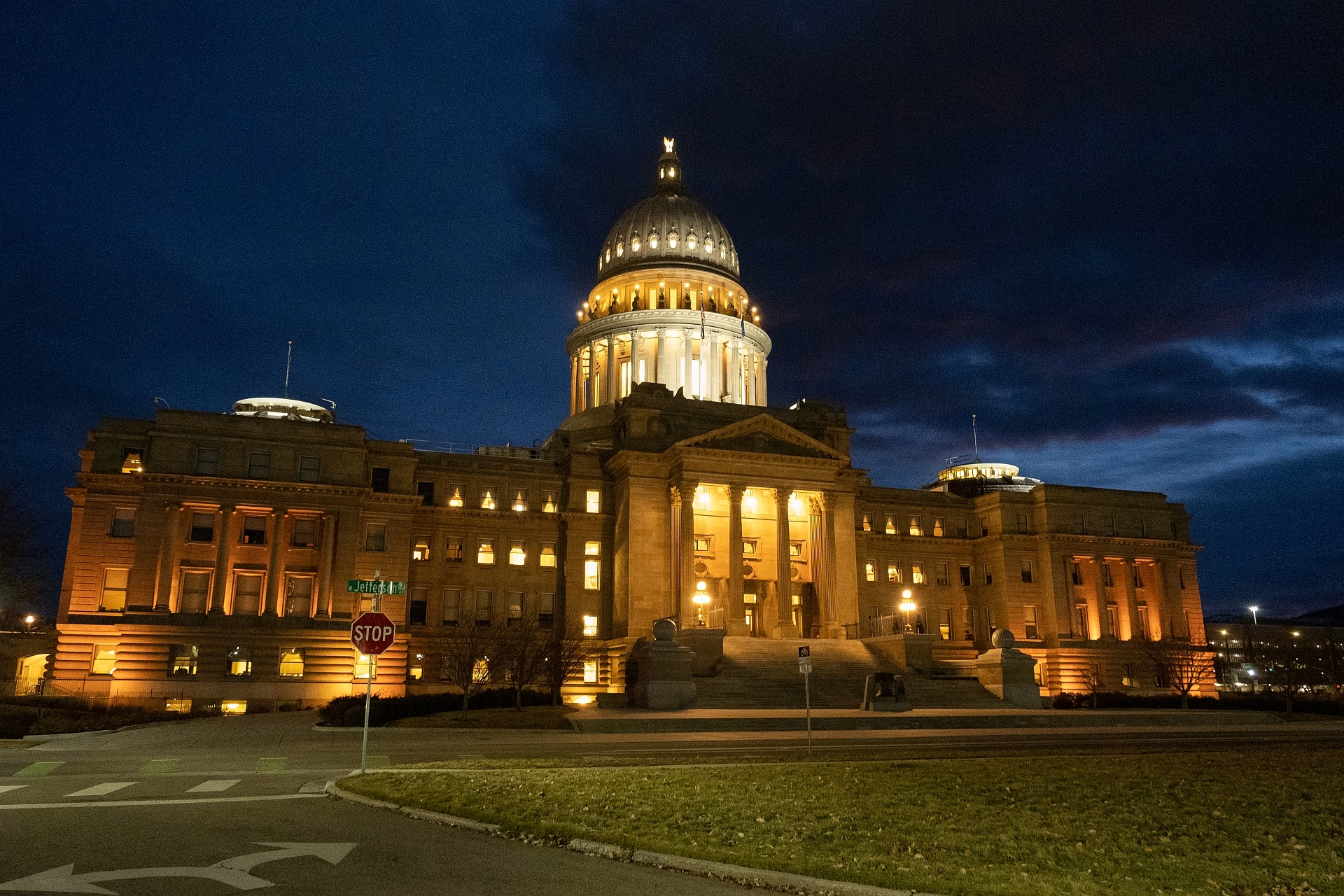
Feature image by James Dawson | Boise Public Radio
The Gem State Chronicle delivers daily analysis, op-eds, press releases, and Idaho Insider updates — free to your inbox.
Free newsletter · Unsubscribe anytime · View on Substack

About Brian Almon
Brian Almon is the Editor of the Gem State Chronicle. He also serves as Chairman of the District 14 Republican Party and is a trustee of the Eagle Public Library Board. He lives with his wife and six children in Eagle.