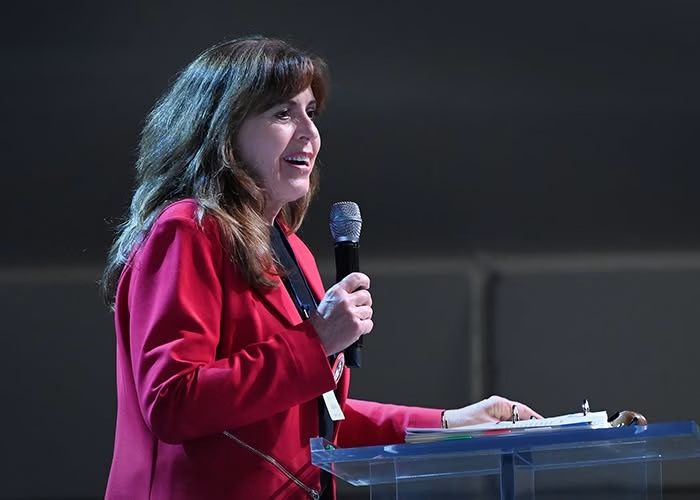
The Idaho GOP State Convention concluded Saturday with officer elections. Delegates voted on the positions of chair, first vice chair, second vice chair, treasurer, and secretary of the state party. Despite the usual rhetoric that accompanies contested elections, the results were not very close. Dorothy Moon became the first Idaho GOP state chair to win a third term since Dennis Olsen in the early 1980s, prevailing in a three-way contest against former state senator Steven Thayn and incumbent first vice chair Mark Fuller.
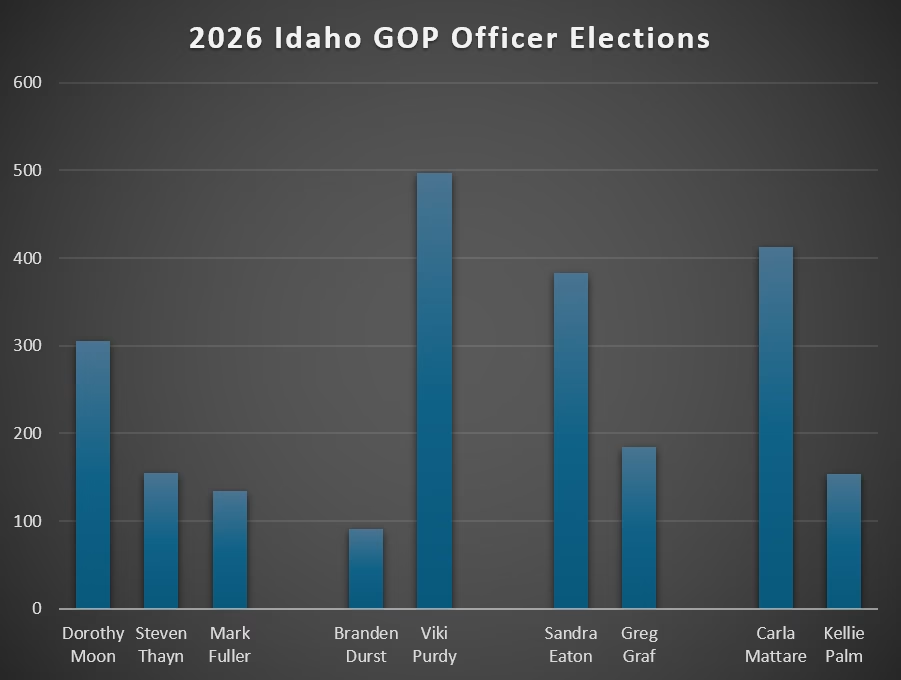
According to party rules, winning candidates must receive a majority of the total votes, which would have required a runoff had none of the three achieved 50 percent plus one. Moon won 306 votes, or 51.4%, barely avoiding a runoff against Thayn, who finished second with 155 votes, or 26.1%. Fuller came in third with 134 votes, or 22.5%.
By way of disclosure, Moon’s victory means I will continue in my role as communications consultant for the Idaho GOP. I’ve been accused of supporting Dorothy Moon out of self-interest, but that’s actually backwards. I’ve been proud to work with her because I believe in what she is doing for the party and for Idaho.
Incumbent second vice chair Viki Purdy, an Adams County commissioner, won the election for first vice chair in a landslide over former state senator Branden Durst, 497 votes to 91. After incumbent treasurer Steve Bender vowed not to run again if Dorothy Moon were reelected state chair, Sandra Eaton defeated Greg Graf 383 votes to 185. In an all-Kootenai County contest, Carla Mattare defeated Kellie Palm in the race for secretary, 431 to 154.
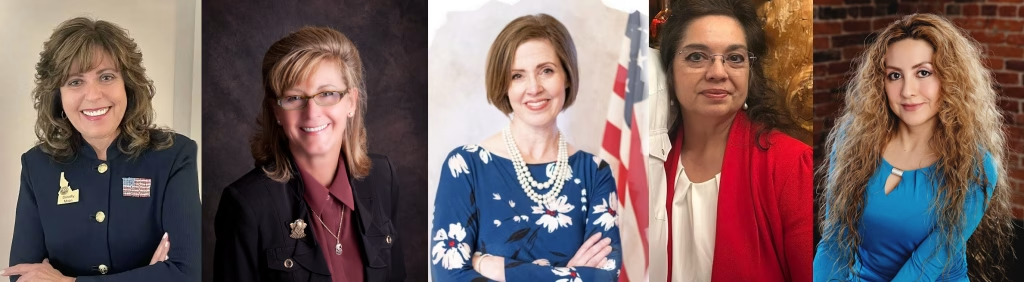
Former state representative Julianne Young was the only nominee for second vice chair and won election by acclamation.
Interestingly enough, all five officers elected on Saturday afternoon are women. I won’t hold my breath waiting for the local media to celebrate this accomplishment. It certainly creates a unique dynamic as the Idaho GOP prepares to lead the fight against the abortion initiative that is likely headed for the November ballot.
Dorothy Moon saw her vote count decrease from her victories in 2022 and 2024 but still managed to win a majority on the first ballot. Her challengers came from very different angles.
Steven Thayn took an intellectual approach, emphasizing big ideas about how to unite Republicans and address issues such as education, healthcare, and poverty. He distributed a book he had written called The Freedom Blue Print, which was intended to address these issues and give the Idaho GOP something to rally around. I’ll have more to say about these ideas in the future because I believe they have merit.
Thayn was nominated by Leah Vickery, a fellow delegate from Gem County, and seconded by Bruce Loertscher from Bonneville County, demonstrating support from the eastern Idaho faction.
Moon’s other challenger was Mark Fuller, who has been a leader in the conservative faction within the Idaho GOP for a long time. At the 2020 state convention in Nampa, which was my first Idaho GOP experience, Fuller lost the chair race to Tom Luna by a mere twelve votes. He ran for second vice chair in 2022 and first vice chair in 2024 and surely expected to be Moon’s heir apparent following her two terms.
Yet friction developed over the past two years, following the same factional divide between those aligned with the Gang of 8, the Idaho Freedom Foundation, Young Americans for Liberty, and others, and the rest of Idaho’s conservative legislators and activists. Fuller’s choice to be nominated by Sen. Christy Zito and seconded by Rep. Lucas Cayler, both members of the Gang of 8 Caucus, demonstrated his close connection to that faction. Frankly, I was surprised he didn’t have an unaligned delegate lined up as either nominator or seconder.
Dorothy Moon was once again nominated by Brent Regan, longtime chair of the Kootenai County GOP who transitioned this year to chairing Region II of the party. Her husband, Darr, seconded the nomination, giving a heartfelt speech in support of Dorothy’s work for the party.
Sitting in the front row, I was amused by the game of chicken played between Regan and Zito over who would nominate first. There is a certain strategy to being the last to speak, but if the nominators wait too long, the chair could rule nominations closed and both would be left out. Eventually, Regan bit the bullet and made his nomination.
All three candidates emphasized their commitment to fighting the abortion initiative, which will be the defining battle of this electoral cycle in Idaho.
This convention marked a change in the factional divides that have existed within the Idaho GOP for many years. As I wrote last month, members of each faction within the Idaho GOP would describe themselves as “conservative,” making it difficult to choose appropriate labels. I often refer to my own side, with its power base in the west and north and its emphasis on individual liberty, as conservatives, while I have referred to the other side, based mostly in the south and east and more concerned with community institutions, as moderates or the establishment. Out of charity, I’ll refer to the factions as western and eastern for now, though as you’ll soon see, even this is inadequate.
In 2019, the Idaho GOP State Central Committee met to elect a new chair following the resignation of Jonathan Parker. Raúl Labrador, recently retired from Congress and coming off a very close loss in the 2018 gubernatorial primary, defeated former state superintendent Tom Luna 111–109. The following year, with Labrador declining to run for a full term, Luna defeated Mark Fuller 274–262. There was a clear factional divide in the party, and it was fairly evenly balanced.
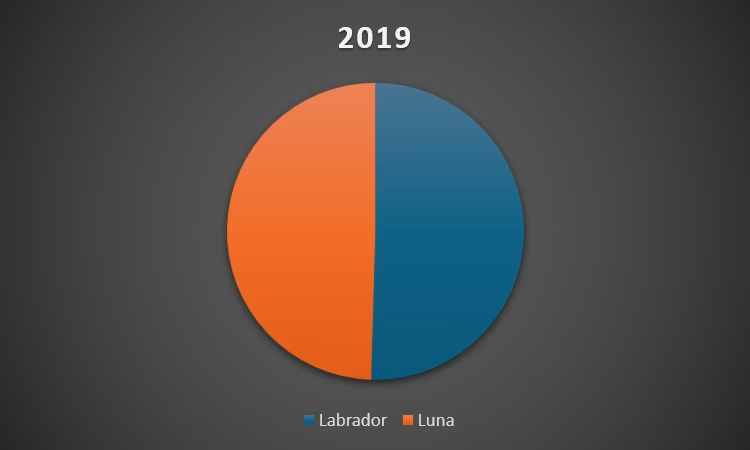
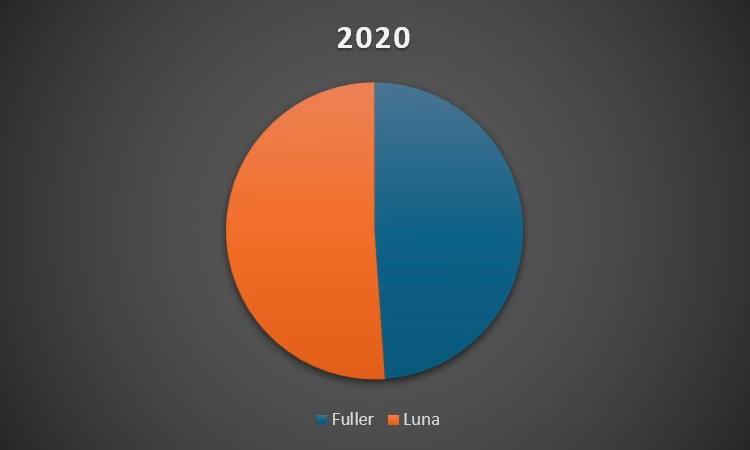
2022 was a turning point. Many people became involved in politics following the COVID-19 lockdowns and were looking for strong leaders who would fight on their behalf. The eastern faction, with its focus on community institutions and maintaining tradition, seemed unprepared for the backlash against the lockdowns. Following a very close loss in the 2022 secretary of state primary, former state representative Dorothy Moon came into the 2022 convention like a wrecking ball, defeating Luna 434–287. She won reelection in 2024 over former state senator—and fellow secretary of state candidate—Mary Souza by an even larger percentage, 376–228.
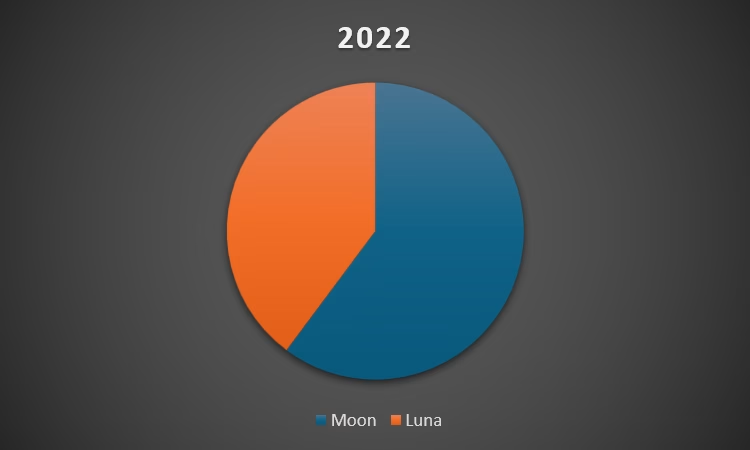
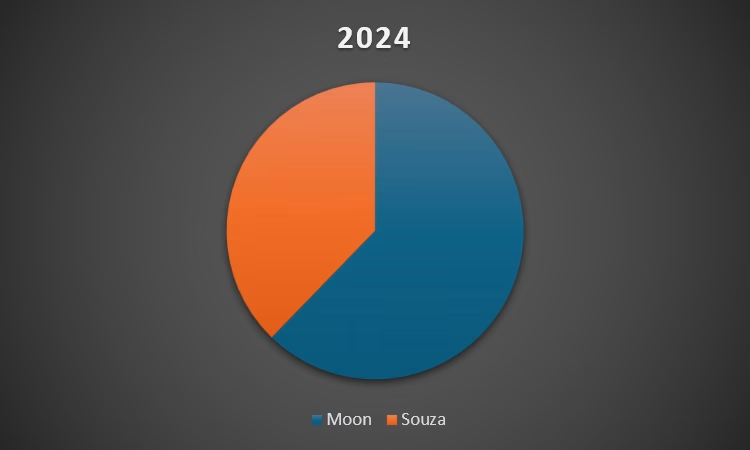
The 2024 victory was even more impactful considering the statewide campaign by the Gem State Conservatives against Moon and the precinct committeemen who supported her. GSC (not to be confused with the Gem State Chronicle!) was originally organized by two former state chairmen, Tom Luna and Trent Clark, and supported eastern-faction candidates throughout the state. While successful in taking over the Bonneville County GOP, and with its allies in the North Idaho Republicans gaining ground in Kootenai County, GSC struggled to make headway elsewhere. As you can see in the charts, the western faction maintained a strong hold on the party.
This year’s three-way race shows that the factional divide has become more complicated. Whereas Dorothy Moon and Mark Fuller shared the stage in 2024 following a conservative sweep of the officer elections, they faced off this year as rivals. Fuller’s faction consisted of those loyal to the Gang of 8, IFF, YAL, and others, but also several who had become personally frustrated with Moon over the years. Then-Treasurer Steve Bender, for example, had a dustup with Moon following Friday’s general session, in which Bender’s credentials committee report turned into more than two hours of tedious back-and-forth on the floor. In frustration, he threw his support behind Fuller, pledging not to run again if Moon were reelected.
On the other side, Steven Thayn is not exactly a member of the eastern Gem State Conservatives faction—his rhetoric and ideas are very different from those of Tom Luna or Trent Clark. Yet he was their candidate in this race.
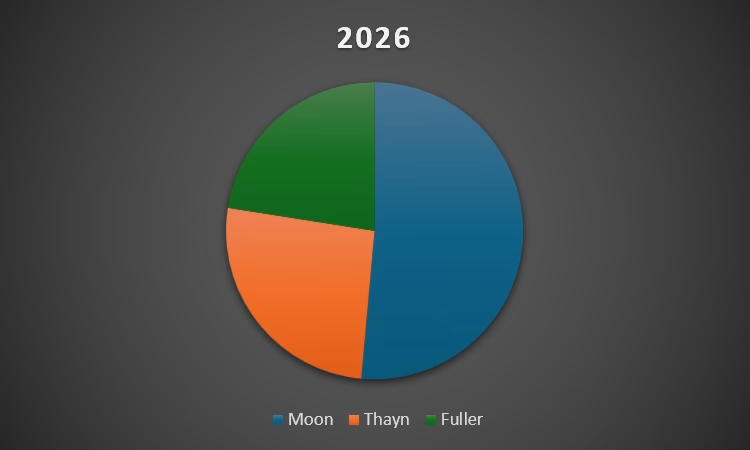
As you can see, the Moon and Fuller vote totals combine for nearly 77.5% of the ballots cast, substantially higher than Moon’s 62.25% share in 2024. Yet the three-way race confounds the data a bit. A more accurate gauge of the ideological factions might be somewhere between Sandra Eaton’s mark of 67.4% in the treasurer race and Carla Mattare’s 72.8% in the secretary race. It’s clear in any case that western-style conservatism is in control of the Idaho GOP, yet differences in strategy, rhetoric, and style have created a new divide just as tangible as any ideological disagreement.
My day-after interpretation of these results is that, in voting for Dorothy Moon, a majority of delegates expressed support for a pragmatic firebrand. Moon is outspoken and does not mince words about her beliefs on any subject. However, she has demonstrated both a willingness and an ability to work with figures throughout the party. For example, her partnership with Sen. Jim Risch and his team has grown substantially over the past year as Risch prepared for this year’s reelection campaign. She has also shown an ability to get things done, such as the presidential caucus, two conventions, the fight against ranked-choice voting, and more. Even those who might have been critical in the past know what they’re getting with Moon, while Fuller and Thayn both represented unknowns.
Dorothy Moon represents the core majority of the Idaho GOP grassroots, with both the eastern establishment faction and the confrontational-politics faction now left in the minority. Perhaps she really can unite the party by bringing together the best of all sides. We need a certain pragmatism in understanding how politics works and how to actually get things done. We also need a bold vision for how things should be.
Of course, more happened at the convention than the election of officers. On Saturday morning, I worked with Brent Regan to withdraw my proposal to create a more concise Idaho GOP Platform. I still believe this is the direction we should go, but two years of slow and deliberate discussion will be better for everyone. I’ll have more to say on that issue in a future article.
The convention also adopted a slate of resolutions, not including one regarding support for Israel, which was stricken on the floor by Sen. Brian Lenney, a delegate from Canyon County. I’ll cover the resolutions in a future article as well.
All in all, my fourth Idaho GOP state convention was another amazing experience. Volunteers from the Ada County GOP did a great job hosting the event. I always enjoy seeing my friends—and adversaries—from across the Gem State together in one room. I believe the party emerges from this convention stronger and more unified, ready to fight the abortion initiative and not only keep Idaho red, but make it more conservative than before.
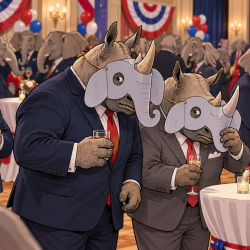
Feature image courtesy of Daniel Murphy.
The Gem State Chronicle delivers daily analysis, op-eds, press releases, and Idaho Insider updates — free to your inbox.
Free newsletter · Unsubscribe anytime · View on Substack

About Brian Almon
Brian Almon is the Editor of the Gem State Chronicle. He also serves as Chairman of the District 14 Republican Party and is a trustee of the Eagle Public Library Board. He lives with his wife and six children in Eagle.