Click here to listen to the podcast edition of this article.
The Idaho State Legislature passed House Bill 135 during the 2025 session, prohibiting illegal aliens from receiving taxpayer-funded welfare benefits. The bill went into effect that July, but a few weeks later, U.S. District Judge Amanda Brailsford, a Biden appointee, blocked it as it applied to HIV treatments.
The Idaho Department of Health & Welfare (DHW) participates in the federal Ryan White Program, which distributes federal tax dollars to “cities, counties, states, and local community-based organizations to provide HIV care, treatment, and essential services to more than 600,000 people.” These are the eligibility requirements according to DHW:
- HIV-positive
- Idaho resident
- Have income at or below 500 percent of the Federal Poverty Level
- Not insured or underinsured for medications and HIV monitoring labs
- Not an inmate of state or federal Corrections system
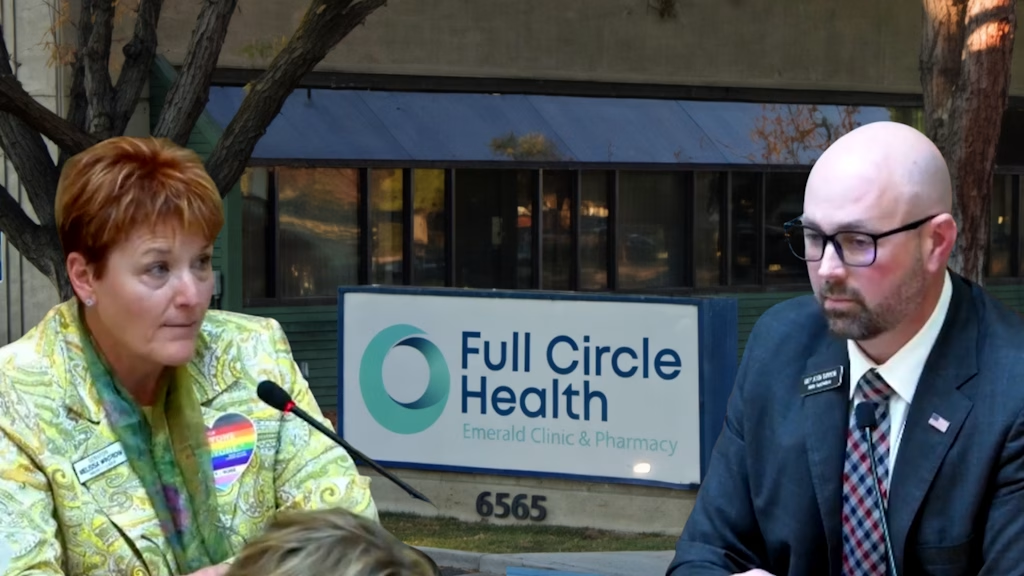
The primary plaintiff in the 2025 lawsuit was Dr. Abby Davids, program director at the Boise Family Medicine Residency of Full Circle Health. According to her bio, Dr. Davids’ expertise includes “LGBTQ and gender affirming care,” “care of newly arrived Americans,” “planetary health,” and “health equity.”
Full Circle Health was originally founded in 1975 as the Family Medicine Residency of Idaho (FMRI). The longtime president and CEO of FMRI/Full Circle Health is Dr. Ted Epperly, who served as the resident physician on the Central District Board of Health from 2006 to 2021. In that capacity, Dr. Epperly advised the board to impose mask mandates in the Treasure Valley. Ada County Commissioners Ryan Davidson and Rod Beck declined to support him for an additional term in 2021, appointing Dr. Ryan Cole to the board instead.
According to records at Transparent Idaho, FMRI/Full Circle Health has received nearly $100 million in taxpayer-funded payments since 2020, including state and federal subgrants, prescriptions, and various medical services.

All of this raises an obvious question: How many illegal aliens with HIV are having their treatments covered by Idaho taxpayers?
Full Circle Health’s website says:
The Wellness Center at the Full Circle Health is a Ryan White grant recipient clinic that provides comprehensive, interdisciplinary medical care to more than 800 individuals living with HIV/AIDS in Southern Idaho and Eastern Oregon.
DHW’s dashboard shows 290 Idaho residents as having “newly diagnosed HIV infection” since 2020:
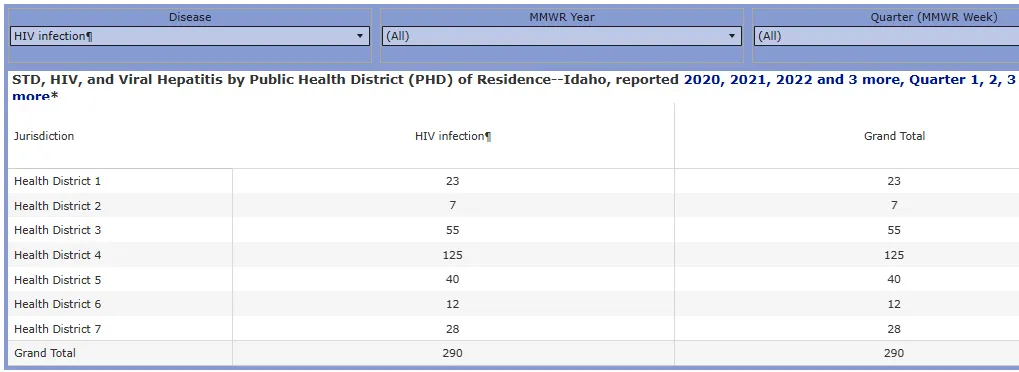
That still doesn’t answer how many illegal aliens are part of this group. There must be at least one; otherwise, there would be no basis for a lawsuit. The complaint notes that Full Circle Health treats “approximately 890 HIV+ patients” and adds that Dr. Davids sees about 100 of those herself.
It continues:
Of the more than 890 HIV+ patients, approximately 175 are immigrants with a variety of immigration statuses. The clinic serves approximately 45 HIV+ patients who are currently undocumented. The clinic serves around an additional 20 patients whose immigration statuses put them at risk of failing H.B. 135’s verification requirements. They are at risk because the statute does not say whether their status would be considered “lawfully present” and/or because they lack a social security number. These uncertain statuses include patients with pending applications for asylum who have an employment authorization document (“EAD”), which is a temporary work permit, patients who are DACA recipients (Deferred Action for Childhood Arrivals), and patients who have a student visa but no work permit. Consequently, more than 60 patients at the clinic risk losing access to HIV medication because of H.B. 135.
Of these patients, Dr. Davids personally cares for approximately 10. If H.B. 135’s verification requirements go into effect, she will lose the ability to provide comprehensive HIV care for these patients, which represent about 10% of her patients with HIV. The clinic’s patients include heterosexual men and women, including people who are pregnant and people from the LGBTQ+ community. One of her recent patients is a pregnant woman who is undocumented and living with HIV.
All of this came to a head in the final days of the 2026 legislative session. An enhancement budget for public health services which became House Bill 978 included language requiring DHW to draft a report on the immigration status of individuals utilizing part of the $478,700 in federal grants appropriated for HIV prevention and treatment:
The Department of Health and Welfare shall compile a report from the public health districts to submit to the Joint Finance-Appropriations Committee by December 31, 2026, on the documented immigration status of individuals utilizing HIV prevention services through the HIV Prevention and Surveillance Program. The format and content of this report will be determined in consultation with the Budget and Policy Analysis Division of the Legislative Services Office.
Rep. Josh Tanner, co-chair of the Joint Finance-Appropriations Committee (JFAC), explained during debate that this language was a direct response to Judge Brailsford’s injunction, as well as an uptick in HIV cases, particularly in eastern Idaho. Democratic Sen. Melissa Wintrow interrupted the chair as he called for a vote, stating that “disease knows no immigration status.”
So the answer to the question posed in the article title is yes: taxpayers are funding treatment for HIV-positive illegal aliens. Sen. Wintrow is, of course, correct that diseases do not respect citizenship, but her argument raises broader questions. Are taxpayers responsible for treating sick people throughout the entire world—or only those who manage to cross our border, with or without legal status?
Is this purely about altruism, or is there also a financial incentive? Treating HIV-positive patients with taxpayer dollars appears to be a significant enterprise. As noted, Full Circle Health has received nearly $100 million in taxpayer funds since 2020. According to its latest IRS 990 filing filing, Dr. Epperly earned $515,430 in 2024 as CEO, while Dr. Davids earned $287,309 as a program director.
In her 2007 book on the Great Depression, The Forgotten Man, Amity Shlaes argued that the true “forgotten man” was neither the impoverished recipient of government aid nor the wealthy beneficiary of government influence, but the taxpayer—the person whose labor funds both. Today, lower- and middle-class Idahoans are paying for HIV treatment of illegal aliens—people who shouldn’t even be here—as well as subsidizing the six figure salary for Dr. Abby Davids, who sued our state for having the audacity to say that welfare benefits should serve American citizens.
The past century has seen increasing government intrusion into the healthcare market, to the point where not only patients but the entire industry have become dependent on taxpayer-funded programs. Even modest attempts to roll back that system—whether by restricting benefits to legal residents or repealing Medicaid expansion—are met with fierce resistance from those who have come to rely on the status quo.
Not only does our welfare system continue to grow, squeezing taxpayers more each year, it also creates opportunities for fraud and abuse, as we have seen in Minnesota and California over the past few months.
Fixing this situation—restoring the proper priorities for our government—will require untangling a Gordian Knot of state and federal regulations. It’s also a reminder that immigration policy affects everything in our society, including healthcare costs, housing, taxes and spending, and more. The DHW report mandated by H978 will be one more tool at our disposal as we head into the new legislative session this coming January.
Gem State Chronicle is a reader-supported publication. To receive new posts and support my work, consider becoming a free or paid subscriber.
The Gem State Chronicle delivers daily analysis, op-eds, press releases, and Idaho Insider updates — free to your inbox.
Free newsletter · Unsubscribe anytime · View on Substack
About Brian Almon
Brian Almon is the Editor of the Gem State Chronicle. He also serves as Chairman of the District 14 Republican Party and is a trustee of the Eagle Public Library Board. He lives with his wife and six children in Eagle.