Election integrity is perhaps the most important issue in any republic. Citizens must have confidence that the votes they cast are properly counted and that election results represent the true will of those who chose to vote. Over the past few years, that confidence has been eroded by questionable results, opaque counting methods, and the growing polarization of our society. Partisans on both sides have developed a habit of crying “fraud” any time their side loses an election, which does not bode well for the future of our republic.
People naturally want to trust our elections, and one oft-suggested idea is hand-counted paper ballots. While paper ballots are a great idea—more on that shortly—I suggest that hand counts are not the panacea people are looking for. Attached below is my sample ballot from this month’s election. Notice that the ballot has four pages—two sheets of paper, printed on both sides—with a total of 36 questions.
The optical scanners used in Ada County can tabulate these ballots in mere seconds, less time than it takes the poll worker to give you your sticker. How long do you think it would take to count them by hand? Go ahead and give it a try. Print the ballot, fill it out however you like, then time yourself tallying each vote.
ChatGPT suggested that a two-person team (one announcing, the other tallying) would likely take 2–4 minutes per ballot, and that sounds about right to me. With 1,212 ballots cast in my precinct, it would take between 40 and 80 hours for that two-person team to count them all.
Of course, some people voted early or by mail, and you could bring on more people to count. If you had a six-person poll worker team, and all six sat down after polls closed to tally votes in three two-person teams, it would still take between 13 and 27 hours.
Hopefully you can see how impractical this would be. Beyond the time involved, hand counts are more likely to introduce errors than machine counts, assuming the optical scanner is conducting an accurate count. State law requires counties to conduct logic and accuracy tests prior to Election Day to ensure that scanners are accurately recording and tabulating votes. If errors are discovered, they must be corrected and the equipment retested. These tests are open to the public, so you can watch in person at your county elections office.
Of course, this doesn’t answer skeptics who worry about scanners and tabulation machines being connected to the internet, systematically flipping votes, or other questions about the process. That’s where the post-election audit comes into play. State law requires the Secretary of State’s office to conduct a hand count of a selection of paper ballots (I told you we’d come back to those) in randomly selected precincts throughout the state. Last Friday, the Board of Canvassers—consisting of the Secretary of State, the State Controller, and the State Treasurer—randomly drew numbers representing counties and precincts until the selections totaled at least 2,100 ballots. For small counties, could mean auditing every precinct.
This year’s selections were precincts in Adams, Bannock, Benewah, Caribou, Gem, Latah, Oneida, and Washington Counties. Teams from the Secretary of State’s office are visiting each of the selected counties this week to hand count a single race as determined by law—attorney general in Adams, Bannock, Caribou, and Gem; the state gun question in Benewah and Washington; Legislative District 6 Senate in Latah; and Congressional District 2 in Oneida. The point is to ensure that the hand count exactly matches the machine count for that race. The public and media are invited to watch in person or online.
While this process is underway, it’s helpful to read the Secretary of State’s post-election audit report following the May primary election, which I’ve attached here:
The May 2026 primary audit shows a remarkable degree of accuracy in each county. The only instance in which a scanner got something wrong was in Power County, where an absentee ballot was folded in such a way that it smudged Sen. Jim Guthrie‘s bubble enough to register as a vote when scanned. The audit team reclassified it as an undervote and recommended that counties double-check absentee ballots during the design phase to ensure folds don’t intersect with voting bubbles.
Sen. Guthrie won Power County with 889 votes over David Worley’s 457, so one vote would not have changed that race.
Other errors discovered during the audit were almost entirely human-related, such as a poll worker forgetting to count a spoiled ballot in the E-Poll Book or a voter checking in but then neglecting to vote at all.
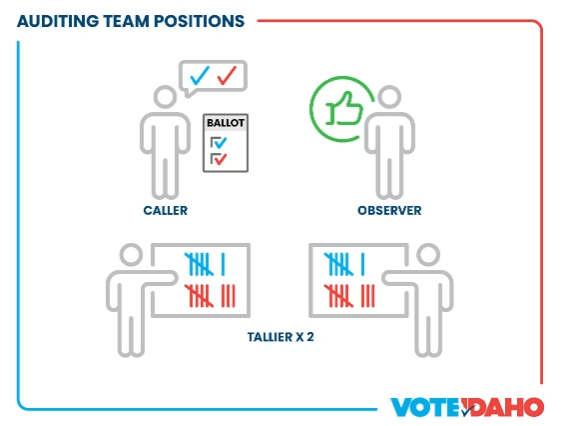
Interestingly enough, above I suggested a two-person team for hand-counting ballots, but the Secretary of State’s office uses a four-person team for its audits. Applying that staffing model universally would substantially increase the personnel required (and potentially the cost) of hand-counting every ballot in every precinct.
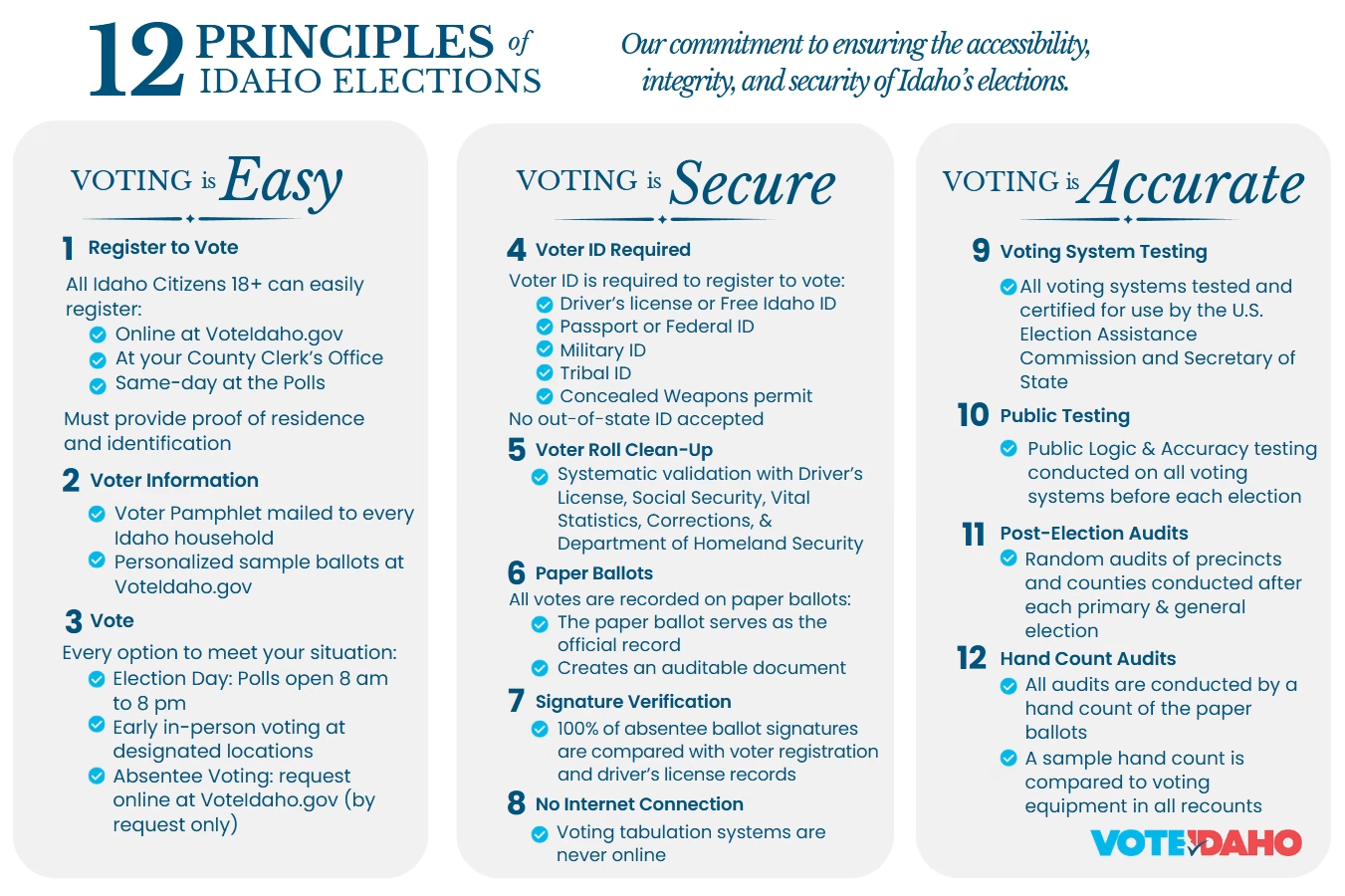
I believe Idaho’s elections are generally secure and reflect the will of those citizens who bother to vote. That doesn’t mean they’re perfect—I believe there are myriad issues with both mail-in voting and early voting. However, the “12 Principles of Idaho Elections” promoted by the Secretary of State’s office—voting is easy, voting is secure, voting is accurate—generally hold true in the Gem State.
If your favored candidate lost an election, now is the time to step back and conduct an honest postmortem to figure out why. Often the problem is not the election system, but a lack of connection between the candidate and his or her constituents, the national mood, or a misallocation of resources. Idaho law provides for open and transparent elections, and it’s the job of candidates and activists to convince their supporters to go to the polls.
As I wrote last week, immediately jumping to the conclusion that the only explanation for an electoral loss is some form of cheating robs us of the important step of figuring out what went wrong and strategizing how to fix it next time. Part of that process is recognizing that elected officials usually represent the will of their voters, which can be a frustrating realization for those who hold strong ideological positions.
I believe we have secure elections in Idaho. If you have questions or concerns, I encourage you to reach out to your county elections office and share them. Take the opportunity to watch a hand-counted audit or a logic and accuracy test. Sign up to be a poll worker in the next election—odd-year elections are great for getting your feet wet without becoming overwhelmed.
Don’t just take my word for it, or that of any national talking head who makes a living spreading fear and outrage. Get involved and see the process for yourself—you might be pleasantly surprised.
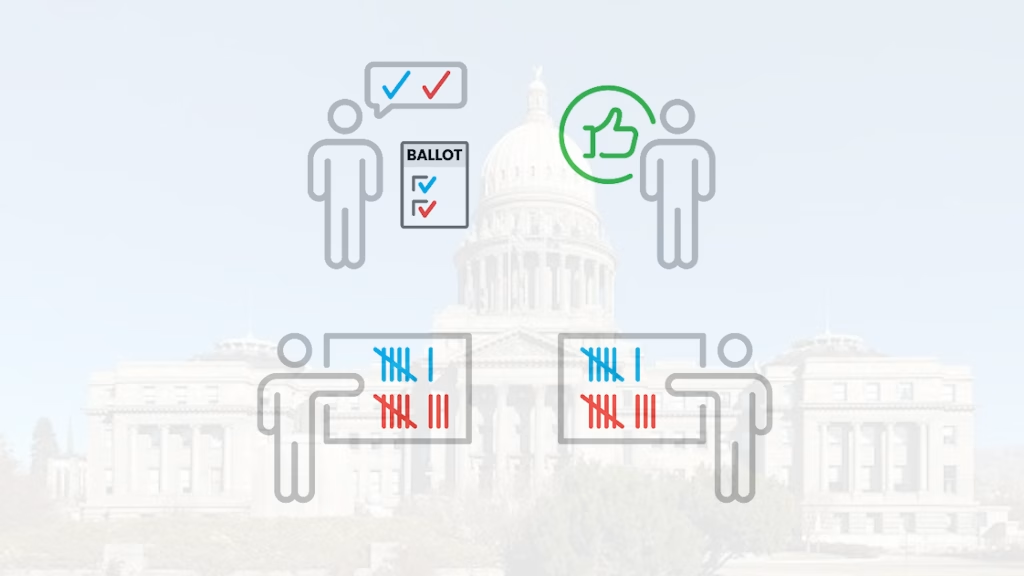
Feature image adapted from a graphic from the Secretary of State’s 2026 primary audit report.
The Gem State Chronicle delivers daily analysis, op-eds, press releases, and Idaho Insider updates—free to your inbox.
Free newsletter · Unsubscribe anytime

About Brian Almon
Brian Almon is the Editor of the Gem State Chronicle. He also serves as Chairman of the District 14 Republican Party and is a trustee of the Eagle Public Library Board. He lives with his wife and six children in Eagle.