Over the last few years, the question of whether Idaho communities should allow the construction of data centers has become a top priority for engaged political activists, both on social media and in town halls throughout the state. Citizens have expressed concerns regarding power utilization, water usage, and farmland being repurposed for these large complexes.
Are data centers necessary infrastructure for the 21st century, or unreasonable impositions on communities? Who pays the costs, who benefits, and who should decide where they go?
Before we dive into the controversies, let’s look at the history. The early internet, beginning in the 1960s, was a series of connections between computer systems at universities and research centers. Individual users could dial in and retrieve messages from bulletin board services, which were often separate from the wider internet. Early consumer access also came through walled-garden products like Prodigy, CompuServe, and America Online.
The rise of the World Wide Web in the 1990s required websites that were always on. When your computer or phone visits a website, it is connecting to another computer, or array of computers, inside a data center somewhere in the world. The advent of cloud computing in the early 2000s intensified the need for large, centralized hubs of powerful servers that were fast and redundant. Amazon Web Services (AWS) launched in 2006 and was soon followed by cloud systems hosted by Google, Microsoft, and other large technology companies.
To best serve users, data centers need to be distributed throughout the country—and the world. Fiber optic cables allow for extremely fast transmission of data, but there are still geographical limits. Streaming a movie from Europe will generally be slower and less reliable than streaming from a data center one county over.
The new paradigm of artificial intelligence (AI) has made data centers even more central to technological infrastructure. Every query to ChatGPT, Grok, Claude, Gemini, or Copilot relies on servers in data centers to process. The AI-driven data center boom has resulted in rapid construction of new facilities, higher power densities per location, increased water use for cooling, and greater proximity to local communities.
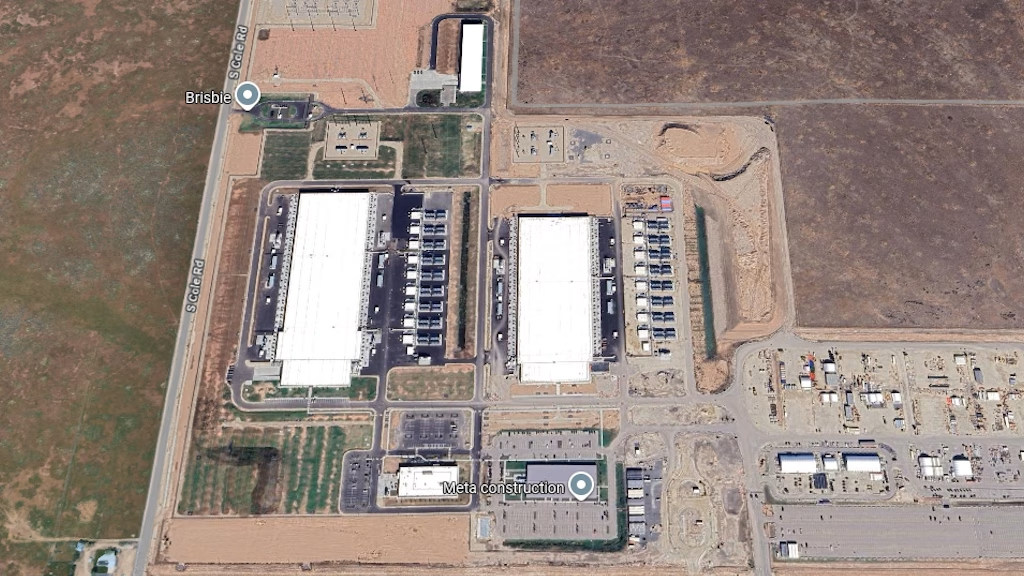
From the perspective of information technology companies, Idaho is an attractive location for data centers: relatively low population, available land, and the ability to move water, power, and data where needed. Kuna, a small city in southern Ada County, has become ground zero for data center controversy. Several years ago, Meta, the parent company of Facebook, purchased land to build a large data center, taking advantage of tax credits the Legislature had created in recent years. Diode Ventures is currently preparing to build a massive data center complex called Gemstone Technology Park.
The Legislature attempted to amend those tax credits this session with House Bills 609 and 820 , which would have added additional criteria for qualifying. Sponsored by Reps. Chris Bruce of Kuna, John Gannon of Boise, and Sen. Lori Den Hartog of Meridian, neither bill made it to the House floor.
Reps. Bruce and Gannon, despite representing opposing political parties, have both expressed concerns about data centers taking advantage of tax breaks in ways that impact local communities.
One bill that did pass was House Bill 895, sponsored by Reps. Mike Moyle of Star and Britt Raybould of St. Anthony. The latter presented the bill on the House floor in late March:
The bill distinguishes between consumptive water usage—an open system in which water evaporates—and closed-loop systems, in which water is continually reused. It encourages new data centers to use closed-loop systems that are more water-efficient and place less strain on the aquifer. Recall that water is a scarce resource, and one of the proper duties of government is to ensure it is shared fairly among a growing population and the farms that help sustain it.
According to my research, the average data center uses between 300,000 and 500,000 gallons of water per day, depending on size and complexity. In consumptive cooling systems, around 80% of that can evaporate into the air, while the remainder may contain concentrated minerals that require treatment before reuse. Closed-loop systems, by contrast, can use minimal water—especially if they rely primarily on air cooling—or tens of thousands of gallons per day if water is still used as a secondary coolant.
The Meta facility in Kuna is expected to use around 70,000 gallons per day. That roughly compares to about 230 suburban households, a small farming operation on less than 100 acres, one to three full-size high schools, or one or two large office buildings. Older, more water-intensive data centers are roughly comparable to a large neighborhood or small town, a large farm, or a small golf course. Golf courses, notably, use significant amounts of water for recreational purposes—yet it is data centers that have received the most scrutiny.
Of course, water is just one component. These facilities also require large amounts of electricity, potentially affecting other consumers and contributing to higher prices. A typical Meta data center uses between 100 and 200 megawatts of electricity, and the Kuna facility is being developed alongside new renewable energy resources, including solar generation. Gemstone Technology Park near Kuna, still in the early stages of development, is expected to use as much as 800MW when complete.
The Meta facility will use as much electricity as a city the size of Boise, while the full Gemstone project could consume as much power as hundreds of thousands of homes across Idaho. This is where data centers operate on a completely different scale than most other land uses.
According to the U.S. Energy Information Administration, Idaho’s total in-state power capacity in 2024 was about 5,548 megawatts, or roughly 5.5 gigawatts. That is not enough to supply all homes and businesses in the state, which is why Idaho imports power from other states.
According to Diode Ventures, the company constructing the Gemstone project, it will bear “100% of the costs solely associated with any upgrades required to interconnect the project to Idaho Power’s system.” However, that does not necessarily mean there will be no broader cost impacts. Gemstone tenants will likely sign their own agreements with Idaho Power, which in turn may need to build new generation and infrastructure to meet the increased demand.
Innovations in nuclear energy could mitigate some of these challenges in the future, but the question remains how much impact large facilities like this will have on our electric bills in the meantime.
The debate over data centers is about more than water or electricity—it’s about governance. Local governments control land use, but the impacts of large data centers extend far beyond county lines, affecting regional power systems and shared water resources. As projects grow in size, states like Idaho are beginning to assert more control over how those resources are used, even as local communities remain the front line for approval and opposition.
Data center operators must make the case that these large, windowless buildings benefit local communities, despite their role in a global computing network. They can receive tax exemptions and credits while also bringing some economic activity. They provide construction jobs in the short term, but once completed, they require relatively few employees, making their long-term local impact harder to quantify. Building a data center involves navigating local zoning rules, city councils and county commissions, and state agencies responsible for water rights and utilities—all while often facing opposition from nearby residents. In some cases, public backlash over approvals has cost local officials their positions.
One thing is certain: in this brave new digital world, data centers are not going away. The incentives remain strong to build more facilities to meet growing demand for cloud services, especially AI. Elected leaders, from city councils to state legislators, along with regulatory agencies, must find the right balance between responsible resource management and continued economic development. It is up to engaged citizens to understand the issue and provide informed input to those making these decisions.
Feature image of the Meta data center under construction near Kuna, via Google Maps.
The Gem State Chronicle delivers daily analysis, op-eds, press releases, and Idaho Insider updates — free to your inbox.
Free newsletter · Unsubscribe anytime · View on Substack

About Brian Almon
Brian Almon is the Editor of the Gem State Chronicle. He also serves as Chairman of the District 14 Republican Party and is a trustee of the Eagle Public Library Board. He lives with his wife and six children in Eagle.