Losing six legislative seats is never ideal, but compared to the rest of the nation, Idaho withstood the blue wave pretty well. Texas, long considered a Republican stronghold, went nearly full blue as Democrats swept statewide offices and won control of the House of Representatives. Republicans lost their legislative supermajorities in one or both chambers in Florida, South Carolina, Indiana, Missouri, Ohio, Missouri, and Kansas.
Early numbers suggest that Republican candidates lost approximately eight percentage points nationally compared with President Trump’s 2024 performance. Idaho wasn’t immune: analysis of legislative races found an average Republican decline of about 6.8 percentage points. Another comparison—Trump’s 2024 vote share against Sen. Jim Risch’s 2026 share—shows a 10.34-point decline.
Here in Idaho, Republicans retained their supermajorities in both chambers by fairly wide margins. The 2024 elections yielded 29 Republican senators to just six Democrats, and 61 Republican representatives to just nine on the blue team, for a total of 90 Republicans and 15 Democrats. That was the second-highest number of Republicans since the modern district system was implemented in 1992. Prior to that redistricting, the Senate consisted of 42 members, with 84 in the House. Districts were oddly drawn, with overlapping floterial districts adding to the confusion.
Heading into the 1992 elections, the Idaho Senate was deadlocked 21–21, and our governor was Democrat Cecil Andrus. Under the new system of 35 districts divided evenly by population, Republicans took a 23–12 Senate majority in 1992, expanding to a 27–8 supermajority in 1994 when Phil Batt brought the governorship back under Republican control. Since then, Republicans have maintained supermajorities in both chambers.
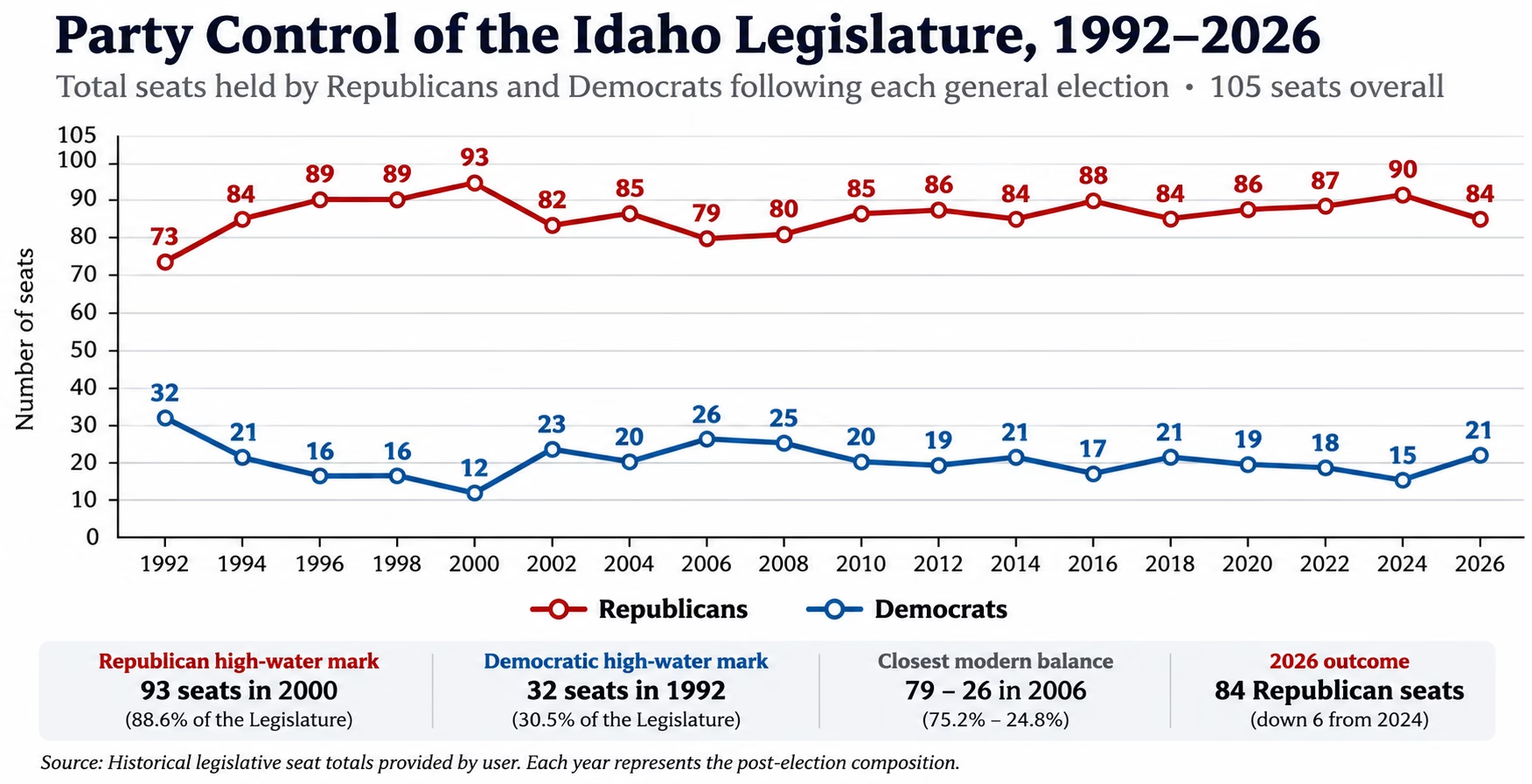
The biggest losses for Republicans typically correspond to blue-wave years such as 2006 and 2018, when the Idaho GOP lost six and four seats, respectively. One outlier is 2002, which was a positive midterm for Republicans nationally but resulted in a loss of eleven seats in Idaho. This could be due to redistricting, but I’m not entirely sure. That election immediately followed the GOP’s largest legislative majority of 93 seats, achieved in 2000.
Since the dawn of the 21st century, then, the Idaho GOP has controlled between 79 and 93 seats. I believe that more or less represents the floor and ceiling for Republican representation in Idaho, respectively. The way districts and demographics are arranged right now, it would be difficult for Democrats to get many more than 25 seats, but it is also unrealistic for Republicans to go much higher than the 90 they’ve held these past two years. Remember the graph I posted yesterday showing the average winning percentage in each district, ordered from most red to most blue:
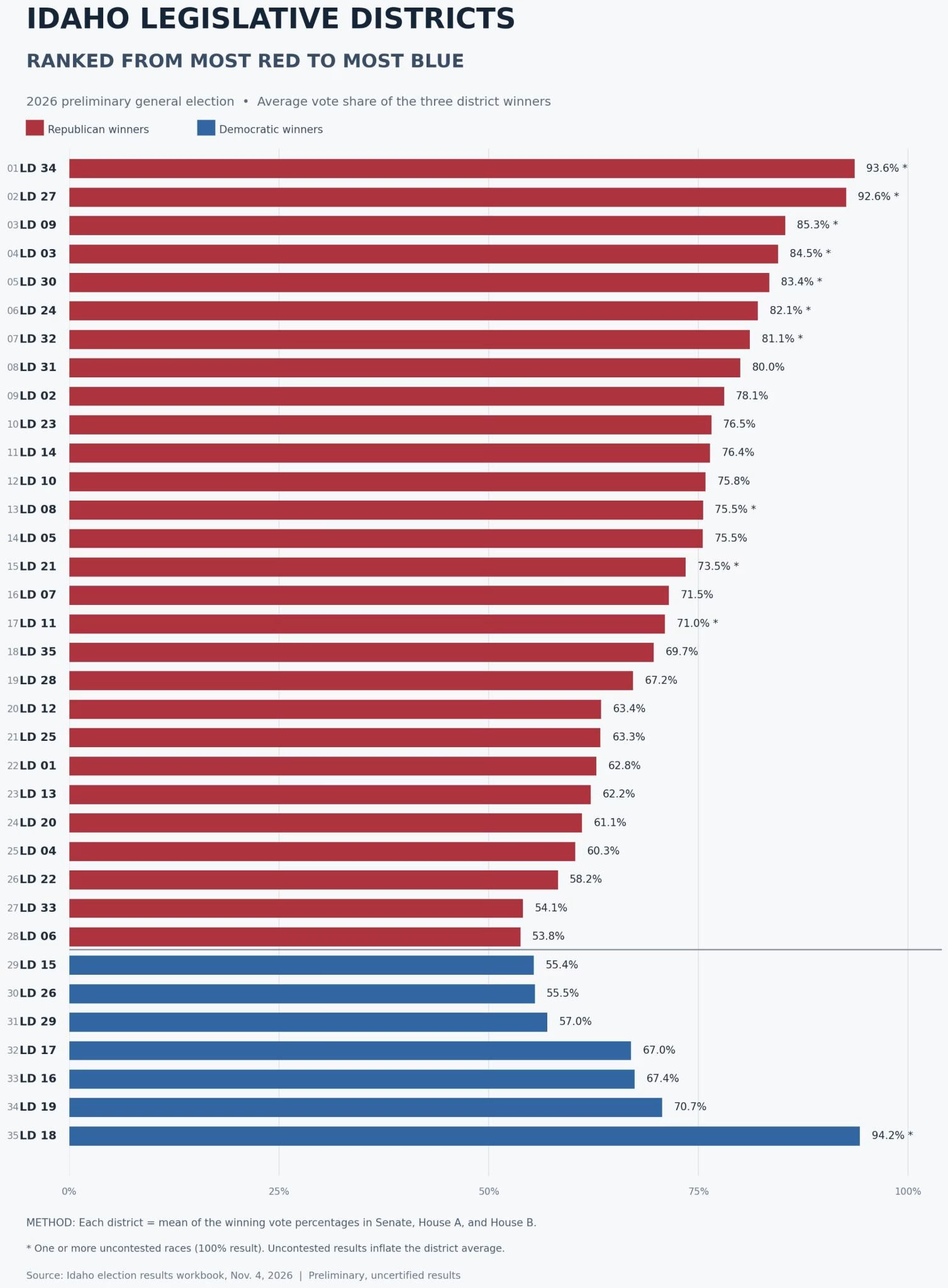
District 18 at the bottom is a bit of an outlier, considering no Republicans stood for election there this year. Nevertheless, you can see some patterns. The Boise districts of 16, 17, 18, and 19 are solid blue. The odds of Republicans picking up a seat there in the near future are slim. Districts 15, 26, and 29 were closer this year, and elected Republicans as recently as 2024. However, in a blue-wave year, those districts went entirely Democratic as well. It’s easy to scaremonger over the loss of six Republican seats, but all six were in swing districts that had previously elected Democratic legislators. That doesn’t mean the losses are insignificant, but it certainly puts the results in perspective.
I broke down support for Proposition 1 by district and found a startling-yet-predictable conclusion: every district that voted in favor of Prop 1 sent three Democrats to the Legislature, while every district that voted against Prop 1 elected three Republicans. Here is how that played out in the five closest districts:
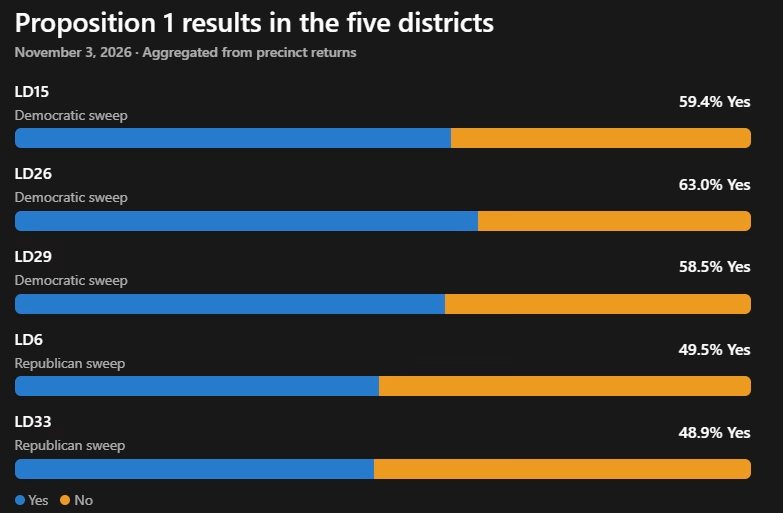
It seems clear to me that Prop 1 drove turnout throughout the state—both among Republicans opposed to abortion and Democrats who support it. That increased turnout was most apparent in Democratic areas such as Boise, Pocatello, Moscow, and Blaine County. A statistical analysis of the change in turnout between 2024 and 2026 shows a moderate but positive correlation with support for Prop 1, especially concentrated in Ada, Bannock, and Blaine Counties. Those three counties just happen to be where Democrats swept swing districts to win their six new seats.
District 26 provides an informative case study in how it was likely difficult—if not impossible—for Republicans to win these swing districts in this year’s environment. LD26 combines populous, left-leaning Blaine County with less populous, right-leaning Jerome County and sparsely populated, conservative Lincoln County. Jerome and Lincoln Counties voted overwhelmingly against Prop 1 and for Republican candidates, but Blaine County had enough Democratic voters to completely overwhelm the rest of the district.
I picked the House Seat B race for comparison, since the Senate and House Seat A races in LD26 each had an independent candidate confounding the data.
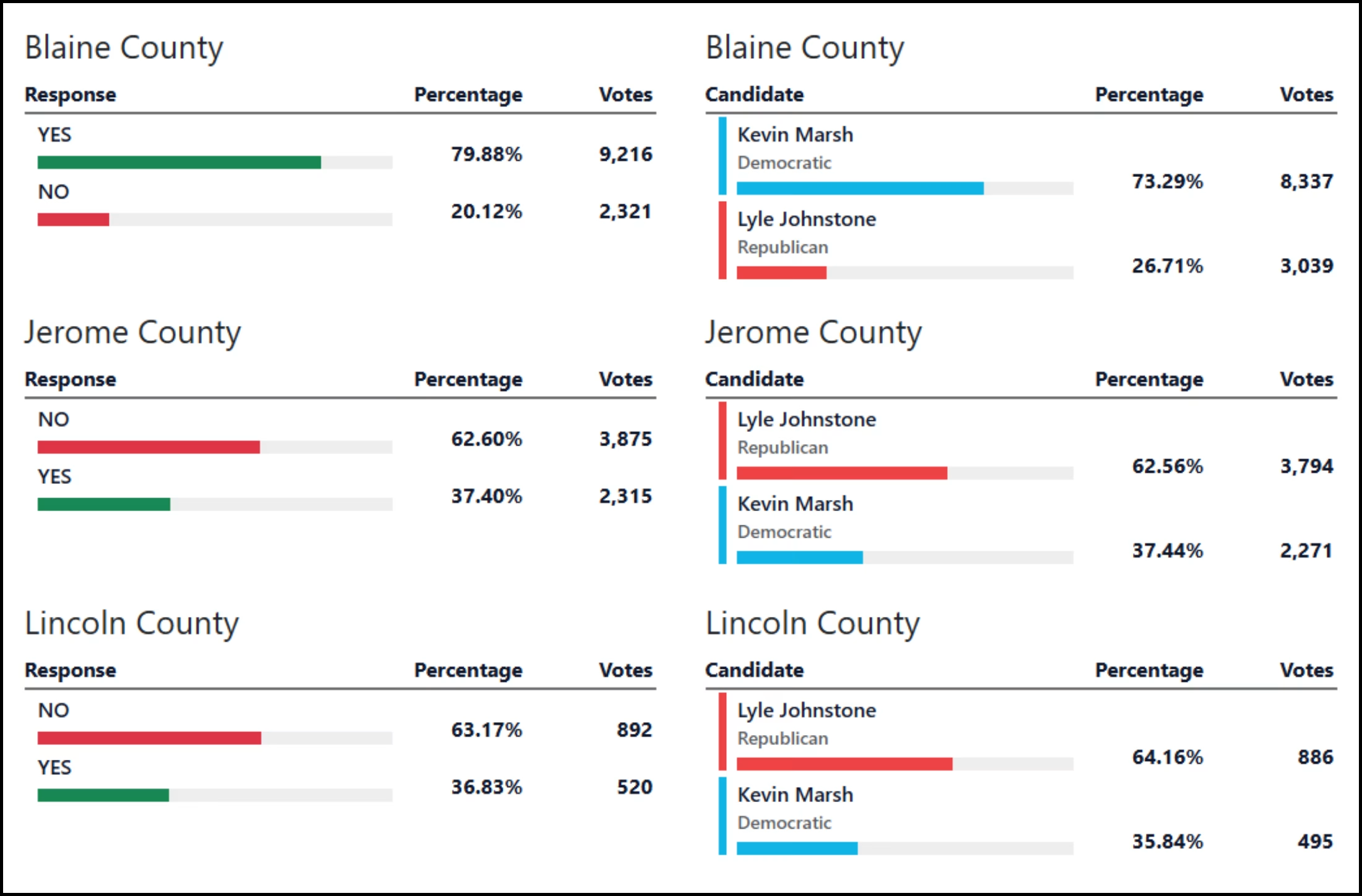
In this year’s political environment, the Democratic vote in Blaine County was simply too much for Jerome and Lincoln to overcome. Data shows that Blaine County voters turned out in numbers similar to the presidential election year of 2024, while turnout in Jerome and Lincoln—though higher than in the 2022 midterm—fell short of the 2024 mark. I strongly suspect that Prop 1 and the national blue wave combined to drive Democratic turnout, enough Republicans stayed home to make a difference, while swing voters who supported President Trump in 2024 either stayed home or voted blue.
Additionally, both Jerome and Lincoln Counties saw leftward shifts compared to 2024, though both counties remained firmly in the red column.
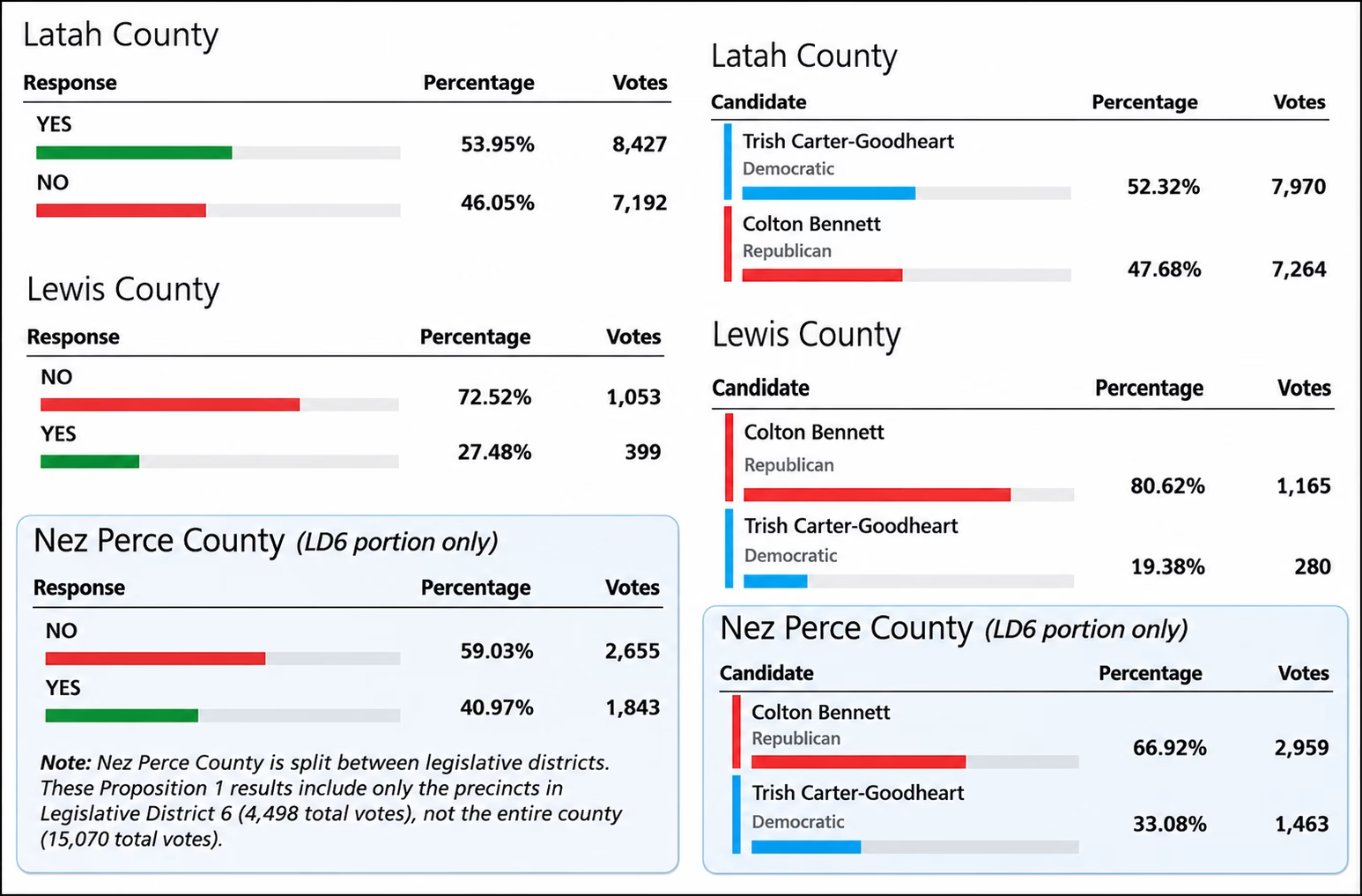
Legislative District 6 is somewhat similar to LD26 in that it consists of three counties and has a blue core. However, Latah County is not nearly as blue as Blaine County, despite the college town of Moscow, and Nez Perce County is split between legislative districts. That means Latah, despite voting both for Prop 1 and the Democratic candidate, could not overwhelm voters in the other two counties the way Blaine can in LD26.
The same structural and geographical features that prevent Republicans from dropping much below 80 seats also prevent them from going much higher than 90. Both sides fight over a very small number of swing districts. In a red-wave year, such as 2024, Republicans can get near their ceiling, while a blue wave can drag them down, but not enough to threaten the party’s supermajorities.
The Idaho GOP remains a force in all 35 districts and 44 counties, with precinct committeemen and volunteers who knock on doors, put up signs, and motivate their neighbors to vote. Voter registration data shows Republicans continuing to increase while Democratic affiliation is decreasing. However, Idaho isn’t immune to national trends. It’s unfortunate that someone like Rep. Dori Healey in LD15 lost reelection because President Trump decided to start a war in Iran and because abortion was on the ballot. But that’s politics. The point I’m trying to make here is that Idaho was already better suited to weather the storm than many other red states. We cannot rest on our laurels, but neither should we give in to loud and unhinged voices who scream that we’re doomed.
What does the new Legislature mean in practical terms? Democrats will have more of a presence on legislative committees, including the Joint Finance-Appropriations Committee, and the calculus for leadership elections will be somewhat different. I believe Republicans no longer have the luxury of infighting. Voters want stability and affordability, not endless purity spirals or right-wing civil wars over personalities. The supermajority is still there, but it’s smaller, and it includes unreliable votes such as Rep. Stephanie Mickelsen and Sen. Jim Guthrie. The center of gravity in the Legislature has shifted a bit to the left from where it was in 2024, though I believe we are still in a much better place ideologically than we were in 2018 or 2020.
Your job as an engaged citizen doesn’t stop on Election Day. Rather, we’ve only just begun. I’ve already updated Idaho Insider with the new lawmakers who will take office in a few weeks. I encourage you to start reaching out with your ideas regarding policies that should be addressed.
We’re entering uncharted waters at the national level, but as I wrote yesterday, Idaho is still Idaho. We’re still a red state, and our voters are still mostly conservative at heart. The last two years have seen some incredible wins. We face steeper challenges over the next two, but that just means we have to work that much harder.
The future of our state depends on it.
The very cool feature image was created with ChatGPT.
The Gem State Chronicle delivers daily analysis, op-eds, press releases, and Idaho Insider updates — free to your inbox.
Free newsletter · Unsubscribe anytime · View on Substack

About Brian Almon
Brian Almon is the Editor of the Gem State Chronicle. He also serves as Chairman of the District 14 Republican Party and is a trustee of the Eagle Public Library Board. He lives with his wife and six children in Eagle.