The titular phrase apparently originates from Reagan’s Directory of Personnel, Scott Faulkner, in 1980. He coined it in reference to executive appointments, but it works for politicians as well: There’s plenty of evidence to show that once in office, they seldom change their ideological stripes. The best forecast for how a legislator votes in the future is how they voted in the past. That’s the logic behind political rating schemes, and behind this continuing study looking at stable voting alliances.
We’re most of the way through the 2026 session, and spending bills are starting to reach the chamber floors. In previous sessions, voting clusters from earlier in the session predicted stances when it comes to appropriations, so let’s look at how those have evolved in the House:
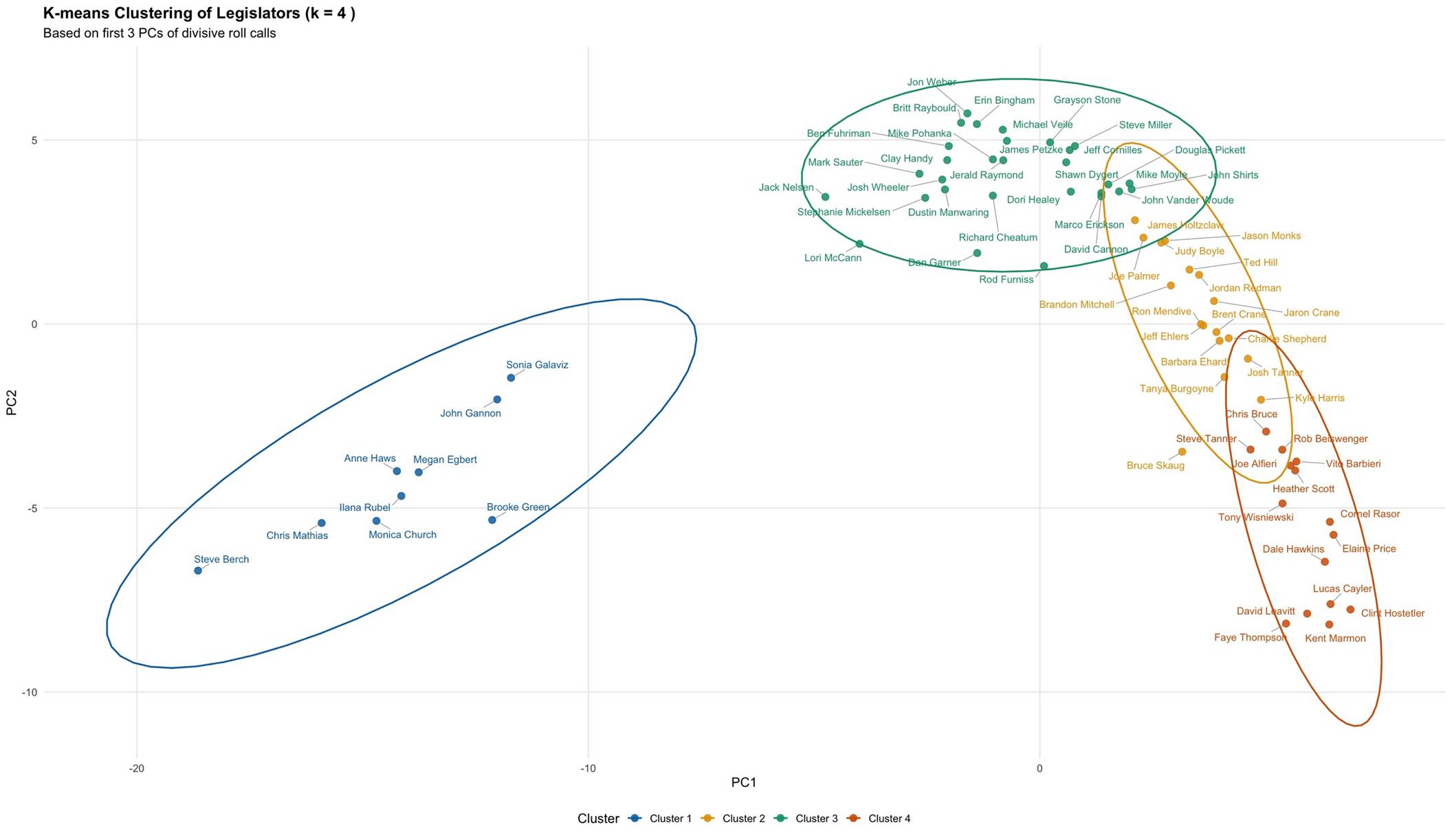
This is very similar to last year’s pattern: Cluster 1 is the Democrats, 2 is what I called the “Swing” cluster last year, 3 is the GOP Establishment, beloved of IACI and Idaho Dairy PAC, and 4 is the small(er) government alliance. (Note the groups appear to overlap because I’m showing three-dimensional data on a flat screen.)
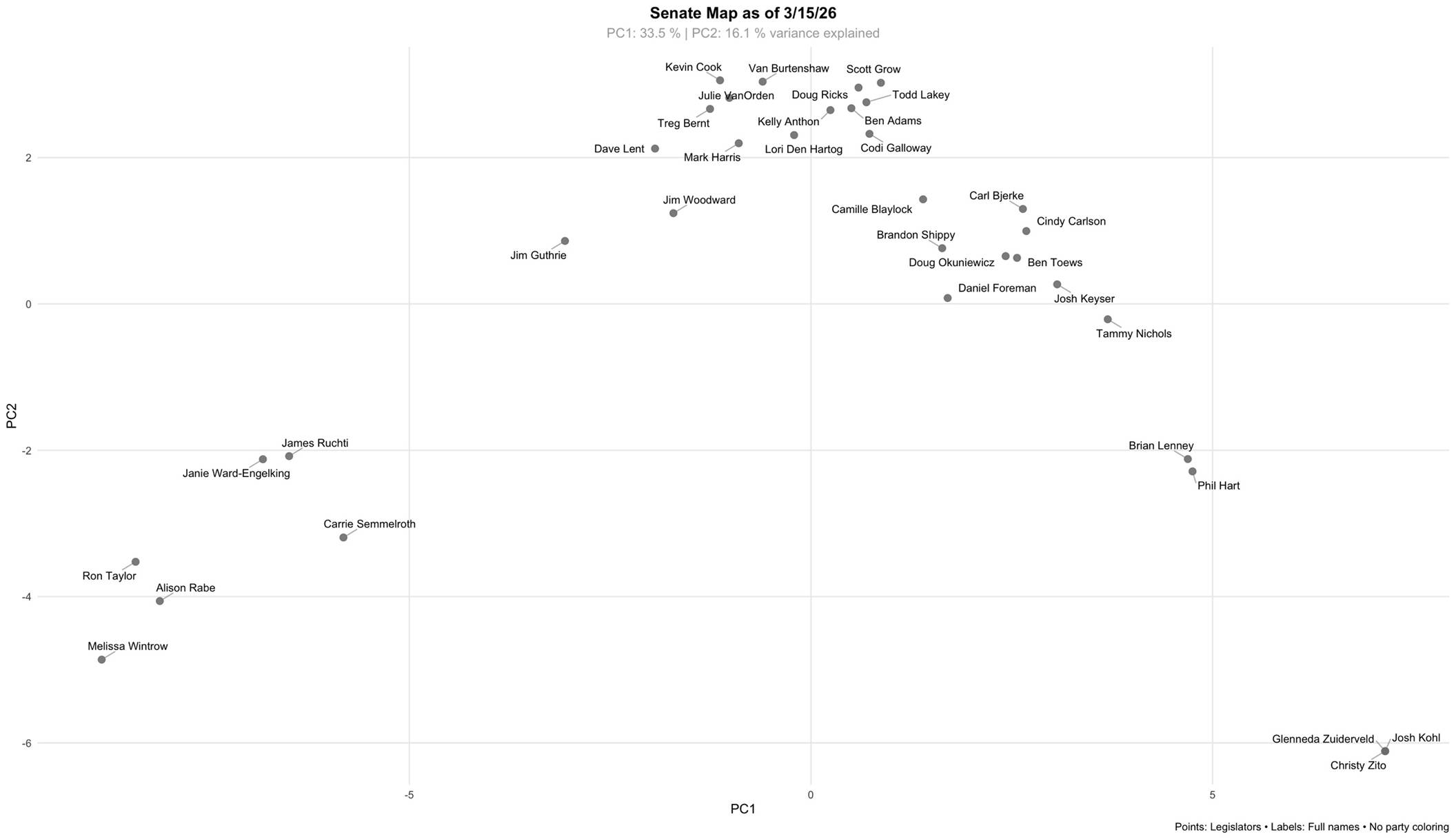
Over in the Senate, the pace is picking up. The map is not so stable as the House, but clusters are clearly forming:
One big Senate vote of the week was the failure of the Idaho Health & Welfare maintenance appropriation, home of budget-busting Medicaid spending. At a District 14 townhall on Saturday, I heard JFAC co-chair Senator Grow say the ‘nays’ were equally split between those who thought the budget was cut too deeply, and those wanting bigger cuts. Was he right?
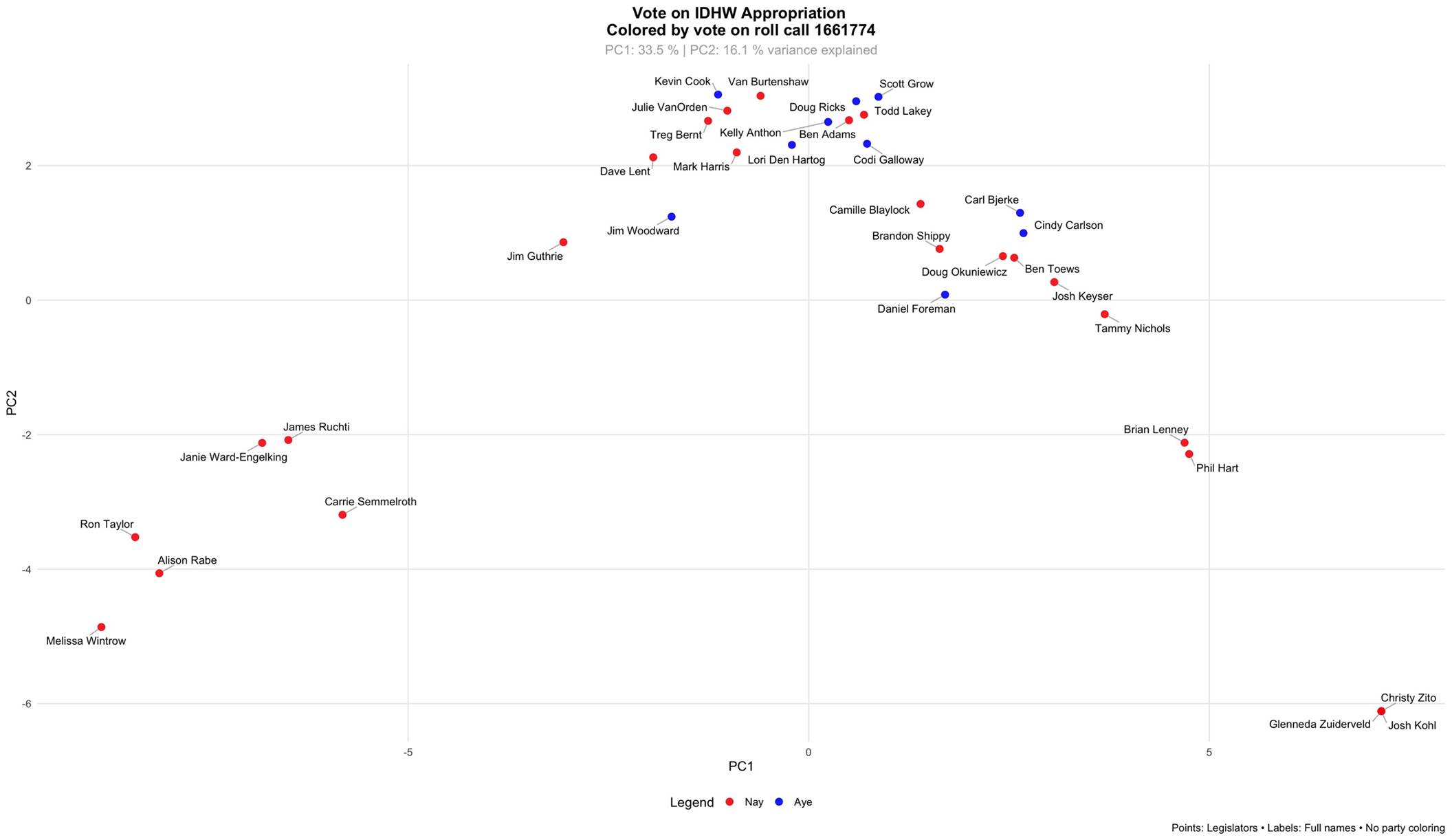
It looks like it: The ‘ayes’ cluster in the middle of the map, with the ‘nays’ on the opposite ends of the spread from Democrats to Gang of 8. One end or the other will have to brought on-side to get this through the Senate. Which way will it go?
In the category of votes that didn’t happen, the House is activist when it comes to dealing with illegal immigration, while the Senate doesn’t even want to talk about it. Senator Guthrie’s drawer is notoriously the place where such dies, since he’s chair of the State Affairs committee, and Pro Tem Anthon regularly sends such bills there, whether or not it’s the most germane destination. Let’s look at the members of that committee as mapped:
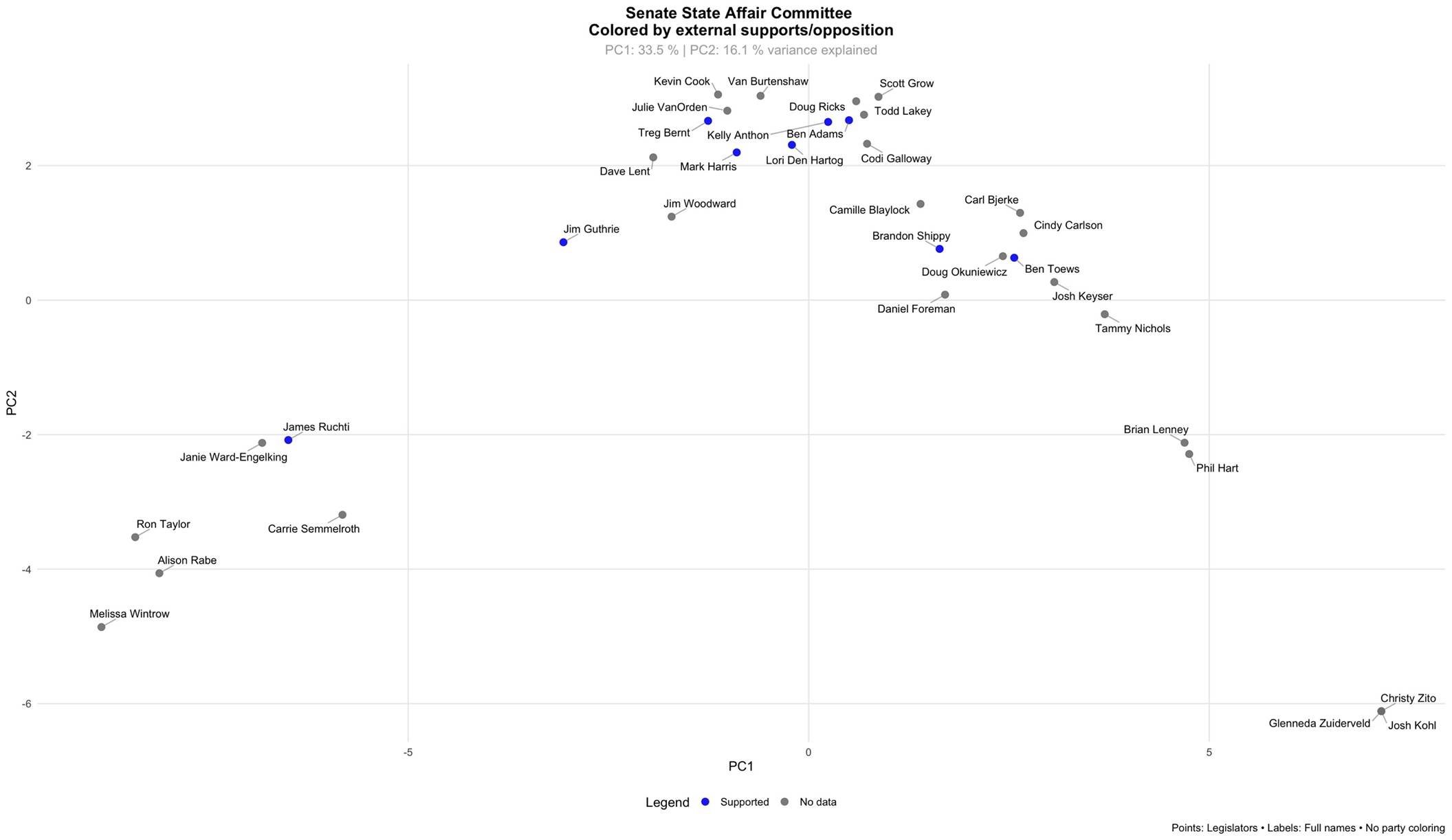
Blue is the membership: Loaded with GOPe/IACI types, not a single representative of the small government end of the spectrum, and the chair the most D-adjacent member of the Republican caucus. Personnel is policy.
Afterword
As mentioned last week, I am making some initial investigations into political contributions in Idaho. My first attempt suggested some interesting patterns, but data quality issues on the SOS Sunshine site make them not ready for prime time. (While the donation recipient identities are well-controlled, the donor identities are very much not, with organizations and individuals appearing in multiple versions, along with things like family members and controlled LLCs that act in concert. Some manual data cleaning will be necessary to make substantial progress.)
The Gem State Chronicle delivers daily analysis, op-eds, press releases, and Idaho Insider updates — free to your inbox.
Free newsletter · Unsubscribe anytime · View on Substack

About Tim Oren
Tim Oren retired to Idaho after a 30 year career in Silicon Valley. Here he gardens, home-brews, teaches kids to shoot, and has applied his well-aged statistics degree to subjects such as educational funding and results, Idaho legislative race targeting, and now legislators' voting patterns. He is a contributor to the Idaho Freedom Foundation and a number of Idaho candidates.