
By Todd Hoffman
To hear the media tell it, the 2026 midterm was a historic beating for President Trump. Republicans lost 48 seats in Congress and control of both chambers. Those are real losses, but were they as big as the headlines suggest? Past midterms can tell us.
First, we need to know what normal looks like. A good baseline tells us two things: what to expect, and how much results usually vary. The average seat change in past midterms tells us what to expect. The range, from the biggest gain to the biggest loss, shows how much results vary. The wider that range, the less any single result should be expected to land near the average. The same idea applies to other measures, like how often the president’s party loses control of Congress.
Comparing like with like
Comparing this midterm with past ones assumes they happened under similar conditions. But in a few ways, Trump’s second term is distinct.
Trump is only the second president to serve two non-consecutive terms. The first was Grover Cleveland, more than 130 years ago. Trump also won his second term against a late replacement. Joe Biden withdrew in July 2024, after the primaries were over, and Vice President Kamala Harris took his place. Other incumbents have stepped aside, including Harry Truman and Lyndon Johnson. But both did so while the primaries were still under way.
None of this rules out a comparison. It is a reminder that every midterm happens in its own setting.
Losing seats is the rule
Chart 1 shows 24 midterms from Franklin Roosevelt’s first, in 1934, to Trump’s second, in 2026. For each one, it shows the net seats the president’s party gained or lost in Congress. It also shows how the party’s share of all seats changed.
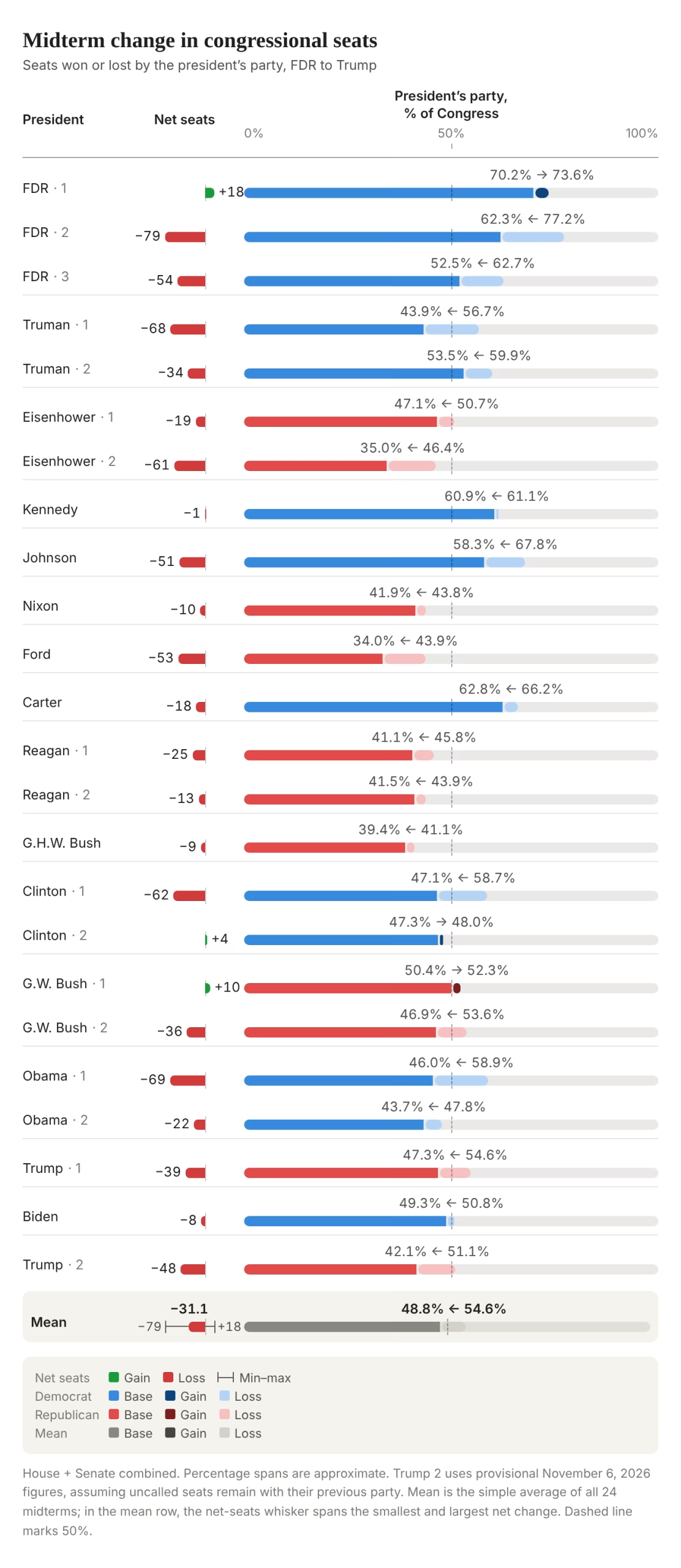
Only 3 of the 24 midterms brought gains for the president’s party: Roosevelt’s in 1934, Bill Clinton’s in 1998 and George W. Bush’s in 2002. Those gains were small. They averaged about 11 seats, and the largest was 18. Only one of them changed control of a chamber. In 2002, Bush’s Republicans won back the Senate.
Losses are far more common. The other 21 midterms brought net losses for the president’s party. They averaged about 37 seats, and the largest was 79.
Losing control of Congress is common too. In 10 of the 24 midterms, the president’s party lost at least one chamber.
Five of those midterms cost the party both chambers. That happened to Harry Truman’s Democrats in 1946, Dwight Eisenhower’s Republicans in 1954, Clinton’s Democrats in 1994, Bush’s Republicans in 2006 and Republicans again this year.
The other five cost the party one chamber. Three times it was the House: Barack Obama’s party in 2010, Trump’s in 2018 and Joe Biden’s in 2022. Twice it was the Senate: Ronald Reagan’s party in 1986 and Obama’s again in 2014.
The pattern has grown stronger over time. In the nine midterms since 1994, the president’s party lost at least one chamber seven times. Losing control used to be a notable event. In recent decades it has become the usual outcome.
How big was this year’s loss?
So this year’s loss fits the usual pattern. But how big was it, compared with the rest?
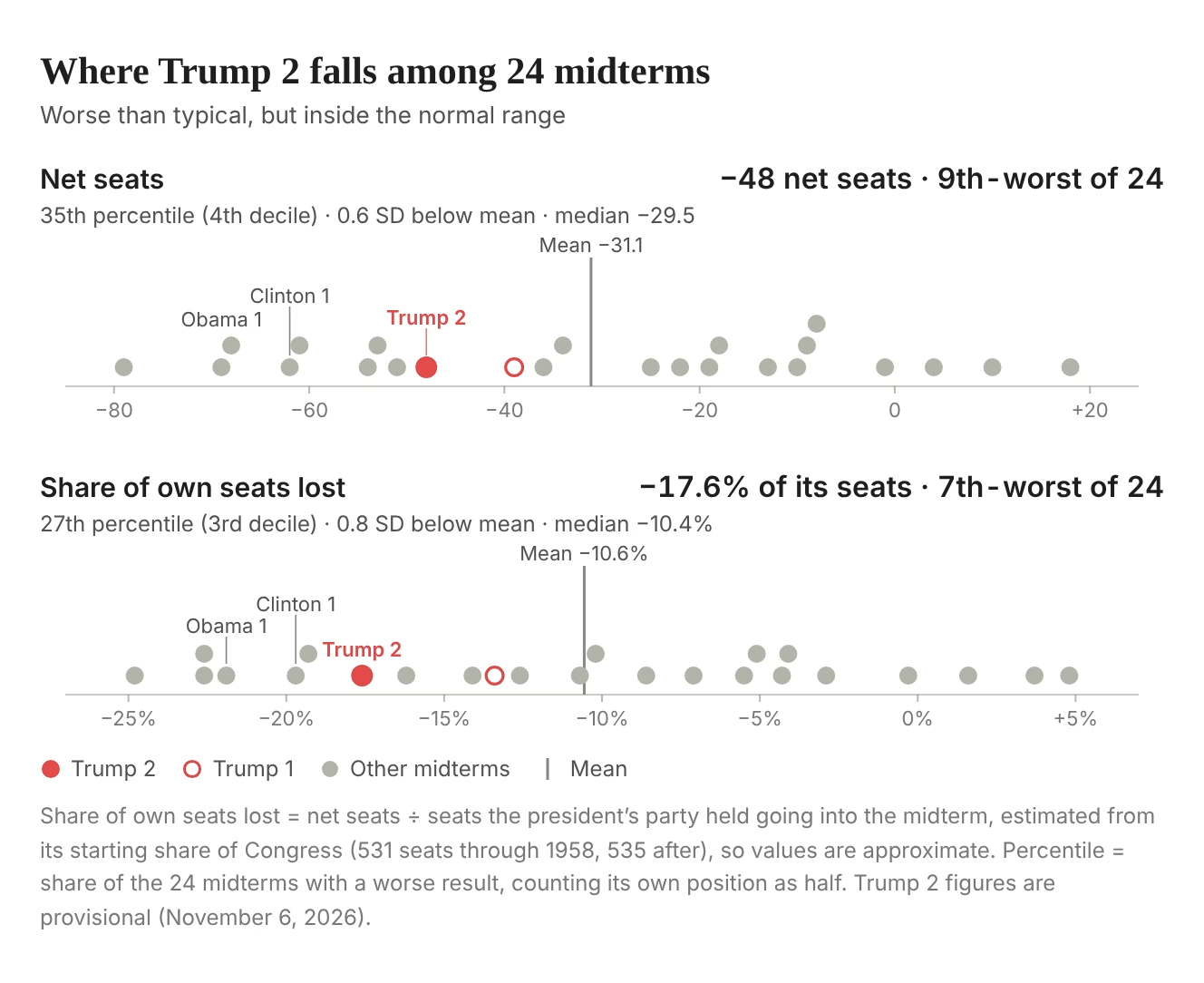
By net seats, Republicans lost 48. That ranks 9th-worst of the 24 midterms. The party’s share of Congress fell 9 points, from 51.1% to 42.1%. That also ranks 9th-worst.
A third measure looks a little worse. It asks how much of what the party held it lost. Republicans lost about 17.6% of the seats they held going in. That ranks 7th-worst of 24.
The results aren’t good, but they are well short of the worst. Clinton’s party lost 62 seats in 1994. Obama’s lost 69 in 2010. They also lost a bigger share of their own seats than Republicans did this year.
The bottom line
By any of these measures, 2026 was a bad midterm for the Republicans, but it was not a historic one. About a third of midterms since 1934 went worse. It was definitely not a bloodbath, but not quite business as usual either. Much of the media coverage has treated it as close to a catastrophe. Swap that hyperbole for evidence, and the call is more modest. It was a loss somewhat worse than expected, in a kind of election where losses are the norm.
A note on the data: Seat counts combine the House and Senate. This year’s figures are provisional as of November 6, 2026, and some races are still being counted. Uncalled seats are assumed to stay with the party that held them before. Final counts are unlikely to change which party controls Congress.
The Gem State Chronicle delivers daily analysis, op-eds, press releases, and Idaho Insider updates—free to your inbox.
Free newsletter · Unsubscribe anytime

About Todd Hoffman
Todd Hoffman is a data scientist specializing in user behavior, pricing and experimentation, with a strong foundation in machine learning and product strategy. He lives in Coeur d'Alene.