Following the 2024 legislative primaries, I wrote about dueling endorsements from Idaho Freedom PAC (IFPAC), which is associated with the Idaho Freedom Foundation (IFF), and the Idaho Prosperity Fund (IPF), which is associated with the Idaho Association of Commerce and Industry (IACI). Both organizations maintain legislative scorecards, and I’ve noted in the past that lawmaker scores are generally inversely correlated between the two. This makes them reasonable proxies for the two major sides in Idaho politics, notwithstanding the Democrats.
That inverse correlation has faded somewhat over the past two years, and we will discuss the implications later in this piece. Nevertheless, IFF and IACI still stand in the minds of many voters and political activists as representing opposite paths for Republican lawmakers in Idaho.
In September 2024, I noted that IFPAC punched well above its weight compared to IPF:
IACI-backed candidates won four upsets in which they defeated IFPAC-backed incumbents, while IFPAC candidates won ten such upsets. IFPAC candidates also won the only two open races in which both organizations made endorsements — Brandon Shippy defeated Scott Syme in district 9 while Lucas Cayler defeated Sarah Chaney in district 11.
That gives IFPAC a net advantage of +8 in races in which the incumbent either lost or did not run for reelection. IACI held 15 seats, while IFPAC held only 4, which is reflective of the fact that most of IACI’s endorsements went to incumbents while IFPAC supported more challengers. 25 of IACI’s endorsements in the head-to-head races I examined were for incumbents.
Both organizations have now begun issuing endorsements for the 2026 legislative primary, so I thought I would circle back and see how things have evolved over the past two years. As far as I can tell, IPF has made 63 endorsements thus far, excluding two for incumbents who are not running for reelection. Of those 63, 47 are for incumbents and 16 are for challengers.
IFPAC, on the other hand, has made only 25 endorsements, with just 9 for incumbents and 16 for challengers.
There is zero overlap between the two slates at this time.
Whereas IPF issues endorsements of its own accord, IFPAC states that “only those who returned completed surveys were considered eligible,” meaning candidates were required to opt in to receive endorsements. Following the factional divide that broke open in the summer of 2024, it is perhaps unsurprising that many conservative legislators declined to complete IFPAC surveys. As of this writing, not a single public member of the Idaho Freedom Caucus has been endorsed by IFPAC.
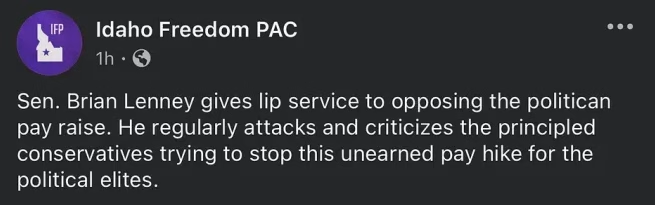
Recall that the operator of the IFPAC Twitter account went after Sen. Brian Lenney in a now-deleted post, despite having endorsed him in that year’s election. That surely drove some away—after all, once burned, twice shy.
Two of IPF’s endorsements are for members of the House who are giving up their seats to run for Senate: Rep. Lori McCann in District 6 and Rep. Soñia Galaviz in District 16. IFPAC has not made any endorsements in either race.
Since both IFF and IACI maintain legislative scorecards, I thought it would be interesting to see where endorsed incumbents land on these metrics. Of IFPAC’s nine endorsed incumbents, all but one are members of the Gang of 8 Caucus. The average IFF Freedom Index score among these nine is 95.6%, while the average Spending Index score is 96.3%. That makes sense.
Looking at challengers, the average Freedom Index score of the opponents of IFPAC-endorsed candidates is 54.6%, while the average Spending Index score is 20.4%. Again, this makes sense. IFPAC is clearly prioritizing incumbents who score highest on the Freedom and Spending Indices, while targeting those who score lowest.
Turning to IPF endorsements, the average IACI score for endorsed incumbents is 63, with a wide range—from Sens. Lori Den Hartog and Jim Woodward at 83 down to Rep. Joe Palmer at 37. Palmer is unopposed, in any case. IPF also endorsed Sens. Josh Keyser and Van Burtenshaw, who each scored 42, and Sen. Kelly Anthon at 46. Burtenshaw and Anthon are also unopposed, with the former chairing the Senate Resources & Environment Committee, while the latter is the president pro tempore. Keyser, meanwhile, is in a three-way race in District 20.
The average IACI score of incumbents facing IPF-endorsed challengers is 55.7, only slightly lower than the average for IPF-endorsed incumbents. These scores range from Sen. Dan Foreman, who is being challenged by Rep. McCann and scored just 33, to Sens. Josh Kohl and Glenneda Zuiderveld, who each scored 75. IPF nevertheless endorsed their respective challengers, Brent Reinke and Casey Swensen.
It seems that IACI/IPF is endorsing on something less substantial than their own scorecard this year. Perhaps this is a case where endorsements are more about who you dislike rather than who you like. The average Freedom Index score for incumbents with IPF-endorsed challengers is 90.2%. Flipping that calculation around, the average IACI score for incumbents with IFPAC-endorsed challengers is 65, which is ironically higher than the average score for IPF-endorsed incumbents.
IPF’s endorsement of Rep. Vito Barbieri is curious as well. He is a public member of the Idaho Freedom Caucus, is in a contested primary, and only scored 53 on IACI’s scorecard. However, like Rep. Palmer, who chairs House Transportation & Defense, Barbieri chairs a committee as well—Environment, Energy, & Technology. This suggests to me that at least some of IPF’s endorsements are about maintaining favor with movers and shakers in the Legislature.
I noted in 2024 that IACI vs IFPAC was Goliath vs David when it came to money, and this year is more of the same. As of this writing, IPF has raised $73,000 and has $318,000 cash on hand. IFPAC, on the other hand, has raised just under $4,600 this year and holds $7,500 cash on hand. It seems likely that IFPAC’s fundraising has been affected by the conservative factional strife of the past two years.
Both organizations could still roll out additional endorsements in the final month before the primary. There are some notable dogs that have not barked. For example, IPF has not endorsed legislators such as Democratic Sen. Janie Ward-Engelking, who scored 92 on the IACI scorecard, or Sen. Camille Blaylock, who scored 75 and has a primary opponent. IPF endorsed both in the 2024 election cycle. IFPAC, meanwhile, has not endorsed Rep. Dale Hawkins, who also faces a contested primary despite scoring 92.8%, after endorsing him in 2024. As mentioned above, IFPAC is only endorsing candidates who returned its questionnaire this year.
These endorsements seem to reflect differing motivations for engaging in the political process. IFPAC is backing those who score highly on IFF’s metrics, limited to candidates who returned its questionnaire. IPF, on the other hand, appears to be operating more on vibes—supporting legislative leaders despite low IACI scores while targeting conservatives who happen to score highly.
By my count, there are 22 contests in which IFPAC and IPF have endorsed opposing candidates. As with the last cycle, it will be interesting to see which organization gets more bang for its buck.
As always, I urge voters to do their own due diligence before casting their ballots. Talk with your candidates, study their records, and decide for yourself who best represents you in the Legislature.
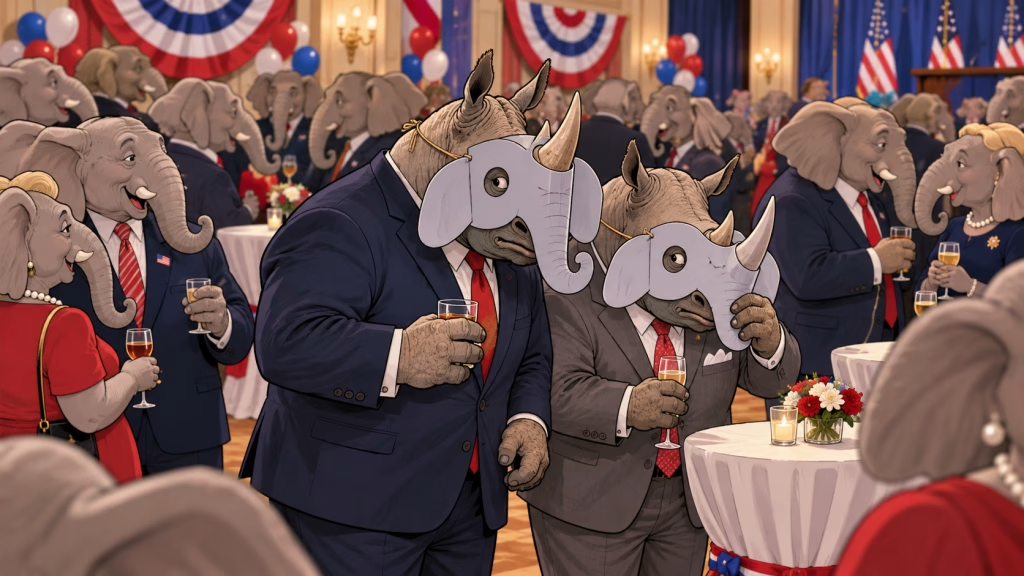
Feature image created with Microsoft CoPilot.
The Gem State Chronicle delivers daily analysis, op-eds, press releases, and Idaho Insider updates — free to your inbox.
Free newsletter · Unsubscribe anytime · View on Substack

About Brian Almon
Brian Almon is the Editor of the Gem State Chronicle. He also serves as Chairman of the District 14 Republican Party and is a trustee of the Eagle Public Library Board. He lives with his wife and six children in Eagle.