On Friday morning, the Idaho Supreme Court heard arguments regarding the Parental Choice Tax Credit, enacted by the Legislature last year through House Bill 93. A group of petitioners including the Idaho Education Association, the Moscow School District, Mormon Women for Ethical Government, and Rep. Stephanie Mickelsen asked the Court to declare the tax credit unconstitutional.
I’m not a lawyer or legal analyst, but my impression was that the petitioners’ lawyers started with a steep hill to climb—and it only got steeper as arguments continued. They tried to convince the Court that H93 violated the Idaho Constitution’s mandate that the Legislature “establish and maintain a general, uniform and thorough system of public, free common schools.”
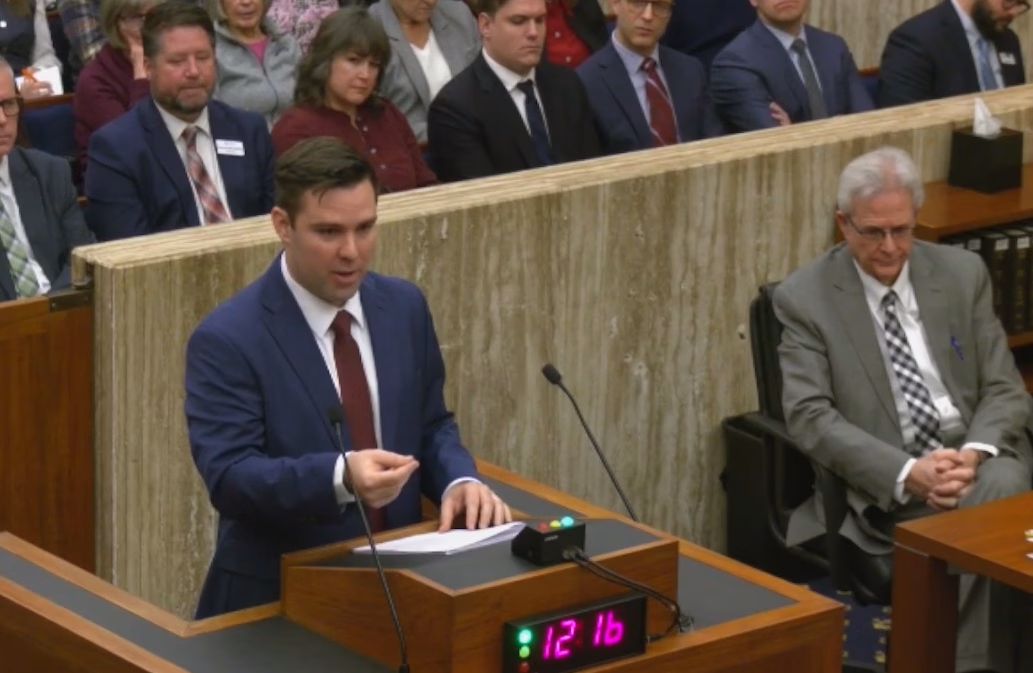
Several justices sounded skeptical, asking whether this requirement prohibited the Legislature from doing anything else. Attorney John Michael Zarian, arguing on behalf of the State of Idaho, pointed out that states have plenary power to act in any way not explicitly prohibited by the Constitution—unlike the federal government, which can only act according to powers enumerated in the U.S. Constitution.
Justices also appeared doubtful of the petitioners’ claims of standing to file suit. How, exactly, were they harmed? Justice Gregory Moeller asked attorney Marvin Smith which petitioner made the strongest case: “If you could only go with one, who would you go with?” Smith was unable to answer, instead saying that the organizations and individuals were “who have suffered discrimination” because of the tax credit.
The defense wasn’t let off the hook, however. Attorney Jeremy Chou, representing the Legislature as a co-respondent, was asked whether taking two donuts after being given permission to take “a donut” constituted a violation of the mandate. Chou explained that it depends on context—in the case of the Idaho Constitution, it does not limit the Legislature to “only” the system of free public schools.
Justices also asked about the definition of a “system”: does allowing parents to claim tax credits for private schools or other educational expenses constitute a “system”? By that logic, do food stamps establish a “system” of grocery stores?
Overall, my impression was that the justices were extremely skeptical of the petitioners’ arguments. They seemed ready not only to dismiss the claim that the tax credit violated the Constitution’s mandate to provide free public schools but also to reject the entire premise of the case—that people have been harmed by the program.
Matt Edwards and I talked extensively about the arguments on today’s episode of Idaho Signal:
Chris Cargill, president of Mountain States Policy Center and a longtime advocate for this tax credit, shared his initial thoughts this morning:
Mountain States Policy Center was in the courtroom as petitioners and the state made their case. While courts rarely tip their hand definitively during oral argument, the justices’ questioning often reveals what they are struggling with—and in this hearing, the struggle was plainly on the petitioners’ side of the ledger.
Over and over, justices pressed on two major problems: whether petitioners even have standing to bring the case at all, and whether Idaho’s Constitution truly can be read to prohibit the state from supporting an education policy outside the public school system.
Everything I heard this morning suggests that the Court will uphold the Parental Choice Tax Credit. Cargill notes that they could do so in two ways—either dismiss the case for lack of standing or rule against the petitioners on the merits. The best-case scenario for school choice supporters, in my view, would be for all but one petitioner to be dismissed for lack of standing, and then the case rejected on the merits.
I also expect a fairly quick turnaround. Thousands of families have already applied and need certainty about what to expect. I don’t foresee the Court pulling the rug out from under them, but we will have to wait and see. In the meantime, I’ll be monitoring the opinions page on the Idaho Supreme Court website.
It’s time to answer the core question: does our Constitution allow the Legislature to give parents and families more opportunity to choose the best form of education for their children, or does the public education establishment hold ultimate authority, now and forever?
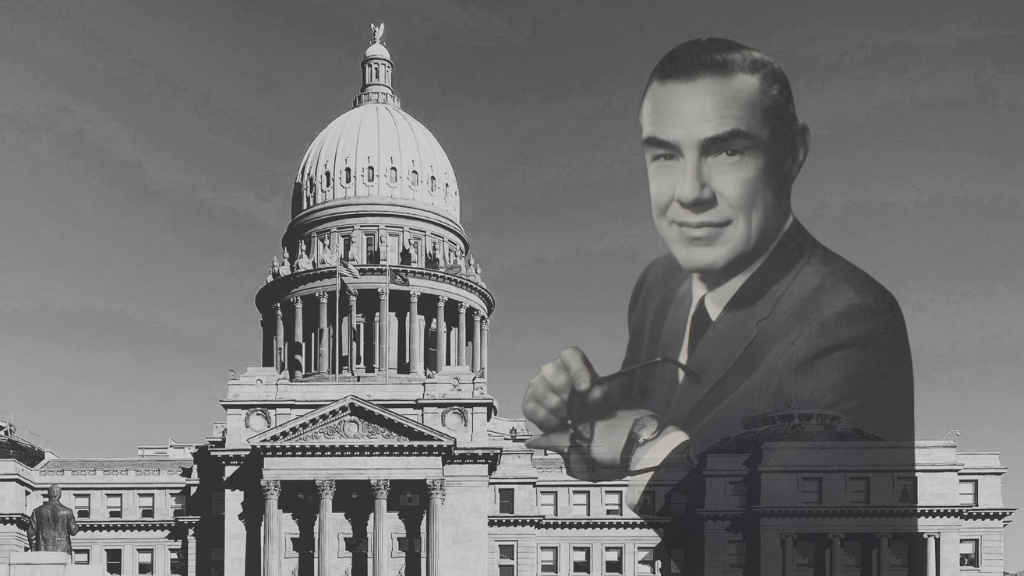
Feature image from Idaho Public TV’s Supreme Court stream.
Gem State Chronicle is a reader-supported publication. To receive new posts and support my work, consider becoming a free or paid subscriber.
The Gem State Chronicle delivers daily analysis, op-eds, press releases, and Idaho Insider updates — free to your inbox.
Free newsletter · Unsubscribe anytime · View on Substack

About Brian Almon
Brian Almon is the Editor of the Gem State Chronicle. He also serves as Chairman of the District 14 Republican Party and is a trustee of the Eagle Public Library Board. He lives with his wife and six children in Eagle.