With perhaps less than a week to go in the 2026 legislative session, a large number of important conservative bills that passed the House remain pending in Senate committees. The Gem State Brief’s bill tracker now has additional dropdown filters, which show that as of Tuesday morning, 21 bills that already passed the House remain ensconced in Chairman Jim Guthrie’s drawer in Senate State Affairs.
That is more than twice the number of House-passed bills pending in any other Senate committee.
Some of the bills Guthrie has declined to schedule a hearing for include:
- H557, preventing cities from enacting policies regarding discrimination by sexual orientation or gender identity.
- H607, creating a private cause of action when establishments allow men to use the women’s restroom.
- H700, holding employers accountable for knowingly hiring illegal aliens.
- H704, requiring Idaho employers to use the federal E-Verify system to ensure new hires are legally allowed to work in the country.
- H720, requiring cities with populations greater than 25,000 to divide into council districts.
Our republican system of government was not designed so that one man could unilaterally veto legislation that already passed the House with 40, 45, 50, or even 55 votes. Yet here we are.
Both the rules of the Senate and Mason’s Manual of Legislative Procedure allow for parliamentary procedures that could bypass a committee chairman, but too few senators are willing to challenge leadership. Earlier in March, Sen. Christy Zito attempted to call House Bill 745 from committee, where Chairman Dan Foreman was refusing to schedule a hearing. Foreman moved to excuse the committee from reporting the bill, a parliamentary procedure designed to block the attempt to bypass the committee. That motion received the required two-thirds majority, with only nine senators voting against it.
Had just three more senators been willing to buck the system, H745 could have been debated on the Senate floor.
Members of any committee can, under Mason’s, move to consider a bill that the chairman did not place on the agenda. Again, however, too few are willing to upset the apple cart. Leadership tends to frown on such actions and has historically been willing to punish those who step out of line. Anyone who hopes to hold a future committee chairmanship knows they must play by the (unwritten) rules.
I recently spoke with a legislator who believes they were denied even a vice-chairmanship simply because they challenged leadership on a procedural vote several years ago.
Of course, the buck stops with President Pro Tempore Kelly Anthon. He not only has the power to appoint and remove committee chairs, but he also decides where to send bills. H700 and H704 came from the House Business Committee, but Anthon routed them to Senate State Affairs instead of the Senate equivalent. He defended the decision in multiple interactions on X over the past few weeks, arguing that he was following longstanding Senate procedures by sending immigration bills to State Affairs.
That might well be true. It seems reasonable, then, to ask the question posed by Anton Chigurh in No Country for Old Men: “If the rule you followed brought you to this, of what use was the rule?”
The purpose of a system is what it does. It’s fair to ask what is the point of Senate rules, procedures, and traditions if the result is one man disregarding the will of a majority of the House—and potentially a majority of the Senate as well.
It raises another question: what is the point of having a Senate at all?
The Idaho Legislature was modeled after the United States Congress, a bicameral legislature with an upper and lower chamber. At the national level, the upper chamber—the Senate—was originally designed to represent the sovereign states in the federal government. State legislatures appointed two senators for each state and had the authority to recall them at any time.
While passing a bill required consent of both chambers, the two bodies had very different day-to-day focuses. The Senate ratified treaties and confirmed presidential appointments, giving states enormous influence over the executive and judicial branches, as well as foreign policy.
The lower chamber—the House—was always meant to have a populist flavor. Membership was apportioned according to population, so the House would always represent the people. It was responsible for drafting all bills related to taxation, reflecting the principle of no taxation without representation.
Idaho’s Legislature was structured similarly, with the upper chamber representing counties and the lower chamber representing the people. The Senate also confirms gubernatorial appointments, while the House is responsible for taxation bills.
However, things have changed since 1890. The 17th Amendment, ratified in 1913, removed the power of state legislatures to appoint senators, curtailing the states’ influence in federal government. In 1964, the Supreme Court ruled that state legislatures must be apportioned by population, not geography, shifting Senate representation from counties to districts.
Today, both the House and the Senate represent the same 35 districts, with two representatives and one senator per district. Yet my impression, after following Idaho politics for some time, is that Senate members still see themselves as distinct from their House colleagues. If the House is the engine of populism, the Senate is the brakes.
And brakes indeed! As of Tuesday morning, the Senate had 49 bills on its third reading calendar, another 30 on second reading, plus 10 gubernatorial appointments and 11 resolutions. Compare this to the House, which had four bills on third reading, 16 on second, and four resolutions.
I can definitely see the wisdom in a chamber that slows the process. Laws passed during populist waves often have unintended consequences. Conservatism values traditions and prefers they not be discarded lightly.
However, when reform is necessary, that same intransigence can be a detriment. When conservative lawmakers are working to dismantle the regulatory and administrative overreach that is strangling our society like kudzu, the Senate’s inability to move quickly allows government to continue operating where it does not belong. With nearly half of President Trump’s final term behind us, time is of the essence with regard to addressing illegal immigration, and hiding behind Senate procedure to avoid some uncomfortable votes is not principled leadership.
The ultimate question, then, is why have a Senate at all? The natural laws of the universe do not require a bicameral legislature. Nebraska voters adopted a unicameral legislature in 1934, and the state operates just fine. Nebraska also gives members the authority to elect committee chairs, rather than relying on seniority or the discretion of leadership.
Idaho would surely function just as well with a unicameral legislature. A single body could handle legislation, administrative rules, and gubernatorial appointments, and would likely get more done in the short three-month session than the current system, where each chamber duplicates work.
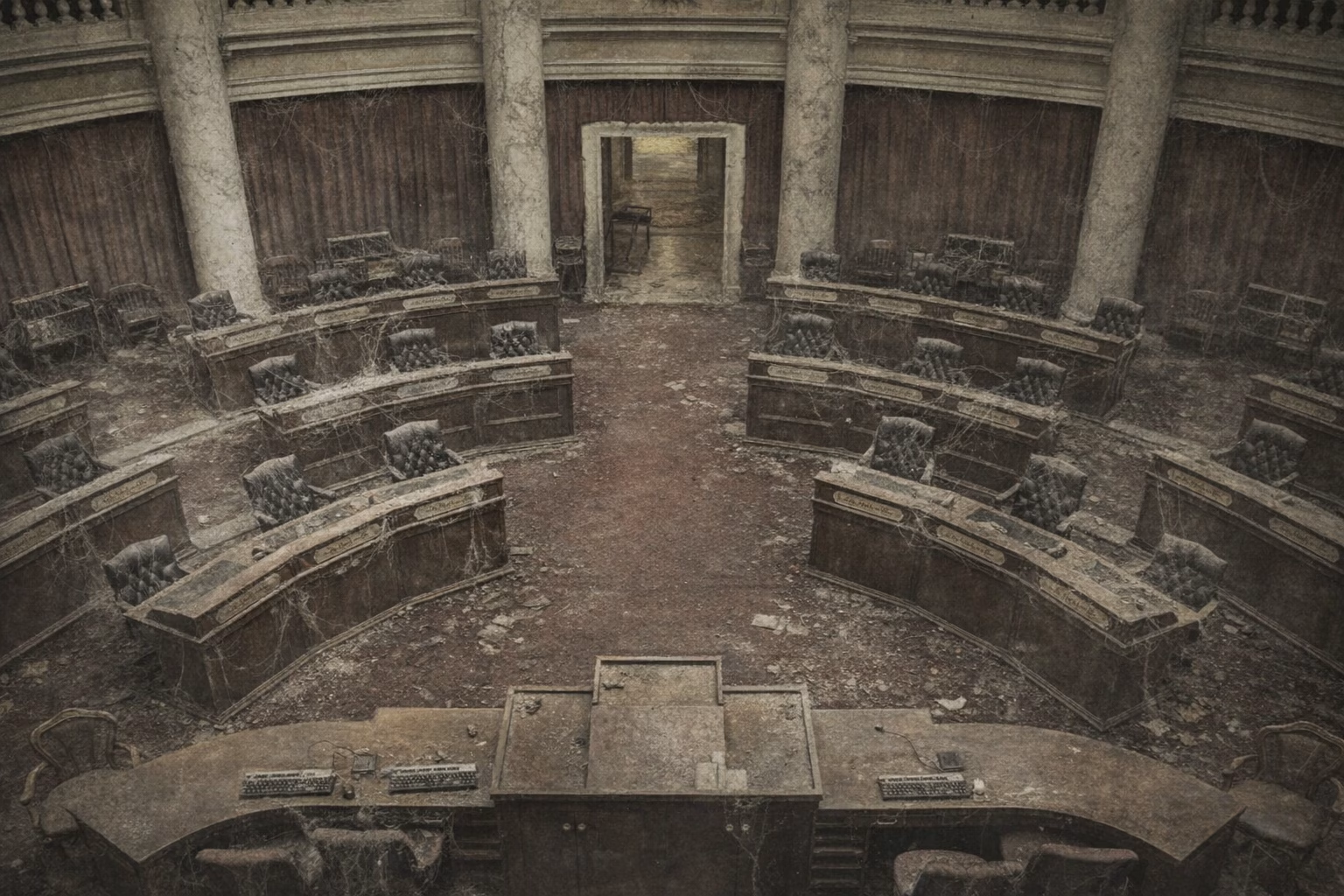
We wouldn’t necessarily have to lose one third of our Legislature—why not just fold the House and the Senate into a single 105-member unicameral body? The chambers might need some remodeling—perhaps we could add a few more desks to the House side, while turning the Senate side into a museum highlighting all the great bills that died on that side of the rotunda.
Sen. Guthrie, rather than abusing his power over the committee agenda—and then having the chutzpah to propose a rule limiting legislative drafts per member—might support abolishing the Senate entirely, so he wouldn’t have to worry about the problem at all.
This is, of course, a modest proposal. There are many reasons not to discard tradition too quickly, and perhaps it’s best not to go that far. In that case, why not make smaller changes, such as requiring that all bills that pass one chamber be guaranteed a committee hearing in the other?
Or why not allow legislators to use the rules already available to them? If leadership quashes any attempt to use Senate Rule 14(e) to retrieve bills from committee chairs’ drawers, why have the rule at all? It should be abolished if it is never allowed to be used.
Likewise, why rely on Mason’s if no one is willing to invoke its provisions to move legislation past recalcitrant chairmen? At that point, you might as well throw the book in the trash and simply do whatever leadership says.
There is plenty of room for reform here. Legislators are not our leaders; they are public servants—our representatives in the lawmaking process. The Capitol is not a palace for an untouchable elite; it is the people’s house, a monument to republican government.
Something has to give, but maybe we can start small. Perhaps the first step is for voters in District 28 to abolish Sen. Guthrie instead.
Feature image created with Microsoft Copilot.
Gem State Chronicle is a reader-supported publication. To receive new posts and support my work, consider becoming a free or paid subscriber.

About Brian Almon
Brian Almon is the Editor of the Gem State Chronicle. He also serves as Chairman of the District 14 Republican Party and is a trustee of the Eagle Public Library Board. He lives with his wife and five children in Eagle.