This year, the Legislature appropriated $3,111,556,200 for public school support. That’s three billion, with a “B”. Of that, $2,754,658,600, or 88.5%, came from the state’s general fund—that is, directly from Idaho taxpayers.
How that money is distributed to schools and districts depends on a rather complex mathematical formula based primarily on student attendance. Click here for the details. To make a very long story short, the more students who attend a school, the more funding that school receives. Grade level and special education needs also factor into the formula.
Using data from the legislative budget dashboard along with long-term enrollment numbers, I put together the following graph showing the increase in appropriations compared to the K-12 public school population. As you can see, appropriations have grown steadily, even as enrollment has leveled off:
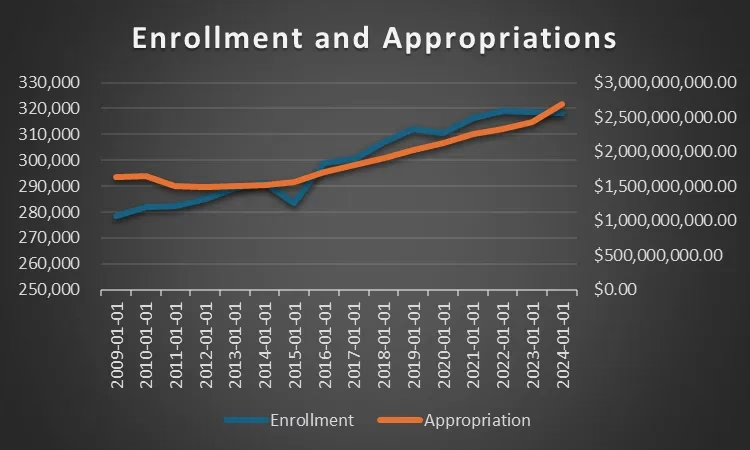
What stands out to me is the more recent drop-off in enrollment. There was a slight dip in 2020, from 311,991 students in 2019 to 310,653, which makes sense, as many families sought alternatives when schools closed during the COVID-19 lockdowns. Enrollment then spiked in 2021, rising to 316,159. It peaked at 318,979 in 2022 before declining slightly over the following two years.
I compared these enrollment numbers to Idaho’s population growth over the same period, and longer. What do you notice?
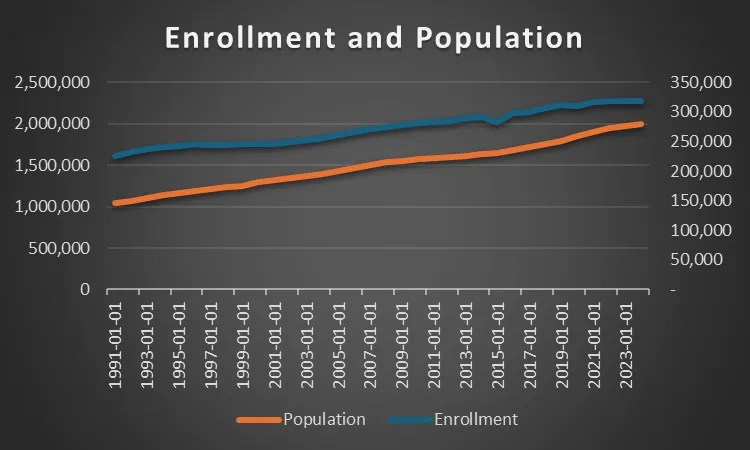
Your eyes are not deceiving you. Enrollment is growing much more slowly than population. I examined both figures going back to 1991 and found that the percentage of Idaho’s population enrolled in K-12 public schools has steadily declined—from 21.72% in 1991 to just 15.89% in 2024.
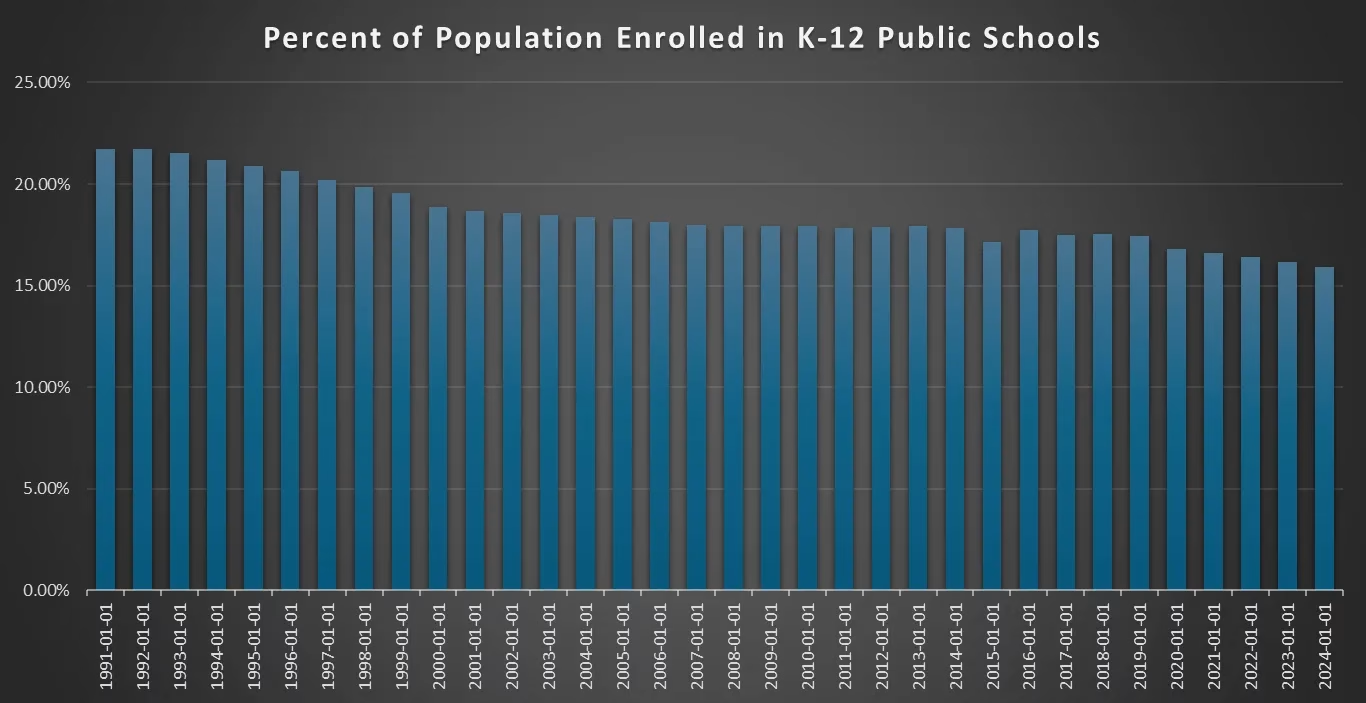
This paradigm has significant implications for budgeting and public policy in Idaho. Despite continual historic and unprecedented investments in public education, K-12 enrollment is not only shrinking as a share of the population but is now declining in raw numbers. Because the funding formula is based on enrollment, this means the cost per student can only increase. It costs a certain amount to run a district office, maintain buildings, and pay teachers and support staff regardless of how many students are enrolled. Inflation has made all of this more expensive as well.
This helps explain why the public school establishment is reacting so aggressively to the idea of money following the student. It is why the Moscow School District, the Idaho Education Association, and Rep. Stephanie Mickelsen filed a lawsuit against Idaho families this year seeking to block the Parental Choice Tax Credit. Despite the fact that the program does not take a dime from public schools—the $50 million involved is a new appropriation, weighed against more than $3 billion in public education funding—they fear that parents will appreciate the flexibility, disenroll from public schools, and accelerate an enrollment decline that is already underway.
It is a truism that those invested in a system will fight to preserve it, no matter its weaknesses. As the adage goes, “the purpose of a system is what it does.” If the public school system is failing to educate students—remember that only about one-third of Idaho’s 4th- and 8th-graders are proficient in reading and math—but is nevertheless providing comfortable livelihoods for thousands of teachers and administrators, then those who currently benefit will naturally resist change.
The public school establishment views any alternative as a threat. It fought charter schools when they were first proposed, and it is now fighting systems in which money follows the student. It can tolerate private schools and homeschooling in small numbers, especially when the barriers to leaving the public system are high. School choice lowers those barriers—or removes them entirely—and that reality terrifies the beneficiaries of the current system.
It boggles my mind that Republicans who otherwise champion free markets over government control and central planning suddenly turn into Vladimir Lenin when it comes to public schools. We would never tolerate government-run grocery stores, auto dealerships, or internet service providers, yet many Republicans—even self-described conservatives—defend government-run schools as untouchable.
I believe there is a place for a public school system. Indeed, like it or not, the Idaho Constitution mandates one, and there is no realistic scenario in which a majority of voters repeal that requirement. We therefore have an obligation to make the system as good as possible. Most of our future citizens—and many future elected officials—will attend public schools. If we want Idaho to remain great, we need great public schools.
One of the best ways to encourage excellence is through robust competition. Today, the public education establishment assumes that most school-aged children will attend public schools and that funding will follow automatically. Imagine instead a system in which parents had real, equal choices—where public schools, private schools, charter schools, co-ops, and other models competed on an even playing field. Public schools would no longer be the default but one option among many. Parents would choose them because they believe they are the best fit for their children, not because they are the path of least resistance.
Getting there requires public schools to improve themselves rather than simply asking for more money year after year. It means thinking outside the box and breaking the stranglehold of teachers’ unions and curriculum publishers over what teachers are allowed to teach. Remember how opponents of phonics fought for years against a method proven to teach children to read. Entrenched systems rarely reform themselves.
As I continued researching the science of reading, I came across a 2022 TIME magazine article describing the struggle to implement phonics in Oakland, California. The article explains that teachers resisted phonics because they associated it with a white, colonialist, patriarchal system of oppression:
As a teacher in Oakland, Calif., Kareem Weaver helped struggling fourth- and fifth-grade kids learn to read by using a very structured, phonics-based reading curriculum called Open Court. It worked for the students, but not so much for the teachers. “For seven years in a row, Oakland was the fastest-gaining urban district in California for reading,” recalls Weaver. “And we hated it.”
The teachers felt like curriculum robots—and pushed back. “This seems dehumanizing, this is colonizing, this is the man telling us what to do,” says Weaver, describing their response to the approach. “So we fought tooth and nail as a teacher group to throw that out.” It was replaced in 2015 by a curriculum that emphasized rich literary experiences. “Those who wanted to fight for social justice, they figured that this new progressive way of teaching reading was the way,” he says.
The field of education has become deeply politicized over the past half century. This is not to say that all public school teachers are liberals or communists, but the system in which they work is heavily skewed in that direction. Teacher-training programs at many universities are steeped in left-wing ideology, and teachers’ unions function as arms of the Democratic Party. Conservative teachers often feel compelled to keep their heads down—or gradually absorb the dominant ideology.
Ideology is the second major reason parents are pulling their children from public schools. Many conservative Christian families increasingly recognize that sending their children to be ideologically shaped eight hours a day, 180 days a year, is unwise. As the late Voddie Baucham put it, “We cannot continue to send our children to Caesar for their education and be surprised when they come home as Romans.”
Rather than acknowledging these concerns, the public school establishment has doubled down. During the COVID-19 lockdowns, as remote learning exposed classroom content to parents, the Biden administration labeled concerned parents “domestic terrorists” for daring to speak at school board meetings. Teachers’ union leaders openly opposed Christianity and conservatism while funneling millions of dollars to Democratic candidates.
Enrollment is declining, which means funding could eventually decline as well. Yet the current system depends on ever-increasing appropriations. These two realities are on a collision course, and meaningful reform is needed before they collide. The Parental Choice Tax Credit—allowing up to $5,000 per student to be reimbursed directly to families—offers a more flexible, durable, and future-proof approach than continuing to pour money into an increasingly rigid system.
The modern, government-run public school system emerged during the Industrial Revolution as a response to a rapidly urbanizing society. It may have served its purpose for a time, but in the 21st century—when technology allows education to be tailored to individual students—it is time to broaden our horizons.
Gem State Chronicle is a reader-supported publication. To receive new posts and support my work, consider becoming a free or paid subscriber.

About Brian Almon
Brian Almon is the Editor of the Gem State Chronicle. He also serves as Chairman of the District 14 Republican Party and is a trustee of the Eagle Public Library Board. He lives with his wife and five children in Eagle.