You’ve been there before. You’re reading a newsletter from a political figure and you notice something… uncanny. Something about the word choice, the rhythm, the style—you can’t quite put your finger on it, but something sounds off, like the written equivalent of Auto-Tune in popular music. You load up Pangram, one of the leading AI detection tools, and it confirms your suspicion: the newsletter was almost entirely written by an artificial intelligence large language model.
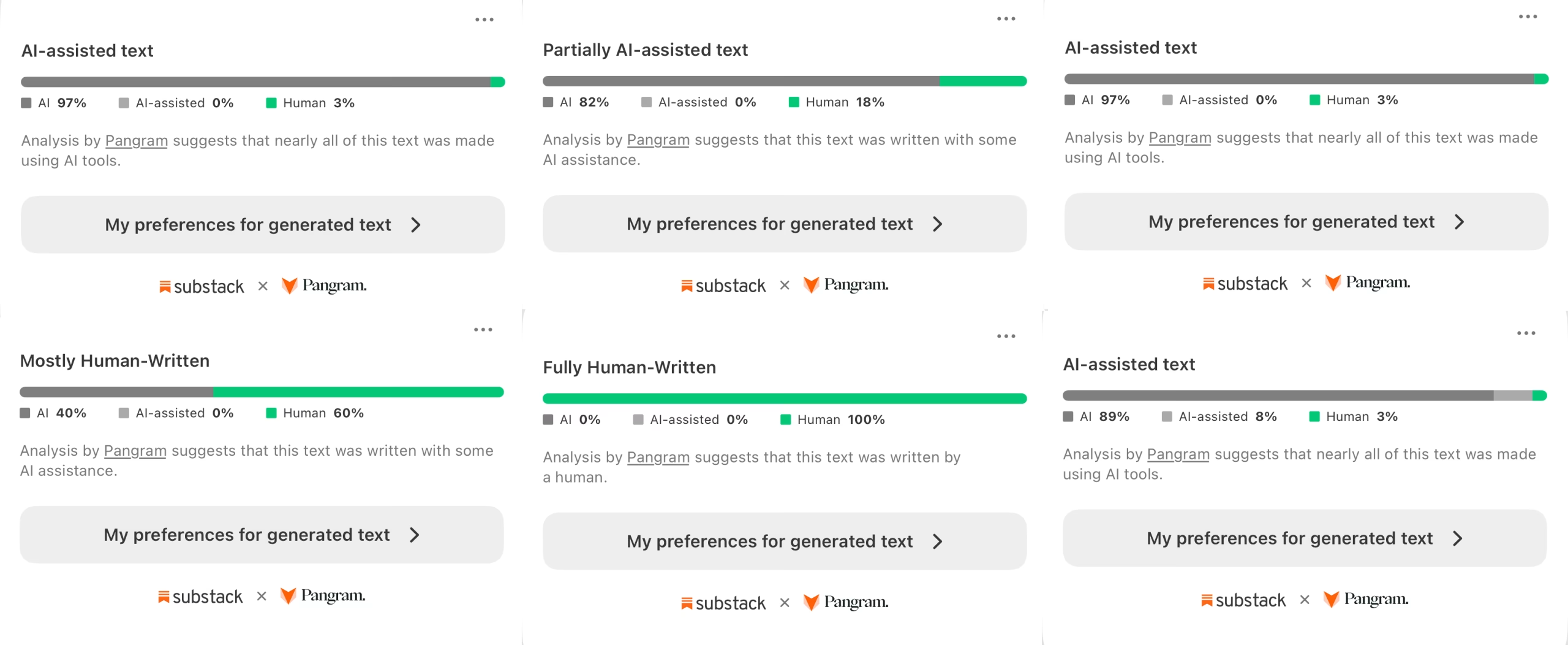
Checking is really easy: the Substack mobile app has Pangram built in, so unless the author has deliberately disabled it, you can click the three dots in the upper right corner and choose “Scan for AI text.” I took a sampling of newsletters from six Idaho legislators over the past two weeks and found varied results:
While early versions of Pangram and other AI detectors gained a reputation for false positives, the current version is pretty accurate. Despite the irony of using AI to detect AI, it makes sense. It works by analyzing statistical patterns in text, examining vocabulary, sentence structure, and language use. Just as a casino boss can catch a player counting cards by counting cards himself and predicting the next move, AI detectors can pick up patterns in language that demonstrate a strong likelihood that an LLM generated the text.
I ran an experiment recently in which I took a draft article written without any AI assistance and ran it through Pangram. It came back as 100% human-written. I then ran that article through ChatGPT for light edits—checking grammar, fixing typos, and occasionally smoothing out awkward phrases—which is part of my normal process. Once again, it came back as 100% human-written. I then asked ChatGPT to substantially rewrite the draft, and it came back as 58% AI-written. Finally, I gave ChatGPT a list of bullet points and asked it to write an article based on those points. This time, it came back as 100% AI-written.
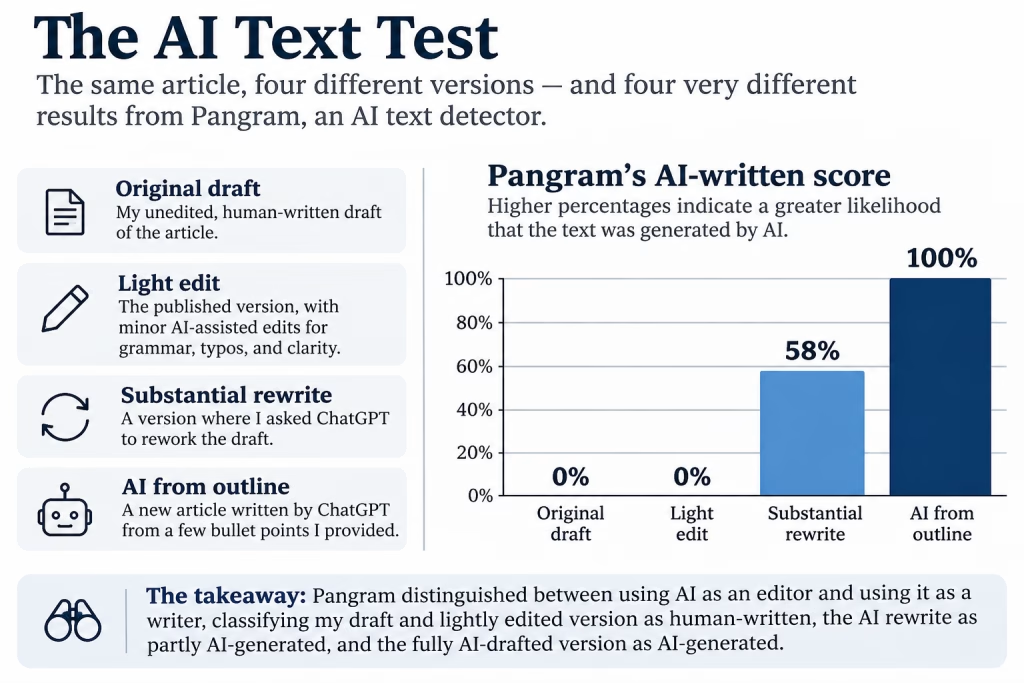
ChatGPT put this graphic together for me, which should prove that I’m not against using AI. It has become an amazing and indispensable tool that has greatly expanded my abilities as a writer and creator. AI can build graphs and graphics, quickly analyze data, assist with research and tracking down sources, build complex webpages and applications, and do in mere seconds what once took human beings hours. I’m in the process of turning Idaho Insider into a fully fledged database that will enable all sorts of useful tools to be built on top of it, and I couldn’t have done it without Claude and ChatGPT.
However, we have to be careful not to let this useful tool become a crutch.
Last month, Ryan Suppe at Idaho Ed News wrote about how Idaho politicians are increasingly using AI to write press releases and newsletters. While my examples above came from legislators, Suppe examined content mostly published by executive branch offices:
Gov. Brad Little’s office this year published three op-eds that included AI-generated content, according to Pangram and GPTZero, two different commercial AI detectors. Attorney General Raúl Labrador’s office also published three, and State Superintendent of Public Instruction Debbie Critchfield’s office had two.
None disclosed that they used artificial intelligence.
The detectors flagged several other elected leaders, too. But many didn’t answer requests from EdNews to discuss their use of AI. Writing from Rep. Mike Simpson, Lt. Gov. Scott Bedke, Secretary of State Phil McGrane, state Rep. Josh Tanner and state Sen. Brian Lenney triggered the detectors.
Those who did talk to EdNews cast doubt on the reliability of AI detectors. Critchfield’s spokeswoman denied using AI at all. Spokespeople for Little and Labrador conceded that they use AI tools but not to the extent that the detectors suggested.
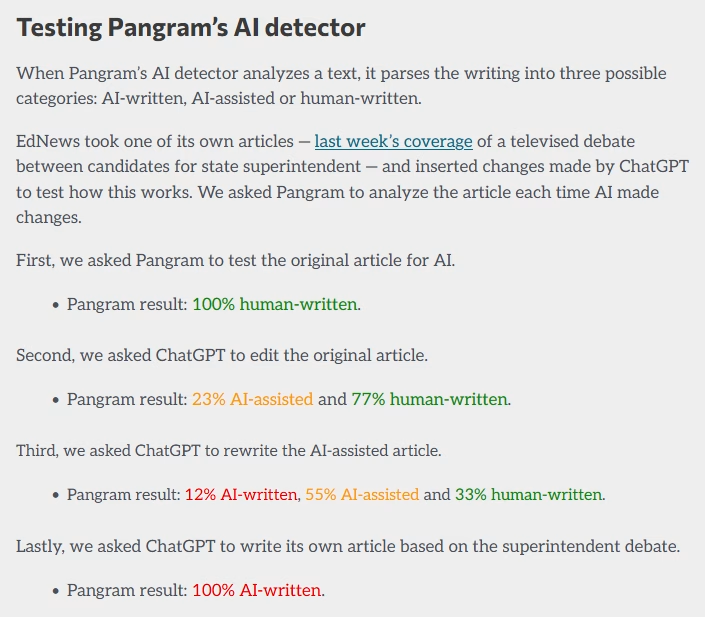
Suppe noted, ironically, that Idaho Democratic Party chairwoman Lauren Necochea’s recent newsletter arguing against data center tax breaks was written with AI assistance. He and his colleagues conducted the same experiment I did, running various versions of an article through AI and then checking them with Pangram:
It’s not just politicians who are turning to AI for assistance with writing. I noted in a recent article about layoffs at the Idaho Statesman that the newspaper had begun creating AI-generated summaries of articles, presumably to serve readers who couldn’t be bothered to read more than a few sentences. AI usage was a major part of a dispute between unionized Statesman employees and management at McClatchy, which owns the newspaper. That dispute came to a head last spring when employees went on a one-day strike. They subsequently signed a contract in which McClatchy promised not to use AI to replace employees or force reporters to use AI tools against their will.
Then the layoffs happened.
If corporate media is tempted by the siren song of AI, independent media is even more so. Last summer, Greg Pruett sold the Idaho Dispatch to Rep. David Leavitt, whose term in the Idaho House of Representatives concludes at the end of this month. Last week, the Dispatch published an article examining the resources used by data centers, the tax breaks our government gives tech companies to build here, and what happens to our state if the AI bubble should burst.
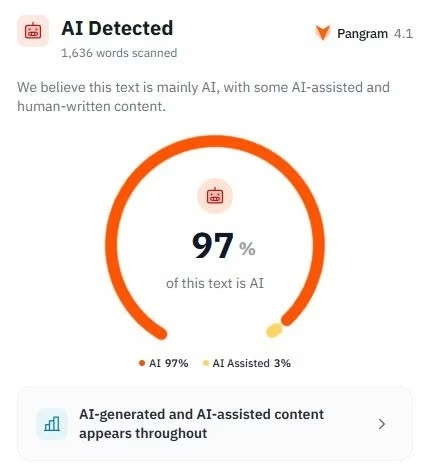
When I read the article, I was pretty sure it was AI-generated, so I ran it through Pangram, which concluded that 97% of the article was AI-written, while the remaining 3% was written with AI assistance.
Ironic.
In an exchange on Facebook, the Dispatch editor defended the platform’s use of AI:
AI is a tool, just like countless other technologies used in journalism. What matters is the accuracy of the information, the research behind it, and the accountability of those publishing it.
I have several concerns about substituting AI-generated text for human writing, the biggest being how it creates separation between the ostensible author and his ostensible work. When AI is doing your writing for you, you lose the ability to feel the flow of the article, to see it through the eyes of your readers, and to connect with it on both emotional and intellectual levels. Writing is just as much art as it is science, perhaps even more so. I’ve long felt that writing was less about simply dumping information onto the page and more like painting or sculpting. A writer chooses each word with care, building something that is aesthetically pleasing and structurally coherent, like a sculptor adding and chipping away until what once was bare rock now resembles the vision he had in his mind from the start.
The Dispatch article linked above is 1,600 words of numbers, statistics, and legal citations—it’s a dry read, for sure. But it’s hard to tell when you’re not the one writing it. At this point, readers are apt to simply paste the URL into their own AI chatbot and ask for a summary, which defeats the entire purpose of writing the article to begin with.
Cartoonist Tom Fishburne summed up this paradigm with an insightful cartoon about how AI can create long emails based on bullet points for one employee, then summarize them on the other end for another. Pretty soon, the internet is just going to be AI-generated text being passed back and forth while human beings only read the CliffsNotes.
This is just the beginning of how artificial intelligence is changing the way we live, including how government works. I’m going to follow my own advice and end this article here, but I’ll be back soon with a second article examining how AI is used in drafting legislation, analyzing legal documents, and supporting education, as well as how government offices are attempting to put guardrails around its use.
Feature image created with ChatGPT, which will never replace true artists either, but is sufficient for simple things like this.
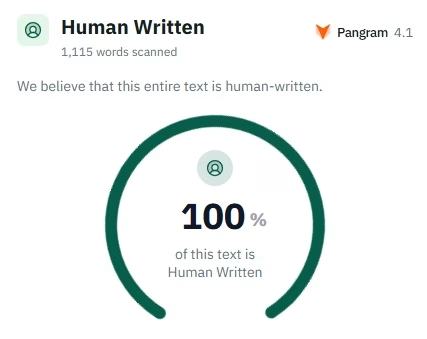
PS: I ran this article’s text (minus the quote from Ryan Suppe) through Pangram after writing and editing. You can rest assured that, despite using AI as a tool, the editor of the Gem State Chronicle does not use it as a crutch.
The Gem State Chronicle delivers daily analysis, op-eds, press releases, and Idaho Insider updates—free to your inbox.
Free newsletter · Unsubscribe anytime

About Brian Almon
Brian Almon is the Editor of the Gem State Chronicle. He also serves as Chairman of the District 14 Republican Party and is a trustee of the Eagle Public Library Board. He lives with his wife and six children in Eagle.