On Thursday, the Too Extreme For Idaho PAC, which is behind the Stop Prop 1 campaign, issued a press release alleging that the Idaho Democratic Party was colluding with Idahoans United for Women and Families, the organization behind Proposition 1, to buy airtime at cheaper rates by funneling money through the party and Terri Pickens’ campaign for governor:
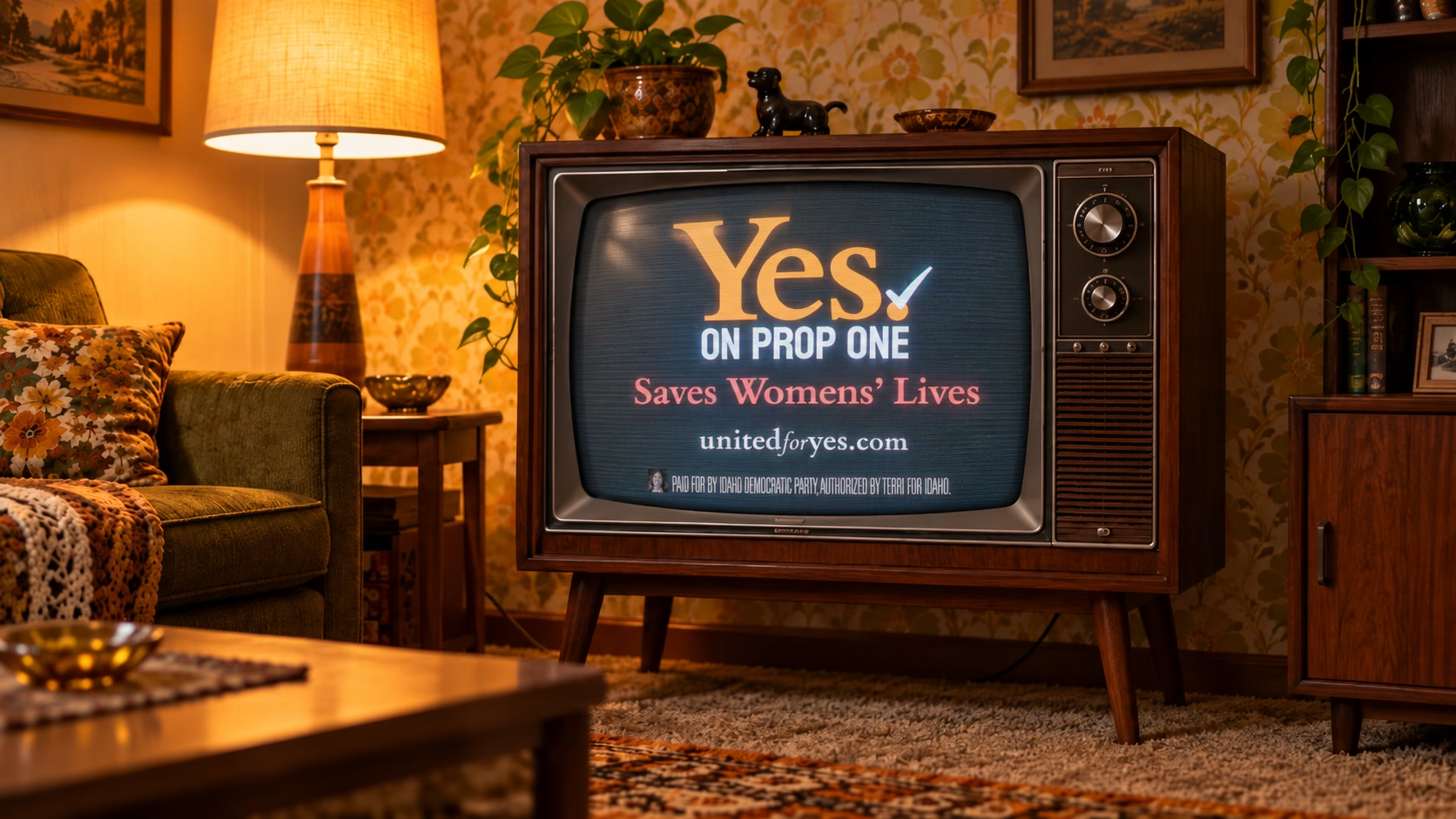
The ad carries the disclaimer that it’s paid for by Idaho Democrats and authorized by Democratic gubernatorial candidate Terri Pickens. But it is solely a Prop 1 ad, using Prop 1’s logo and messaging, with no mention of Pickens or the Democratic Party. Idaho Secretary of State records show that the money for the ad, more than $620,000, came from the Prop 1 campaign and was funneled to the Idaho Democratic Party.
Why the subterfuge? Because political parties and individual candidates pay dramatically lower rates, sometimes as much as a 70 percent discount, for ads than issue campaigns – such as Prop 1 and Stop Prop 1 – do.
I was sent a version of the ad in question that aired on local TV stations in Idaho, and I’ve uploaded it here. Notice the disclaimer at the end: “Paid for by Idaho Democratic Party, Authorized by Terri for Idaho.” This is despite the fact that the ad has nothing to do with the Pickens campaign or the Democratic Party in general—it is a pure advocacy ad in favor of Prop 1.
Now here’s the exact same ad published by Idahoans United for Women and Families, which I found on the organization’s YouTube channel. According to the Facebook Ad Library, the organization is also paying for social media ads using the same video. Note the disclaimer on this one: “Paid for by Idahoans United for Women and Families.”
Whenever a candidate or issue-based campaign purchases airtime for political ads, the station in question must keep a record of those orders. I looked at the files of KIFI, a TV station in Idaho Falls whose broadcast area includes the battleground area of Legislative District 29, and found that airtime for the first ad was purchased at half the price of the second.
Why? Federal law requires stations to give candidates their cheapest rate in the 60 days leading up to a general election, but they can still charge PACs and other organizations more. An ad authorized by the Pickens campaign is therefore much cheaper than one bought directly by Idahoans United. Federal Communications Commission rules specifically say that ads receiving the cheaper rate must include the candidate, either by voice or by picture. Note that the TV ad above included a tiny thumbnail of what appears to be Terri Pickens beside the disclaimer, which is on screen for a hair over four seconds—which just so happens to be the minimum threshold for federal candidates, though there’s no specific rule for Idaho statewide races.
So what happened here? The Idaho Democratic Party apparently took an existing pro-Prop 1 ad from the initiative’s primary sponsor, slapped its own name and the name of its gubernatorial candidate on it, and bought TV airtime at discounted candidate rates.
The Idaho Democrats described this ad buy in two different ways. In its paperwork with KIFI, the party identified it as a candidate ad for Terri Pickens, listing itself as her authorized committee and the party’s treasurer as her committee’s treasurer. But the only payment from the party to Screen Strategies thus far reported on the Secretary of State’s Sunshine portal was classified as an independent expenditure in support of Prop 1. Under Idaho law, independent expenditures cannot be made in cooperation or consultation with a candidate or their campaign.
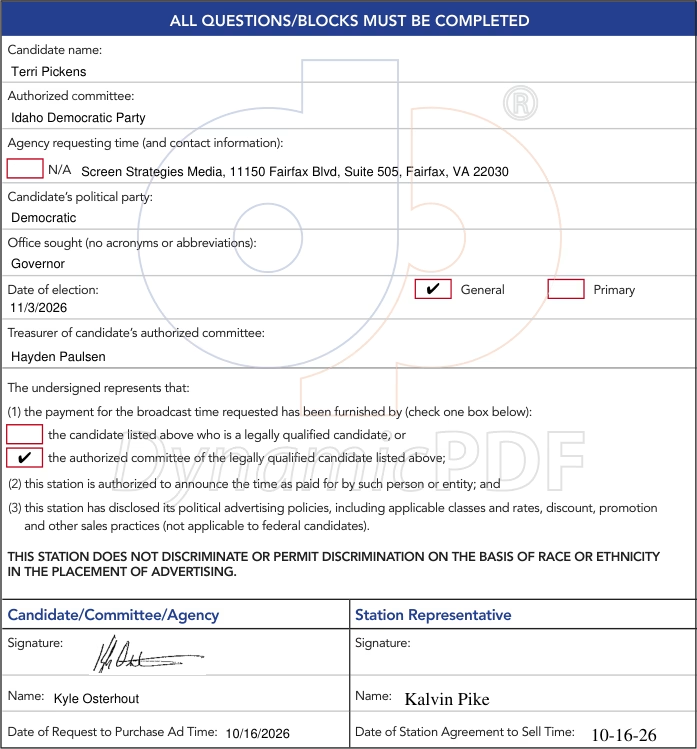
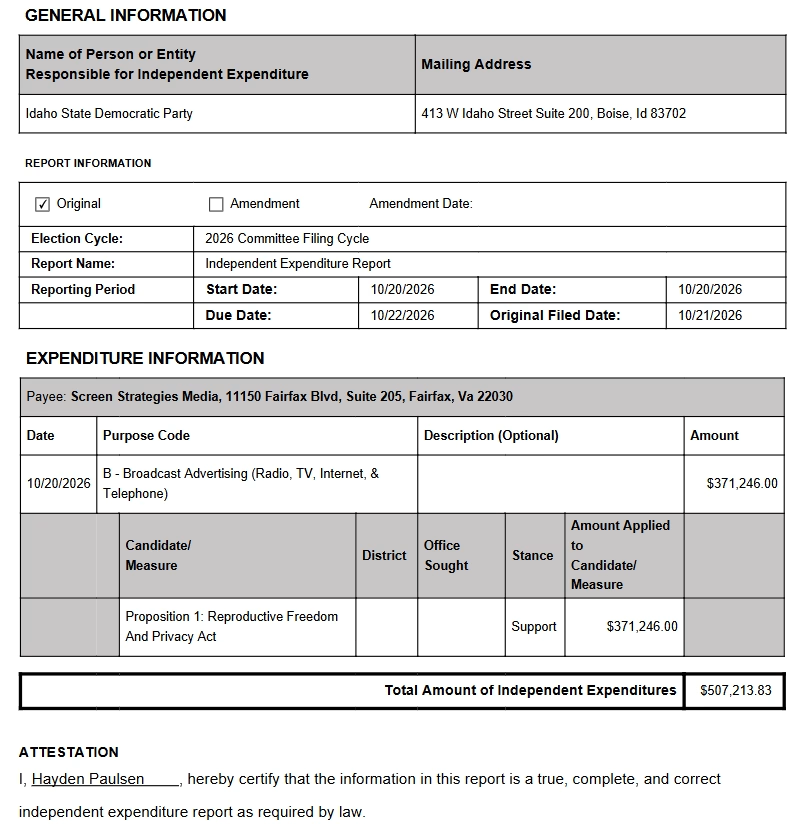
Both can’t be true. If the ad was coordinated with Pickens, then Idaho law caps what the party can give at $10,000 per election. If it was independent, then it should not have qualified for candidate rates.
As of this writing, the Terri Pickens campaign has raised just under $250,000, which is less than the party’s single payment for ads in her name. That brings up an obvious question: who really paid for the ad?
On October 16, Idahoans United gave the Idaho Democratic Party $245,500, followed by $375,000 four days later. On the same day as the second donation, the Democrats paid Screen Strategies Media $371,246 and reported it as an independent expenditure supporting Proposition 1. Screen Strategies is the preferred ad buyer for Idahoans United and was paid more than three-quarters of a million dollars by the organization in September alone.
On October 16, the same day as the first donation, Screen Strategies placed an ad order at KIFI in Idaho Falls that was categorized as “IDP/Pickens for Governor,” in which the Idaho Democratic Party itself was named as Pickens’ authorized campaign committee.
Money is fungible, of course—just because money moved from Idahoans United to the Idaho Democratic Party and then to Screen Strategies doesn’t necessarily mean that Idahoans United paid for these particular ads. But the connection certainly seems plausible.
The Pickens campaign also bought airtime on KIFI, but used Peppershock Media for ad buys, not Screen Strategies. Idahoans United also purchased other airtime on KIFI using Screen Strategies. The Idaho Dems/Terri Pickens Prop 1 ad was booked during programs including Local News 8 This Morning and Good Morning America at exactly half the rate charged to Idahoans United for the same slots the previous week:
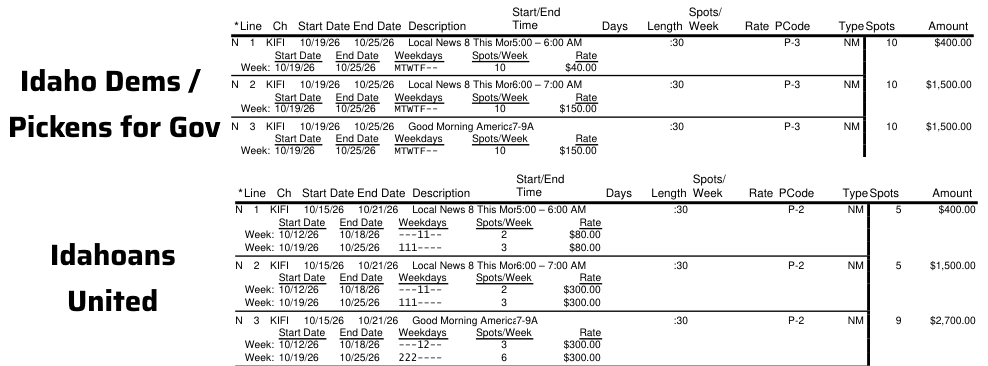
KIFI coded the two buys with separate codes—P-2 and P-3. It’s unclear whether those codes specifically refer to a class of time reserved for candidates as opposed to issue-based ads. The total ad orders at KIFI and its sister station KIDK total only about $23,500 of the $371,246 that the Democratic Party spent, but they are illustrative of what happened here.
I am not a lawyer, nor an expert in campaign finance law, so I can’t say whether this is legal, illegal, or just skirting the line. That will be for the Secretary of State and Attorney General’s offices to decide, and according to people familiar with the matter, both are looking into this. As a Republican district chair and consultant for the Idaho GOP, I’m obviously not unbiased. What I can do is speculate on the possible strategies behind this move. Betting markets show that few people think Terri Pickens is going to defeat Gov. Brad Little in ten days, so what’s the Democrats’ best play here?
They surely want to drive turnout not only in support of Prop 1, but also to win the battleground districts in West Boise, Blaine County, and Pocatello. The Democrats could potentially gain six more legislative seats in those districts alone, and abortion is a motivating issue for left-of-center voters, so it makes perfect sense that they would use that issue to win down the ballot. There are also county offices and other taxing districts at stake.
Whatever the authorities decide about how this was done, the fact is that the Democrats are motivated to turn our state blue. Are you motivated to keep it red? Early voting is open for one more week. Get out to vote, or make sure you have a plan to vote on Election Day. The future of our state is in your hands.
Feature image made with ChatGPT.
The Gem State Chronicle delivers daily analysis, op-eds, press releases, and Idaho Insider updates — free to your inbox.
Free newsletter · Unsubscribe anytime · View on Substack

About Brian Almon
Brian Almon is the Editor of the Gem State Chronicle. He also serves as Chairman of the District 14 Republican Party and is a trustee of the Eagle Public Library Board. He lives with his wife and six children in Eagle.