Human beings, especially in the frenetic, social-media-infused 21st century, tend to have a bias for the present. We subconsciously assume that the way things are now is the way things were before. We watch massive social changes play out before our eyes, but acclimatize so quickly to the new normal that we forget how much things actually changed.
It’s a truism that Republicans are conservative. Nearly every Republican in Idaho calls him or herself a conservative, often accompanied by modifiers such as “constitutional” or “proven.” Ask ten random Republicans about the meaning of “conservative” and you’ll get at least ten different answers, but there’s no question that most members of the Grand Old Party believe the label applies to them.
It wasn’t always this way. At the turn of the 20th century, the GOP had taken up the mantle of progress. Republican leaders such as Teddy Roosevelt were proud progressives, believing that science and industry had advanced to a point where social ills could be solved with the right policy levers. While later Republican presidents like Calvin Coolidge were fiscally conservative, the idea that government should not spend money or operate various programs was not widespread in the GOP. Recall that the very first Republican Party platform, adopted in 1856, called for increased federal investment in railroads.
Franklin Roosevelt built a powerful political machine by combining progressivism with populism—using the machinery of government to directly benefit certain constituent groups via farm subsidies, retirement pensions, and federal jobs programs. It was in response to the massive government expansion of the New Deal that the modern concept of conservatism was born. Conservatism was not necessarily a Republican thing, however; by the late 1930s, Democrats had a huge advantage in Congress, yet it was conservative Democrats who opposed much of FDR’s agenda.
Even in the decades following FDR’s administration, there were still progressive Republicans as well as conservative Democrats. It was really in the late 1990s and early 2000s that the political polarization so familiar with us today began to take shape; a process that accelerated during the Trump era as the last few progressive Republicans jumped off the train. Republican voters today demand conservative candidates, just as Democratic voters demand progressives. By now, the two words are largely meaningless except as team identifiers—modern Democrats have little in common with Teddy Roosevelt, for example.
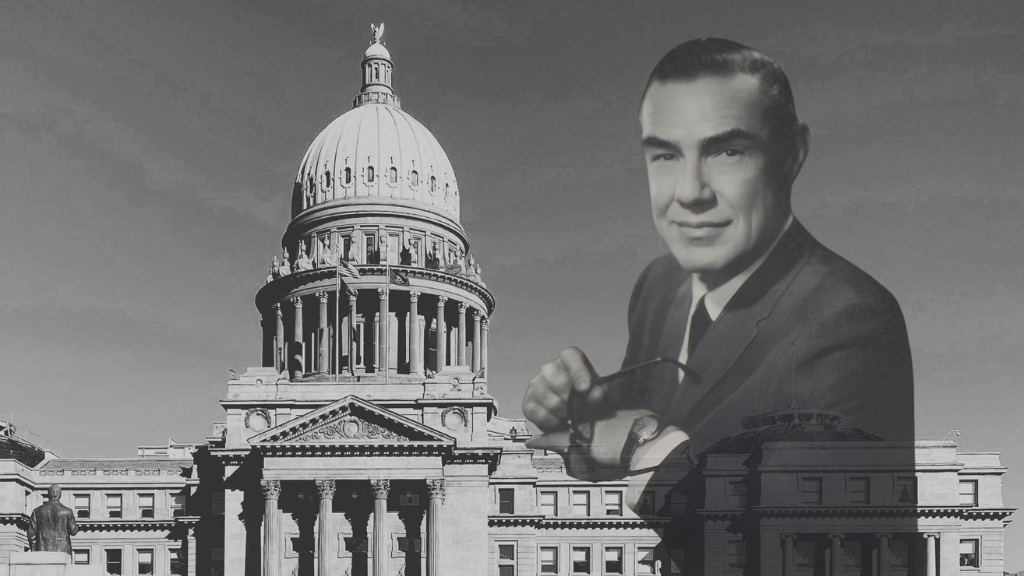
I recently read the autobiography of Robert Smylie, a man who dominated Idaho politics for more than two decades. Born in Iowa, Smylie moved to Caldwell to attend the College of Idaho and fell in love with the Gem State. After graduation, he moved to Washington, D.C., to study law at George Washington University, and then spent World War II as a lawyer in the U.S. Coast Guard. He moved back to Idaho in 1947 to accept an appointment as deputy attorney general under Robert Ailshie. When Ailshie died suddenly later that year, Gov. C.A. Robins appointed Smylie attorney general at the tender age of 33—young enough that Smylie served as president of the Ada County Young Republicans while also serving as Idaho’s attorney general. He won election in his own right in 1950.
Prior to 1946, Idaho governors served two-year terms. In 1944, citizens voted to amend the Constitution to implement four-year terms beginning with the 1946 election, but also to prohibit self-succession. That meant Gov. Len Jordan could not run for reelection in 1954, so Smylie ran that year, winning election just days after his 40th birthday.
Robert Smylie would go on to serve three terms as Idaho’s governor after shepherding a new constitutional amendment allowing self-succession. Voters approved the amendment in 1956, allowing Smylie to run again in 1958 and 1962. He ran for a fourth term in 1966 but was defeated in the Republican primary by Don Samuelson in what was seen as a referendum on Smylie’s support for a new 3% sales tax. Ironically, Idaho voters approved the tax itself in a real referendum that November.
Beyond the sales tax, Smylie’s agenda was one we would probably call very progressive today. He led on issues such as increasing the minimum wage, increasing funding for public schools, and the creation of the Department of Commerce, the Department of Parks and Recreation, the Idaho State Historical Museum, and the Department of Water Resources. He suggested increasing unemployment benefits to mitigate the recession of 1958, and proposed a massive reorganization of government that would have eliminated the office of lieutenant governor and made the state superintendent of public instruction an appointed position, but was unable to get enough Democrats on board to secure the required two-thirds majority in the Legislature.
Smylie supported increasing the gasoline tax to help pay for new highways under President Dwight Eisenhower’s interstate freeway initiative, and spurred the creation of the Public Employees Retirement System of Idaho (PERSI) to provide pensions for state workers.
The political shape of Idaho was very different in the 1950s and ’60s than it is today. Remember that Idaho sent an outright socialist to serve in the United States Senate in 1945—Glen Taylor ran for vice president on a ticket with arch-progressive Henry Wallace in 1948. During Smylie’s tenure as governor, Idaho elected Democrat Frank Church to the Senate for the first of four terms. Robert Smylie noted in his 1954 campaign for governor what it would take to win the Republican primary:
…one had to carry at least six of the ten northern counties, win quite well in Ada and Canyon Counties, and run about even in the rest of the state. We had also concluded that in the general election campaign there were really only ten counties that were important, and that a good campaign would concentrate on those ten counties. They were Kootenai, Nez Perce, Canyon, Ada, Twin Falls, Cassia, Bannock, Bonneville, and Madison. This did not mean that you neglected the rest of the counties, but you had to—if you had good political sense—try and gather the grapefruit where the trees grew.
Democrats controlled both chambers of the Legislature in 1959, with Smylie the only Republican statewide elected official to survive the blue wave following the recession of 1958. As a progressive, however, Smylie was able to find Democratic allies to support his agenda.
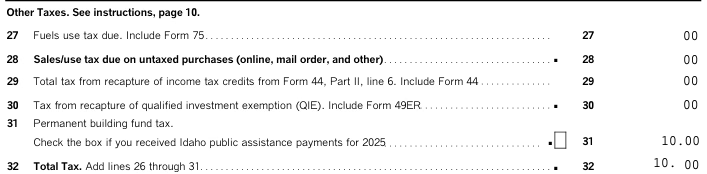
During the 1959 legislative session, Smylie sought to increase taxes to bring the state portion of public school funding to equilibrium with local taxes. Democrats crafted a $10-per-return “income tax license fee” to cover the gap, which he signed, but Idaho Republicans immediately denounced it as a “head tax.” In 1961, the Legislature redirected the proceeds from the General Fund to the Permanent Building Fund. The same $10 tax still appears on your Idaho state income tax return today.
Smylie traveled the state in the leadup to the 1960 election, hoping to regain control of the Legislature for Republicans. He was successful—Democrats have not controlled either chamber since then—but he also planted the seeds of his own defeat when he recruited Don Samuelson to run for the State Senate in Bonner County:
I encouraged him to enter the campaign and arranged some financing for him, and also campaigned around Bonner County one day on his behalf. He was elected. It was the same Don Samuelson who would cost me the governorship in 1966. Samuelson was a far-right conservative and was chosen by that wing of the party to seek revenge against me for my progressive style of government.
Robert Smylie’s progressive agenda cost money, and by the mid-1960s, the government was out of it. From statehood until the 1930s, Idaho’s state government was funded by license fees, excise taxes, and a state property tax, on top of the existing local property taxes. In 1931, with the Great Depression in full force, the Legislature enacted the Property Tax Relief Act, establishing personal and corporate income taxes whose revenues were used to reduce property taxes levied for state purposes. The state property tax remained in place, but the income tax was meant to reduce the amount that property owners had to pay. When even that was not enough to pay for the state’s share of New Deal assistance programs, the Legislature enacted a 2% sales tax in 1935, which promptly voters rejected it in a referendum the following year.
Smylie proposed a 3% sales tax in his 1965 budget address to the Legislature, with the governor calling it a move toward “political maturity.” He called upon legislators to quickly pass the tax, saying:
The only practical and the only feasible means of meeting the needs of our schools and our state government, if you regard yourselves as liberals, you should be supporting this legislation because we cannot do those things for the people that we ought to be doing for the people without this kind of legislation.
Republicans and Democrats in the Legislature united on the issue, and the tax went into effect on July 1. Citizens opposed to the tax secured enough signatures to put it on the 1966 ballot as a referendum, by which time Smylie had already lost the Republican gubernatorial primary. He characterized his defeat as a wake-up call for proponents of the tax, who organized a “Save Our Schools” campaign to ensure the tax survived the November election. It did, with more than 61% of voters approving it. Today, the sales tax stands at 6%.
Smylie described his post-political career as “attempting to stem the continual drift of the Republican Party toward the councils of the radical right,” adding that “the ineffectiveness of those endeavors is apparent in the domination of that wing of the party in the legislative affairs of the state today.” He wrote his autobiography in 1997, passing away seven years later. His final notes include suggestions for the Legislature, including returning to biennial sessions and maintaining a legislative record of every word spoken on the House and Senate floors. That, at least, has been achieved with the digital media archive.
Smylie also decried one-party rule in Idaho, suggesting that a more competitive political field would bring debates out in the open rather than keeping them in closed-door caucuses. Finally, he urged the Legislature to do away with a long-running unwritten tradition:
Lastly, they might stop calling the governor by the snide label they devised in the seventies. “The Gentleman on the Second Floor” is the duly elected governor, and that is what they should call him. Anything less lacks civility and constitutional correctness.
The era of Robert Smylie is not too far removed from our own. Robert’s son Steve served in the State Senate in the early 2000s, lost the Republican primary for state superintendent to Tom Luna in 2006, and held a seat on the West Ada School Board until 2020. Many Republicans who today call themselves “conservative” believe that means conserving the progress of Robert Smylie and others who led Idaho from the 1930s through the 1960s. Still others define conservatism as returning to a pre-New Deal vision of government, or even a pre-19th-century model.
Within the partisan polarization of the past 20 or 30 years, it’s entirely possible that Robert Smylie has more Democratic admirers today than Republican ones. Whatever one thinks of his positions, we today must reckon with the decisions that were made decades ago and understand that the lines between conservative and progressive, and even Republican and Democrat, are not so neat and tidy as we would like to believe.
Rather than arguing about who is a “true Republican” versus a “RINO,” I believe we should focus on the issues. Explain why a policy is good or bad without resorting to labels or clichés. It’s harder, sure, but it will pay much better long-term dividends for the future of our state.
The Gem State Chronicle delivers daily analysis, op-eds, press releases, and Idaho Insider updates — free to your inbox.
Free newsletter · Unsubscribe anytime · View on Substack
About Brian Almon
Brian Almon is the Editor of the Gem State Chronicle. He also serves as Chairman of the District 14 Republican Party and is a trustee of the Eagle Public Library Board. He lives with his wife and six children in Eagle.