Last week, McClatchy Media Company laid off dozens of newspaper staff throughout the Northwest, including ten reporters and three editors at the Idaho Statesman. That represents more than half the paper’s newsroom. There have been few confirmations regarding who was let go, but sports reporter Michael Lycklama—who also chairs the Idaho News Guild union—told Boise State Public Radio that he was among them:
Lycklama was a sports reporter for the paper for 12 years. He said he got an email Thursday morning notifying him of an HR meeting 30 minutes later.
“That was all the notice that I got, and got a nonsensical explanation that didn’t explain any reasons why they’re doing the things that they’re doing,” he said.
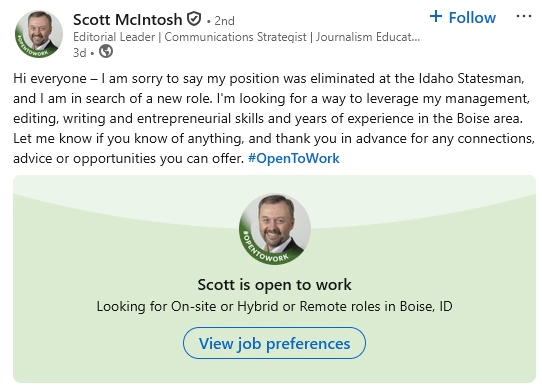
Opinion editor Scott McIntosh announced on LinkedIn that he was one of those laid off as well:
Melissa Davlin, lead producer for Idaho Reports on Idaho Public Television, also serves as president of the Idaho Press Club, an association of local journalists. She issued a statement in response to the layoffs:
As president of the Idaho Press Club, I’m deeply distressed by McClatchy’s mass layoffs at the Idaho Statesman.
To those who lost your jobs on Thursday: I’m heartsick for you. I know how hard all of you have worked to bring the news to the residents of Treasure Valley and beyond, through long-term investigations, breaking news with public safety implications, and endless public meetings. I’m proud of every single one of you for putting yourselves out there every day.
To everyone else: Our community has lost valuable coverage and insights from this team of dedicated writers. The remaining Statesman employees are now put in the unfair position of trying to maintain a competitive level of reporting with fewer resources than ever.
Everyone benefits from a robust media ecosystem with multiple outlets and healthy competition between reporters. Now, there are fewer journalists to hold the powerful accountable. This is not only a bad day for Gem State media, but for everyone who cares about transparency and responsible government.
These layoffs come just a few months after members of the Idaho News Guild staged a one-day strike to demand higher wages and a policy to ensure McClatchy would not replace human reporters with AI-generated content. The union succeeded in getting a new contract, but now more than half its members are out of a job.
I’m not here to dance on the Statesman’s grave. While I believe the paper has taken a sharp leftward tack that has put it at odds with the majority of Idahoans—more on that later—I’ve generally found its individual reporters to be reasonable people. I’ve had numerous pleasant interactions with Carolyn Komatsoulis, Sarah Cutler, Rose Evans, and others, and would not wish the uncertainty of sudden unemployment on any of them.
However, this is a good time to follow up on my article from last year regarding the changing media ecosystem and explain why these layoffs were entirely predictable.
I believe the decline of the Idaho Statesman is due to three major factors:
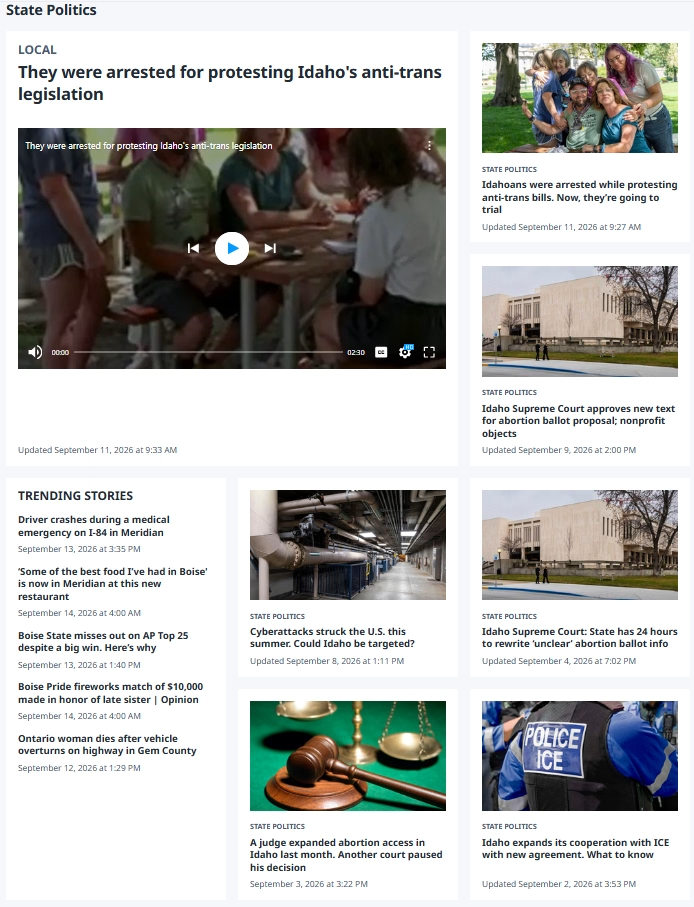
First, as I said above, the paper has taken positions much farther to the left than the median Idaho citizen. As I write this, the front page of the Statesman’s politics section is dominated by a puff piece about LGBTQ+ activists who were arrested for trespassing in Gov. Brad Little’s office earlier this year. Three of the top five stories are about abortion, and another warns about increased ICE activity following the governor’s enrollment of the Idaho Department of Corrections (IDOC) into ICE’s 287(g) warrant model. Media bias is not merely seen in what issues papers choose to cover and what they do not, but in the perspectives reporters take in each story, such as how legislation that mandates people use bathrooms that match their biological sex is called “anti-trans” in the headline.
While the Statesman’s op-ed page does often feature center-right voices, such as former Gov. Butch Otter’s endorsement of Sen. Jim Risch on Sunday, it is dominated by far-left perspectives. Regular opinion columnist Bryan Clark’s entire portfolio is attacking Republicans—over the summer, he’s used his column to go after Speaker Mike Moyle, Rep. Bruce Skaug, Sen. Jim Risch, Sen. Camille Blaylock, Sen. C. Scott Grow, Attorney General Raúl Labrador, and more. It’s nothing but pure hatred, week after week.
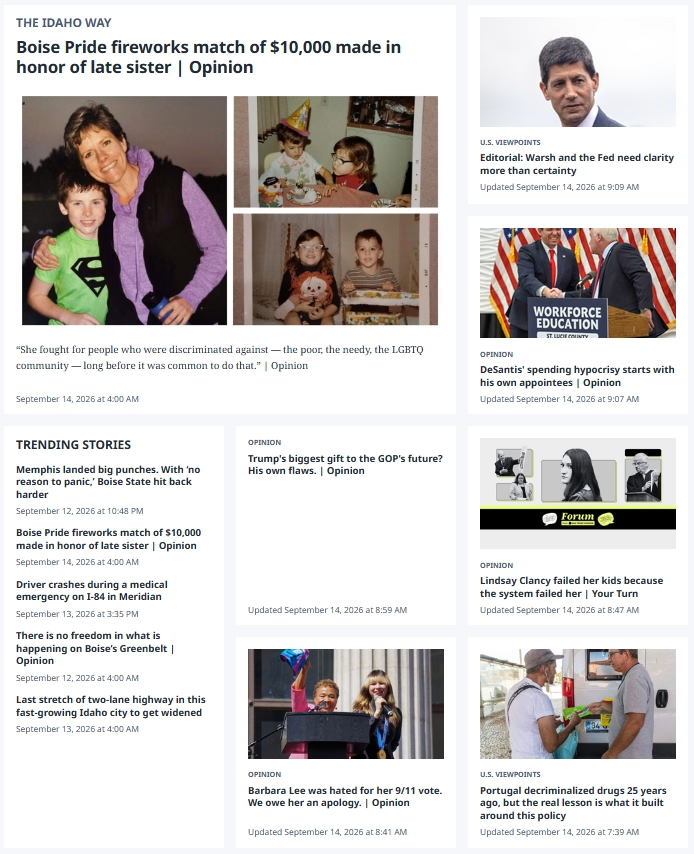
As I write this, the main opinion page features a piece on how “the system” failed child murderer Lindsay Clancy, something about President Trump’s flaws, a piece on how Florida Gov. Ron DeSantis is a “hypocrite,” a puff piece about an LGBTQ+ activist, a denunciation of school choice programs that don’t extend benefits to immigrant families, and many more.
Many of the posts on the Statesman’s opinion page are not Idaho-centric at all, but are republished from national wire services, which brings me to the second reason the paper is failing: It has lost its focus on Idaho.
A quick count of stories linked from the front page of the Statesman this morning shows 22 national stories compared with 17 local stories. That includes sections labeled “From Our Partners,” including five stories from Us Weekly, five from TheStreet, and five from Bargain Hunter.
The Statesman’s X feed is a perfect example of this phenomenon. As I write this, the most recent posts are about home warranties and appliance repair, both of which were at least partially generated by AI. Third is a link to a summary of a previous story about Meta’s new data center, with a byline that says, “Edited by Scott McIntosh. Produced with AI assistance.” The original story by Mark Dee is linked in the middle of the article and is actually an informative and valuable piece of reporting. What’s the point of using AI to create a summary and linking to that on X instead of the full article?
The next two stories on X are another article about home warranties (distinct from the first) and a story from Us Weekly about a celebrity death. That is followed by a repost of a good op-ed by Devon Kurtz of the Cicero Institute regarding Boise’s homelessness problem, and then a salacious headline about Sydney Sweeney’s latest photoshoot. After that is another Us Weekly article attacking Kai Trump.
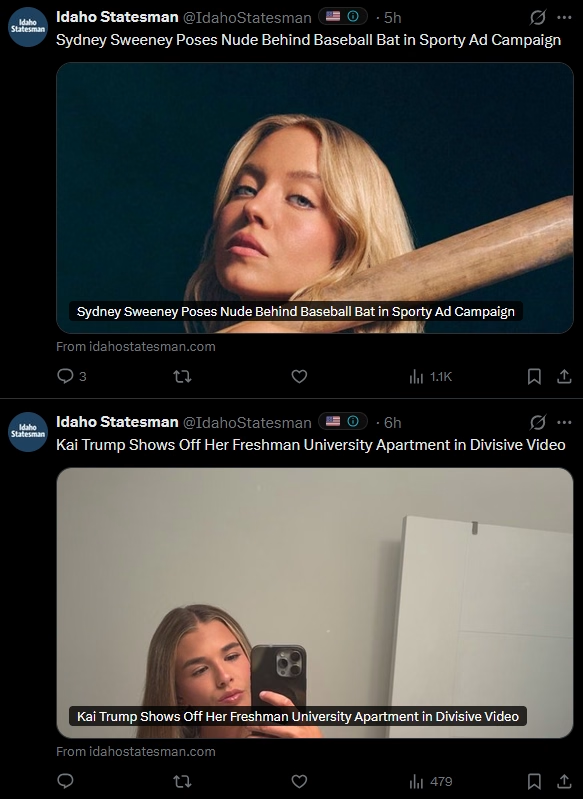
In short, the Statesman’s news feed is 90% slop.
Drawing stories from wire services and other publications might have made sense 30 years ago, when consumers got their news from a physical paper delivered each morning before dawn. Yet it doesn’t make sense today, when readers can visit Us Weekly, TheStreet, or any number of national publications with just as many clicks as it takes to read the Statesman.
Which brings me to my third, and final, point: print newspapers have never truly adapted to the internet.
Running a newspaper used to require a lot of capital investment. Printing presses that could churn out tens of thousands of newspapers every morning weren’t cheap, not to mention the staff needed to run the presses, deliver the papers, and, of course, write the stories. Papers made money by selling not only subscriptions, but also advertising space to local businesses as well as access to classifieds.
The internet quickly obliterated that business model—why pay a newspaper to place a small message in the Sunday paper when you could post it for free on Craigslist or Facebook Marketplace?—and newspapers never fully recovered. It became a vicious cycle: newspaper revenues decreased while fixed costs increased or at least held steady, so papers raised prices and filled their pages with more ads, which only drove readers further away. Just a few months ago, a user posted on Reddit—today a very left-wing environment, the sort that believes local newspapers are important in protecting our democracy—complaining about the Statesman’s $15-per-month subscription fee.
In 2008, the Statesman joined forces with the Idaho Press-Tribune to share printing equipment at its Nampa facility, and ten years later moved all its printing to a facility in Twin Falls. In 2019, the Statesman ceased its Saturday edition, and by late 2023, was only printing three days a week.
In addition to destroying newspapers’ revenue model, the internet democratized news media. Before the advent of the internet, “journalism” required earning a degree from a big school and getting a job with a real newspaper, like the Idaho Statesman. Now, anyone with a mobile phone can do “journalism.” Nick Shirley has done more real journalism in the past year than most reporters with bylines at big papers. Not only has this made newspapers less important—why bother subscribing to a legacy news outlet when you can follow a bunch of citizen journalists on social media and be much better informed?—it has caused the legacy media to double down on its own pretensions. Remember when The Washington Post put “democracy dies in darkness” on its masthead following the election of Donald Trump? Many reactions to the layoffs at the Statesman carry this same tone, as if some sacred trust was broken.
In light of all of this, it smacks of incredible hubris that the Idaho News Guild demanded big raises for unionized employees earlier this summer. Those of us outside the news media bubble could see layoffs coming from a mile away. The reporters might see themselves as priests of democracy, but the hedge fund that bought McClatchy in 2020 just sees a negative balance sheet.
In my article last year, I took a look at the various journalistic models operating in Idaho. I believe we are in a time of transition from the legacy model of journalism to something new. The Statesman has been trying to keep the legacy model alive for decades, but declining readership, cutting back on print editions, and now these layoffs show that model is dead and gone. The Idaho Capital Sun is funded by an array of left-wing nonprofits, which insulates it from the realities of the free market, but that said, its small staff seems to do a much more comprehensive job covering Idaho politics than the Statesman. BoiseDev is supported by readers and local organizations, does a great job within its niche, and is often the first to break important political stories.
Finally, there is independent journalism, such as the Gem State Chronicle. I’m still just one man, and don’t have the resources to hire reporters to cover multiple subjects at once or outsource day-to-day operations such as updating the website or posting on social media. I often rely on other outlets such as the Statesman or the Capital Sun to cover local politics, upon which I provide analysis and commentary. I’d like to reach the level of BoiseDev or the Capital Sun at some point, but I’m not there yet.
The dual trajectories of the 21st century are toward more centralization in some areas, but decentralization in others. School choice, for example, is the future of education, rather than lumping every child into a one-size-fits-all brick-and-mortar system. News media is following the same path.
It’s entirely possible that readers will soon get their news from an AI assistant that curates thousands of sources into a single daily briefing rather than opening the morning paper or visiting a single website on a computer. The model that the Idaho Statesman is desperately trying to preserve simply has no place in the 21st century, and why should a New Jersey-based hedge fund care about civic institutions in Idaho, anyway?
That doesn’t mean that the need for news has diminished. On the contrary, America—and Idaho—needs independent journalists more than ever. Someone has to do the legwork to find the information that AI assistants will incorporate into their daily briefings. With regard to political coverage, someone needs to be physically in the room when legislators debate a bill, to capture tones of voice, facial expressions, things that occur off-camera or are otherwise not captured by video or transcripts. Someone needs to be there asking the right questions.
There need to be enough independent journalists to cover not only state politics, but local politics as well. The decisions made by your city council members often have more of an impact on your daily life than those made by senators, governors, or presidents, yet it’s often hard to find solid coverage of city councils, planning and zoning boards, and the like.
Am I overestimating reader demand? Is the Idaho Statesman’s coverage of Sydney Sweeney and home warranty options more in tune with what readers want than comprehensive coverage of local politics? If that’s the case, then nothing matters, does it?
I like to think that engaged readers desire more than slop. I believe there is a market for platforms that bring real, actionable information to citizens who want to play an active role in the politics of our Republic. If the Statesman, even with its long and prestigious pedigree, has become unable or unwilling to provide that, then it deserves to die and have that space filled with other platforms that are eager to pursue excellence.
The future of news media is in flux, but nature abhors a vacuum, and it will be filled with something. Idaho citizens deserve something good and useful.
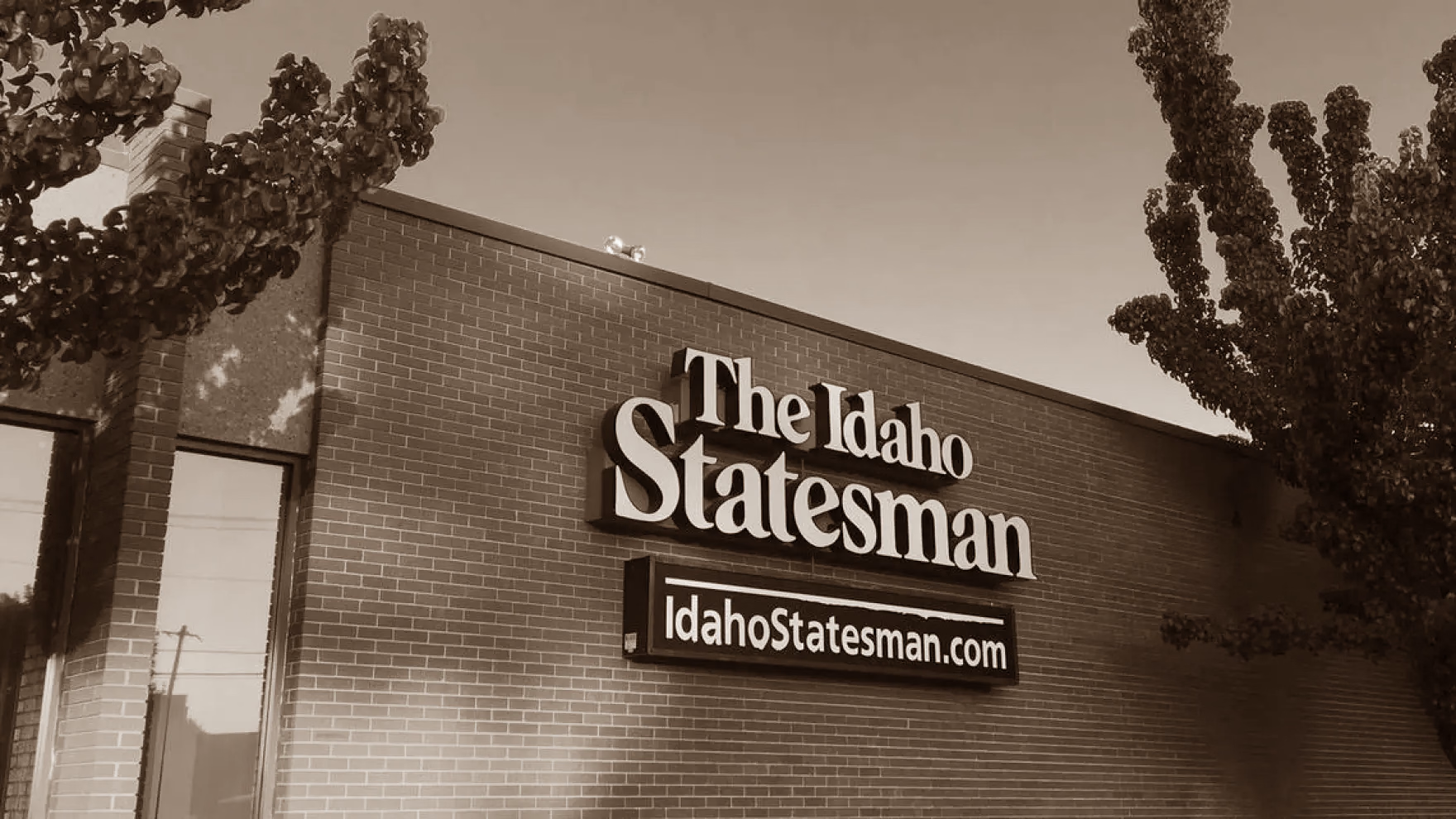
Feature image from the Idaho Statesman.
The Gem State Chronicle delivers daily analysis, op-eds, press releases, and Idaho Insider updates — free to your inbox.
Free newsletter · Unsubscribe anytime · View on Substack

About Brian Almon
Brian Almon is the Editor of the Gem State Chronicle. He also serves as Chairman of the District 14 Republican Party and is a trustee of the Eagle Public Library Board. He lives with his wife and six children in Eagle.