
Last year, State Representative Todd Achilles resigned from the Legislature—and from the Democratic Party—to run an independent campaign for U.S. Senate against incumbent Sen. Jim Risch. Earlier this month, I wrote about how Achilles has attempted to obfuscate his liberal voting record in his appeal to Idaho voters:
You might have received a text message from the Achilles campaign attempting to imply that he is actually more conservative than Sen. Jim Risch, the Republican incumbent. One citizen was even told that Achilles is conservative and a former Republican.
This rhetoric doesn’t match his record. Having served parts of two terms in the Idaho House of Representatives as a Democrat, Achilles can’t hide his true positions.
Later in July, the Spokesman-Review published an article detailing how the Ada County Democratic Central Committee gave an ultimatum to David Roth, the Democratic nominee for this Senate seat:
The Ada County Democrats sent a letter on July 8 to David Roth, who won their party’s primary in May, giving him just over a month to prove his campaign “has turned a corner” and has a chance of unseating Sen. Jim Risch, a Republican who has represented Idaho in the U.S. Senate since 2009. If Roth doesn’t raise $50,000 and produce a campaign plan by Aug. 12, the party’s executive committee said, it will consider endorsing Todd Achilles, an independent candidate whose campaign has picked up steam in recent months.
Reporter Orion Donovan Smith explained that Roth dismissed the veiled threat as “ridiculous” and said he had no intention of complying with the demands. However, yesterday, Roth announced on social media that he was stepping down from the race.
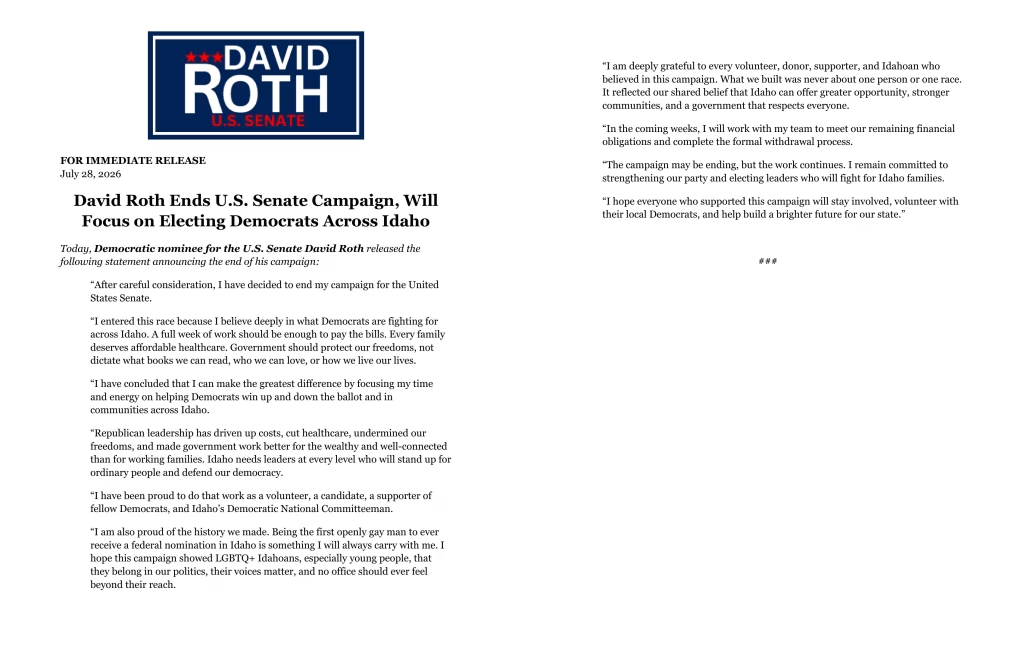
Note that Roth never mentioned Todd Achilles by name, leaving his specific reasons for dropping out vague. Also note how his statement was a complete 180 from where he stood just a few days earlier, when he defiantly told the Spokesman-Review that he wasn’t leaving.
When did he change his mind, and what pressure was brought to bear in the meantime?
According to Laura Guido at the Idaho Capital Sun, Achilles said in a July 7 interview that “if David really wants to make change, there’s an opportunity to work with us or work with others to make that change. I think just being a name on a ballot isn’t good for Idaho.” It certainly seems like members of the Achilles campaign working behind the scenes to convince Roth to step down.
The Spokesman-Review article also highlighted the vast differences in fundraising between the three candidates. As of the end of June, Sen. Risch had a $3.5 million war chest compared to Achilles‘ $692,000. Roth, however, had raised a paltry $8,642 while carrying $10,846 in debt.
Roth did not appear to be seriously campaigning, either. Prior to his statement ending his campaign yesterday, his most recent social media post was on July 12. Roth previously ran for U.S. Senate against Sen. Mike Crapo in 2022, raising just under $100,000, yet still losing with only 29% of the vote.
Indeed, an op-ed in the Lewiston Tribune by former Democratic congressman Larry LaRocco called out Roth’s lackluster electoral performances over the years and urged him to withdraw:
In 2020, Roth collected 35% against Marco Erickson for Idaho state representative.
In 2022, Roth garnered 29% against U.S. Sen. Mike Crapo.
In 2024, Roth got 31% against Congressman Mike Simpson.
There’s an unpromising pattern here with a 100% predictable outcome.
Roth filed in 2025 to run against Risch. In a recent Federal Elections Commission filing, Roth showed a negative balance of cash on hand after raising only $8,000 in a full year. There is very little evidence of a campaign infrastructure, committee or voter engagement.
What conversations happened behind the scenes between the Spokesman-Review interview and yesterday’s announcement? David Roth’s chances of victory were the same yesterday as they were the day he won the primary—as were Todd Achilles’ chances, for that matter. So what changed to convince the perennial candidate to step down this time?
There were still some who believed in David Roth, however. Last month, Dave Manson, director of the Idaho Falls Soup Kitchen and Community Food Basket of Idaho Falls, wrote an op-ed in the Idaho Statesman arguing that it was Roth—not Achilles—who stood the best chance of unseating Sen. Jim Risch:
LaRocco’s theory is that independents are surging and Democrats are dead weight. The numbers say the reverse. Achilles has outraised Roth many times over and still sits at 7 % A glossy “independent” label and a fat email list aren’t translating into votes. And on name recognition — the very traction Roth supposedly can’t build — fewer Idahoans have never heard of him than have never heard of Achilles. Six in ten 10 don’t know Roth yet. That’s runway, not a ceiling.
Nevertheless, what’s done is done. Roth is out, and Achilles is the de-facto Democratic challenger.
Had Todd Achilles remained in the Legislature and filed to run as a Democrat, I think it likely that he would have won the primary, and the overall situation would have been much the same as it is now: Achilles versus Sen. Jim Risch on the November 2026 ballot. However, that little letter “I” next to his name does a lot of work. Achilles has based his entire campaign on the narrative that he is an independent voice speaking truth to power rather than a rank-and-file progressive Democrat.
It remains to be seen how strongly Idaho Democrats will publicly support Achilles’ campaign. The letter referenced by the Spokesman-Review suggests the Ada County Democrats are likely to endorse him, while the Kootenai County Democrats previously voted to remain officially neutral. Either way, this is yet another ironic example of the Democratic Party—which constantly styles itself as the defender of “democracy”—disregarding the will of the people as expressed in its own primary elections.
- In 2022, Steve Scanlin won the Democratic primary for attorney general. However, when Raúl Labrador defeated incumbent Lawrence Wasden, Scanlin dropped out and the Democrats appointed Tom Arkoosh to run in his place. Labrador nevertheless won with 62.6% of the vote.
- In 2024, Patricia Stanger, a senior citizen in Idaho Falls, won the Democratic primary for House District 32, Seat B, unopposed. When incumbent Rep. Wendy Horman emerged victorious from a three-way Republican primary, Stanger withdrew and was replaced by Cecile Pérez. Horman still won with 78% of the vote.
- Also in 2024, the District 11 Democrats tried to pull off a switcheroo. Toni Ferro and Anthony Porto withdrew from their legislative races, and the central committee attempted to appoint each to the other’s vacancy. This was presumably an effort to create more favorable matchups after incumbent Rep. Julie Yamamoto was defeated by Kent Marmon and incumbent Sen. Chris Trakel was defeated by Camille Blaylock. After initially approving the appointments, the Secretary of State’s office determined that reappointing candidates who had already withdrawn violated Idaho law, and the whole process was reset to the status quo. Marmon and Blaylock each went on to win with 65.9% of the vote.
- Everyone remembers how President Joe Biden withdrew from the 2024 presidential race following a disastrous debate with Donald Trump that fully exposed the cognitive decline Democratic Party leaders and news media figures (but I repeat myself) had been trying to conceal from the American people. Despite Biden having decisively won the Democratic primary, party insiders installed then-Vice President Kamala Harris. Trump would go on to win both the Electoral College and the popular vote.
- Just a few weeks ago, Democrats forced Graham Platner out of the U.S. Senate race in Maine despite his overwhelming victory in the party’s primary. Party leaders did not seem to mind the Nazi tattoo or the credible allegations of assault from a conservative victim, but when a liberal woman added her own allegations, that was apparently a bridge too far. I suspect the real reason Democrats turned on Platner was polling showing declining support against incumbent Sen. Susan Collins.
After the District 11 switcheroo, I carried a resolution to the Idaho GOP calling for legislation prohibiting post-primary withdrawals. That provision became part of a much larger elections bill sponsored by Reps. Wendy Horman and Brandon Mitchell, which is now the law of the land. A candidate who won a primary can no longer simply withdraw and allow the party to select a new nominee for the general election.
Nevertheless, the Todd Achilles campaign seems to have allowed Idaho Democrats to make an end run around that law. By pressuring David Roth to drop out, they ensure there will be no Democrat on the ballot for U.S. Senate this November, clearing the way for the state party and county central committees to freely support Achilles. While this could help Achilles’ campaign by opening the door to left-wing super PACs that might have been hesitant to invest in a three-way race, a Democratic Party endorsement would decisively torpedo the narrative that Achilles is an independent muckraker taking on the entrenched establishment in both parties.
For his part, Todd Achilles acknowledged the changed landscape. However, just like Roth, he chose not to mention his former opponent by name:
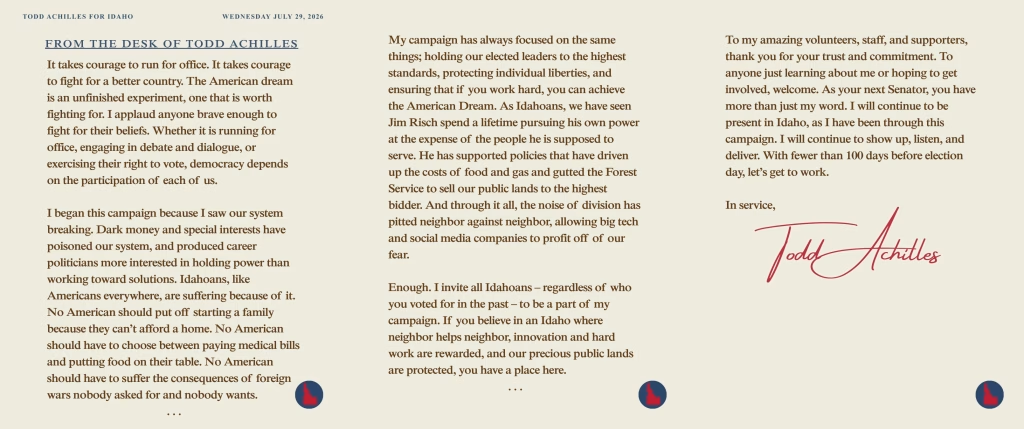
So here we are: a progressive is challenging the Republican incumbent for the U.S. Senate. We just took the long way to get here.
What do you think? Does this change the race? Will we see national organizations take a stronger interest now that it’s down to two major contenders? Will Sen. Risch and his allies be forced to expend more resources than they had planned to hold the seat?
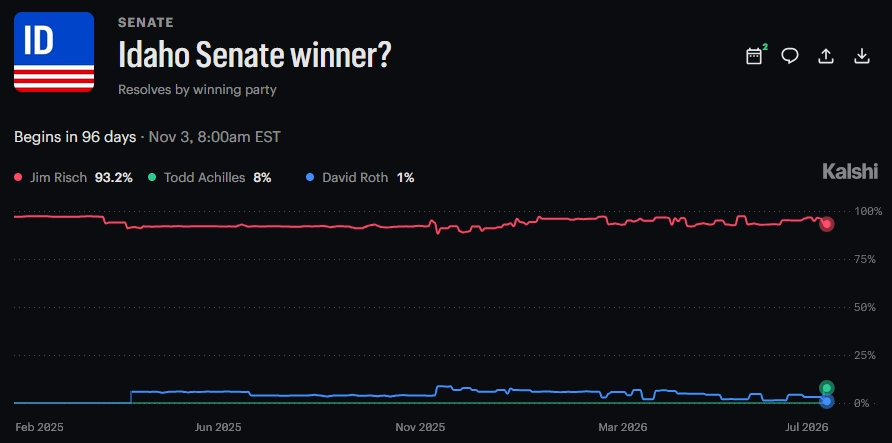
Of course, if you truly believe Achilles has a shot at unseating Sen. Risch, then you stand to make a fortune on Kalshi:
The Gem State Chronicle delivers daily analysis, op-eds, press releases, and Idaho Insider updates — free to your inbox.
Free newsletter · Unsubscribe anytime · View on Substack

About Brian Almon
Brian Almon is the Editor of the Gem State Chronicle. He also serves as Chairman of the District 14 Republican Party and is a trustee of the Eagle Public Library Board. He lives with his wife and six children in Eagle.