This country is planted thick with laws, from coast to coast, Man’s laws, not God’s! And if you cut them down, and you’re just the man to do it, do you really think you could stand upright in the winds that would blow then? Yes, I’d give the Devil benefit of law, for my own safety’s sake!
Sir Thomas More, The Man for All Seasons
What is the law? It’s both an easy question and a very difficult one. All of us are subject to layers upon layers of laws. We have city and county ordinances that govern how we interact with our neighbors, state laws that govern all sorts of matters, and national laws on top of that. Idaho is subject to our state constitution as well as the U.S. Constitution. Administrative agencies craft rules to comply with statutes, and those rules carry the force of law as well.
Underneath all of these lies the so-called Common Law, based on ideas, traditions, and judicial precedents that have stood the test of time. Even deeper is Natural Law, an attempt to understand the way God crafted the universe and how we can best align ourselves with reality.
Like computer code, laws tend to become complex and sometimes contradictory over time. Legislatures add new laws, often neglecting to prune or repeal old ones. History shows that the men regarded as great leaders were often lawgivers, reforming and replacing burdensome systems with new codes that could be more easily understood. When he wasn’t on the battlefield, Napoleon Bonaparte rewrote much of Europe’s legal system. The Code Napoléon remains the basis for French law, as well as for many nations once under French influence.
The very concept of a country is tied to the land where a certain set of laws applies. The United States of America, for all intents and purposes, means the people and places subject to the U.S. Constitution and American law. The same is true of our state. “Idaho” means the jurisdiction where Idaho law can be enforced. Cross the Snake River and you may find yourself under the jurisdiction of Oregon or Washington law (though as an Idaho resident, you remain subject to certain provisions). Cross our northern border and you will find yourself under Canadian law.
The reason we have nations and states is that different peoples have different preferences about how they should be governed. One of the great delusions of the Global War on Terror was the belief that we could impose American laws and traditions on foreign peoples. Afghanistan has very different laws from the United States. So does China. So does Uganda.
The laws of Idaho and the United States have their foundation in English Common Law and the Christian tradition of Western Europe. Trying to apply a foreign legal system within our borders creates problems, much like installing incompatible software on the wrong hardware. In recent years, many people have expressed concern about the potential imposition of Sharia, or traditional Islamic law, and have called for legislation to protect Idahoans from that possibility.
Two bills were introduced this session to ensure Idahoans would be governed only by our own laws.
Senate Bill 1233, sponsored by Sen. Dan Foreman, approached the issue by prohibiting religious or cultural laws from being enforced in Idaho. The bill consisted of a single paragraph:
CONSTITUTIONAL COURTS ACT. No state court at any level of jurisdiction or authority shall enforce, consider, or apply any judgment, decree, ruling, or decision of arbitration based on a body of religious or cultural law that does not fully support and conform with the rights of citizens as defined in the United States constitution and the constitution of the state of Idaho.
The policy team at Idaho Freedom Foundation (IFF) expressed concerned about the bill, rating it a -2 on its Freedom Index:
The problem with this wording is the common meaning of the rights enumerated in the Idaho and United States constitutions often no longer comport with our Founders’ original intent after a century of legal positivism. The purpose of originalism is to restore the proper meaning of these rights by interpreting the text in light of original intent. Oftentimes, original intent contradicts our contemporary understanding of the plain meaning of the text. For example, the Supreme Court’s decision in Roe v. Wade erroneously extracted the constitutional right to abortion from the text of the Fourteenth Amendment’s right to privacy. The Supreme Court was only able to correct this error in Dobbs v. Jackson by going beyond the plain text and finding the right to abortion is not deeply rooted in our nation’s history and tradition. S1233 would prohibit the reasoning of Dobbs by stipulating that for “a body of religious or cultural law” to be valid, it must first align with the plain definition of the right in question as enumerated in the Constitution.
Sen. Foreman faced opposition during the committee hearing on S1233. Sen. Brian Lenney debated against the bill, saying that targeting religious law could run afoul of courts, while targeting foreign law stood a better chance of survival. Both he and Sen. Josh Keyser, who also debated against the bill, said they supported the idea, but were concerned about the implementation.
Caleb Pirc, general counsel for the Idaho Family Policy Center, pointed out that the bill could prevent judges from referring to William Blackstone’s Commentaries on the Laws of England for context when interpreting the law. IFF’s Samuel Lair added that Sir Edward Coke, a renowned English legal theorist cited by the U.S. Supreme Court more than 70 times, could effectively be barred from Idaho courts under the bill’s language.
The questions raised by IFF and in testimony before the committee demonstrate how fuzzy the concept of law can be. All human language contains some degree of imprecision, which means context is necessary to understand what words truly mean. To fully understand the Constitution and our founding documents, we must look to the cultural and religious traditions of the Founding Fathers, placing ourselves in their context rather than imposing our own.
Critics worried that S1233 might unintentionally sever that connection to historical context. The bill was defeated on the Senate floor by a 15-19-1 vote. As the roll call shows, the votes did not fall neatly along predictable factional lines:

On the other side of the rotunda, Speaker Mike Moyle introduced House Bill 602, which took a different approach toward similar goals. Whereas S1233 focused on religious and cultural law, H602 targeted foreign law in a way that appears designed to ensure that the religious and cultural foundations of American law would not be undermined. H602 is longer than S1233—three pages—but its purpose can be summarized by a paragraph explaining legislative intent:
LEGISLATIVE INTENT. It shall be the public policy of this state to protect its citizens from the application of foreign laws when the application of a foreign law will result in the violation of a fundamental right guaranteed by the constitution of the United States or the constitution of the state of Idaho, including but not limited to due process, freedom of religion, speech, or the press, and any right of privacy or marriage embodied in the constitution of the state of Idaho.
Speaker Moyle and Rep. Steve Tanner presented H602 to the House Judiciary, Rules, and Administration Committee on Tuesday afternoon, where it passed unanimously. The only significant question came from Rep. John Gannon, who asked whether it could lead Idaho to attempt to supersede international treaties. He later noted that the bill explicitly exempts treaties from its scope.
The IFF policy team rated H602 +1:
To effectuate this purpose, the legislation would prohibit any court or adjudication panel from basing its ruling on “a foreign law that would not grant the parties affected by the ruling or decision similar fundamental liberties, rights, and privileges” such as “due process, freedom of religion, speech, or the press, and any right of privacy or marriage embodied in the constitution of the state of Idaho.”
Notably, the H602 specifies that “it shall not be construed to require or authorize any court to adjudicate or prohibit any religious organization from adjudicating ecclesiastical matters,” ensuring the bill does not infringe upon the freedom of religion.
H602 could receive a vote on the House floor as early as Thursday.
The 21st century has brought mass movements of people and rapidly changing demographics throughout the Western world. Ideas once taken for granted—such as the cultural and religious foundations of our laws—are now being questioned or even discarded. Different peoples have different legal traditions, but only American law, built on centuries of English and Christian tradition, should govern in Idaho. I’m pleased that the Legislature is taking this issue seriously, and I thank Sen. Foreman, Speaker Moyle, Rep. Tanner, and everyone else who has worked on these bills. Let’s ensure that our children and grandchildren continue to enjoy the benefits of the law that we now take for granted.
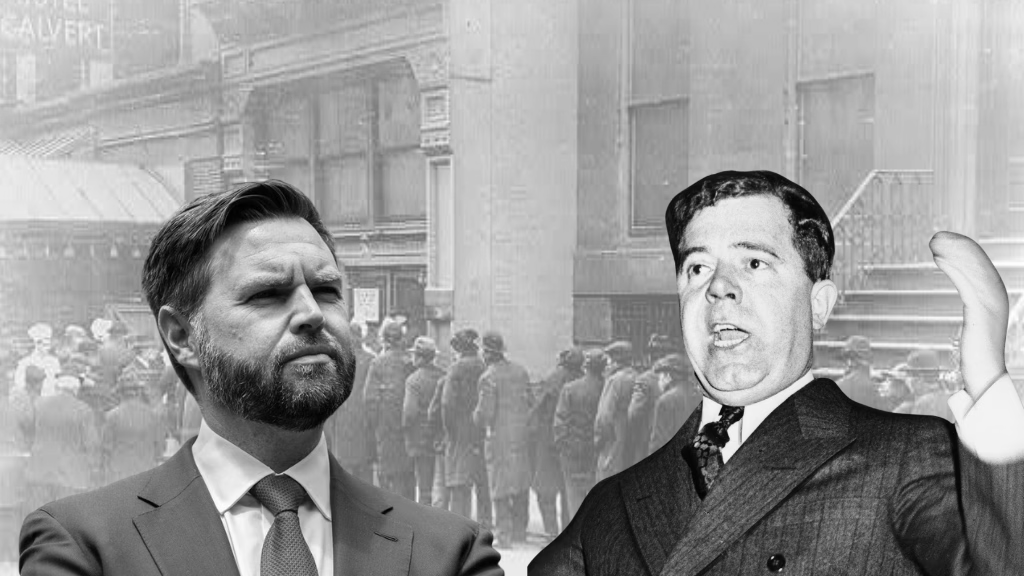
Feature image made with Microsoft Copilot
Gem State Chronicle is a reader-supported publication. To receive new posts and support my work, consider becoming a free or paid subscriber.
The Gem State Chronicle delivers daily analysis, op-eds, press releases, and Idaho Insider updates — free to your inbox.
Free newsletter · Unsubscribe anytime · View on Substack

About Brian Almon
Brian Almon is the Editor of the Gem State Chronicle. He also serves as Chairman of the District 14 Republican Party and is a trustee of the Eagle Public Library Board. He lives with his wife and six children in Eagle.