By Secure Idaho | Originally published on X
Idaho doesn’t just have an immigration problem. It has an illegal labor problem. Let’s start with what too many politicians avoid saying clearly: Illegal immigration is driven by jobs.
People come because they know they can get hired. And they know they can get hired because employers face little real risk for breaking the law.
That’s the incentive. And it exists here too.
The Scope of the Problem in Idaho
Estimates from national research organizations put Idaho’s unauthorized population somewhere up to 62,000 individuals in recent years.
Industry groups themselves admit how widespread illegal labor is. Idaho dairy representatives have publicly stated that roughly 90% of dairy workers are foreign-born and many lack legal status. That’s not activists talking. That’s industry acknowledging dependency.
When entire sectors quietly rely on illegal labor, that’s no longer anecdotal. That’s structural.
And it has consequences:
• Depressed wages in entry-level and manual trades • Lawful workers pushed out of the market • Housing pressure tied to concentrated labor pipelines • Identity fraud becoming normalized • Law-abiding businesses undercut by competitors who cheat
Taxpayer impact is rarely discussed, but it’s real. Estimates from fiscal policy groups place the annual cost of services tied to illegal immigration in Idaho in the hundreds of millions of dollars per year when factoring in education, healthcare, and law enforcement.
You can argue about the exact dollar figure. You cannot argue that it’s zero.
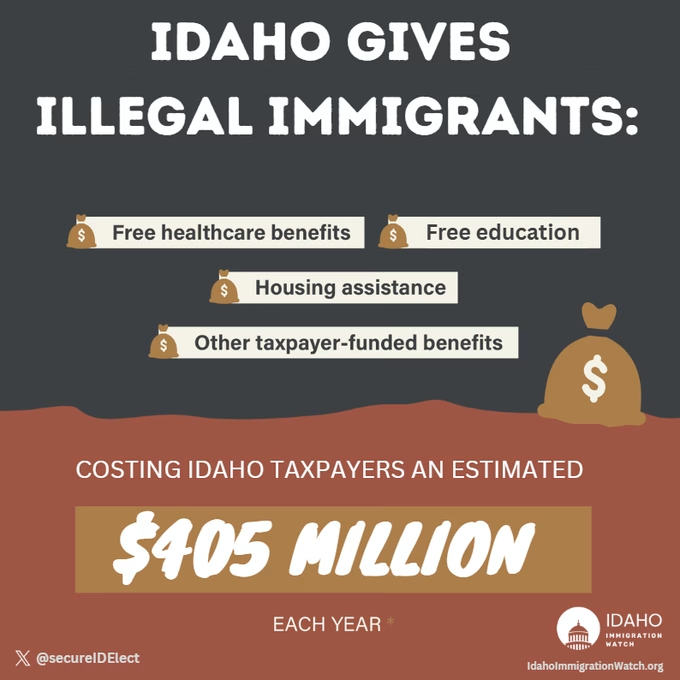
Source: Federation for American Immigration Reform (FAIR).
The Root Cause: The Job Magnet
You can deport one worker. Another will come if the job is still there.
If the job disappears, the incentive collapses.
That is why serious reform focuses on employers rather than just individuals. And that is where E-Verify comes in.
What E-Verify Actually Is
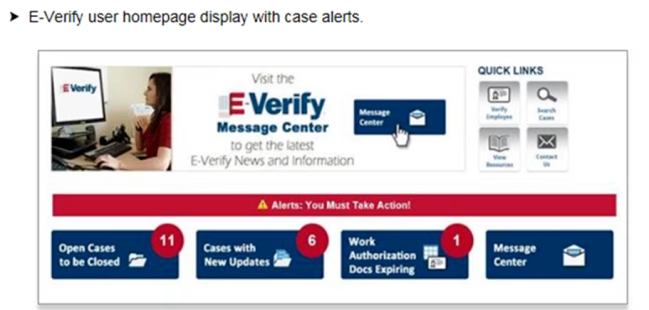
E-Verify is a free online employment verification system run by the federal government.
When a new hire completes an I-9 form, the employer enters that information into the system. The system checks it against existing records at the Social Security Administration and the Department of Homeland Security.
Most confirmations come back in seconds. Some take a few minutes. For the vast majority of lawful hires, it is immediate.
For small businesses, the process usually takes only a few minutes per new hire. There is no special equipment required, no fees, and no complex legal process.
E-Verify is not a raid or an immigration enforcement action. It is simply employment verification.
It shifts responsibility to the employer, which is where the incentive structure begins.
Is This “Big Government”?
No. Employers already have to complete an I-9. That has been federal law since 1986.
E-Verify does not create a new database or build a registry of citizens, and it does not track where people work over time. It checks existing paperwork against databases the government already maintains.
Widespread identity fraud, including stolen Social Security numbers and fake documents, is what creates abuse. Verifying at the point of hire helps reduce that.
Conservatives and libertarians should also consider the bigger picture. Illegal labor expands government in other ways. When wages are suppressed and public services are strained, taxpayers absorb the cost.
Enforcing hiring laws early is a more limited government approach than expanding programs to deal with the consequences later.
Does It Work?
Arizona passed the Legal Arizona Workers Act in 2007, mandating E-Verify and imposing meaningful penalties, including business license suspension, for knowingly hiring unauthorized workers.
In the first year, Arizona’s unauthorized immigrant population declined by approximately 17 percent, according to demographic analyses at the time.
This was not the result of a border wall or a mass deportation effort. It was employment enforcement.
E-Verify usage increased significantly, compliance became routine, and the economy did not collapse. The law was challenged in court and upheld.
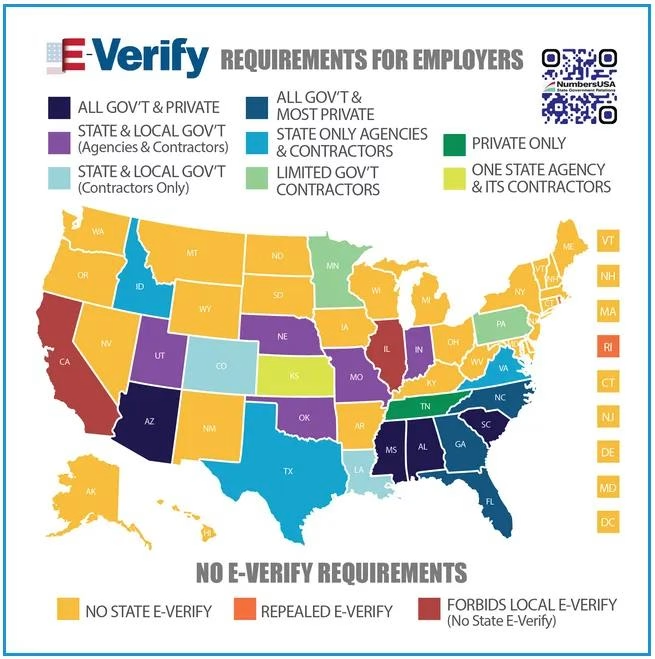
Arizona is not alone. Many states require E-Verify in some form. Idaho already requires E-Verify for state agencies and for contractors working on public works projects.
So the debate is not whether E-Verify can function. Idaho already uses it. The real question is whether the same hiring standards should apply to all employers.
The “Small Business Burden” Argument
One of the most common objections is that E-Verify would be too onerous for small businesses.
But consider the small business owner who follows the law and then loses bids to a competitor cutting labor costs 20 to 30 percent by hiring illegally. That is a real disadvantage.
Mandatory E-Verify does not punish lawful employers. It protects them. When verification is required across the board, the incentive to cut corners disappears and the playing field is more even.
That is not anti-business. It is basic fairness.
What Real Reform Requires
If Idaho is serious about reducing illegal labor, the policy must change incentives.
That means:
- Mandatory E-Verify for all new hires
- Consistent compliance audits
- Escalating penalties for repeat, knowing violations
- Business license & permit consequences for willful offenders
Without consequences, compliance becomes optional.
With consequences, it becomes standard business practice.
This isn’t about punishment. It’s about aligning incentives so that following the law is the norm, not the exception.
The Political Reality
Many lawmakers say they oppose illegal immigration. Far fewer are willing to confront employer incentives.
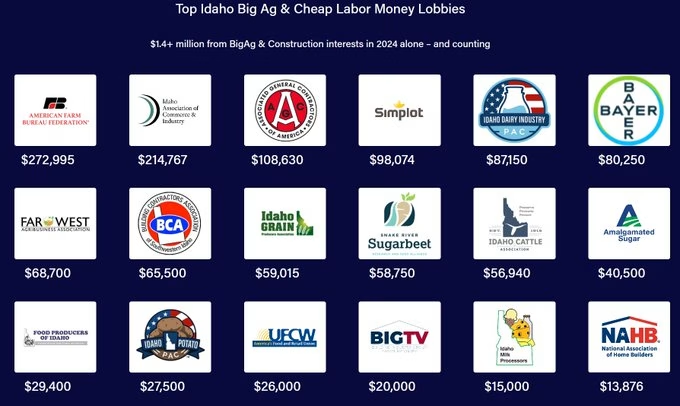
That difference reflects where organized pressure comes from. Some of the strongest opposition to mandatory E-Verify comes from industry groups that rely on a flexible labor supply and contribute heavily to state campaigns.
Those incentives are part of the policy debate whether people acknowledge them or not.
If lawmakers refuse to enforce employment verification, they are effectively choosing to preserve the illegal hiring system. The phrasing may be uncomfortable, but the policy outcome is the same.
The Choice Before Idaho
The border is federal. Jobs are local.
Idaho controls business permitting and licensing, which means the state can require employment verification as a condition of operating here.
As long as illegal labor remains low risk and low consequence for employers, the problem will not resolve itself.
If we want fewer illegal workers in Idaho, we have to reduce the incentive to hire them. That requires consistent enforcement of E-Verify, not just symbolic gestures.
Applying the law evenly and expecting compliance is not extreme. It is basic governance.
👉 If you believe Idaho should enforce its hiring laws, stay engaged at IdahoImmigrationWatch.org and follow the legislation closely.
The Gem State Chronicle delivers daily analysis, op-eds, press releases, and Idaho Insider updates — free to your inbox.
Free newsletter · Unsubscribe anytime · View on Substack

About Secure Idaho
Secure Idaho advocates for local governance to secure Idaho’s sovereignty and Keep Idaho, Idaho. Visit its website at https://www.secureidaho.org/