This Monday morning, Rep. Ted Hill presented House Bill 561, which adds enforcement mechanisms to last year’s much-discussed flag bill, to the House State Affairs Committee. After nearly two hours of debate, the committee sent the bill to the floor with a “do pass” recommendation on a 12–2 party-line vote.
Watch the full hearing here, or catch the highlights with my live thread on X.
Near the end of the hearing, Rep. Anne Haws explicitly compared H561 to a law passed by Nazi Germany in 1935 mandating that only the swastika flag could be publicly displayed. She said her grandfather fought against the Nazis, condemning their censorship and oppression of religious freedom. She added that she has inherited that passion, and that it led her to oppose this legislation.
Similarly, Eric Stidham—who, along with Haws and two other lawyers with Holland & Hart, has offered his services to the City of Boise pro bono—called the legislation a “Soviet-style” bill and implied that the sponsor, Rep. Hill, was acting cowardly.
Rep. Heather Scott objected, accusing Stidham of impugning motives, which is not allowed in committee testimony. Hill himself later requested an apology, reminding the committee that he literally flew missions with the Navy against the Soviets.
A woman of Basque heritage named Gloria Totoricaguena also spoke against the bill, spending nearly her entire testimony sharing the history of the Basque people. The Basque flag was originally exempted from restrictions in an earlier version of the bill, but that carve-out was removed in this draft. She discussed how the Francisco Franco regime banned the display of the Basque flag and—prompted by Rep. Stephanie Mickelsen—suggested that this bill was history repeating itself.
I believe that Haws, Stidham, and Totoricaguena were each making a category error. They were conflating a proposed regulation to prohibit government entities from flying ideological flags with a blanket ban on individual expression. As many people explained Monday morning, including Rep. Hill himself, this bill has nothing to do with the free expression of citizens or private organizations. It is simply about ensuring that government bodies—which are meant to be objective, impartial, and representative of all citizens—are not picking sides in ideological battles.
The line between the public and private sectors often seems fuzzy when Democrats are speaking. Remember the 2012 DNC claiming that “government is the only thing we all belong to.”? You and I might see a clear difference between restrictions on government and restrictions on individuals, but some of the commenters Monday morning seemed to consider them one and the same.
In Idaho and across America, the left increasingly denies that there is a line between government-sponsored speech and that of individuals. This paradigm can be seen in the angry reactions to Gov. Brad Little’s decision to rescind his appointment of Estalla Zamora to the Idaho Human Rights Commission. Leftists seemed especially angry, claiming that Little fired Zamora merely for exercising her free speech. The Idaho 97, a left-wing group I’ve written about before, seemed especially hysterical:
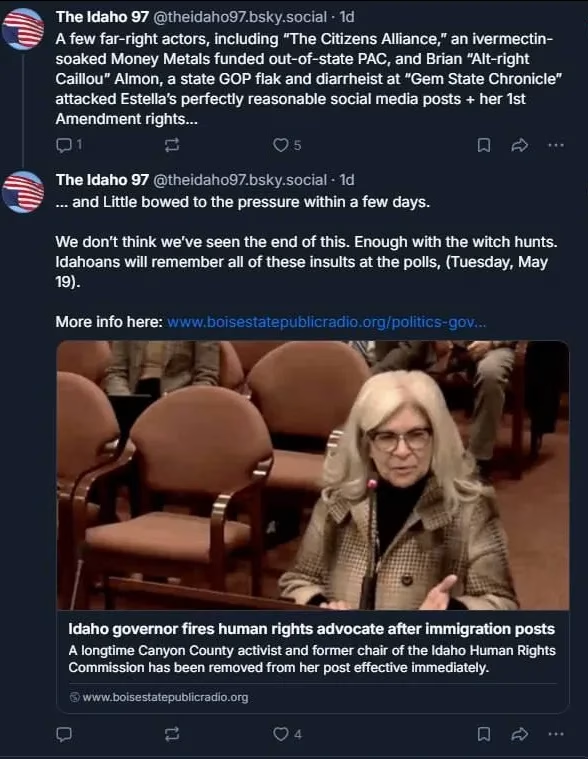
Christina Davis at the Washington Digest had a much more reasonable perspective:
This is a principle so basic it shouldn’t need defending. A commissioner tasked with adjudicating civil rights matters — including, potentially, cases touching on immigration — cannot publicly campaign against the federal agencies enforcing immigration law and then claim to be a neutral arbiter. The two postures are incompatible. Zamora wasn’t fired for holding private opinions. She was removed after broadcasting those opinions on social media while occupying a position that demands impartiality.
As I said on X following news of Zamora’s firing, she is perfectly free to speak her mind, but she does not have a right to a government position. The governor has plenary power to appoint commissioners, and there is no reason he must reappoint someone simply because she has been there for thirty years.
As with the flag debate, this is not specifically about ideology, but about roles. Our counterparts on the left do not seem to believe there is any limit to the scope of government. This leads to confusion about when someone is acting as a private citizen and when someone is acting as an agent of the state. Government should not be shutting down private free expression, but neither should it be picking sides in ideological battles.
During Monday’s debate on H561, Rep. Joe Alfieri made a salient point: if this were about cities flying a flag the left considered offensive—such as the Confederate flag—how many members of the committee would be voting differently? Democrats seem to have no problem recognizing the danger of divisive state-sponsored speech when it involves ideas they oppose. But when it is an issue they support—whether Boise flying the pride flag or an Idaho Human Rights Commissioner agitating against ICE—they become valiant defenders of free speech.
In America, government is of the people, by the people, and for the people, as Abraham Lincoln famously said. But that should not fool us into thinking that governing is the people. As an entity, government has the authority to create and execute laws, and it retains a monopoly on violence to enforce them. It must therefore be kept strictly in check, lest it use that authority to oppress individuals or groups disfavored by those in power. When the City of Boise flies the LGBTQ+ pride flag over City Hall, it is not saying “all are welcome,” but rather, “agree with our agenda or get out.”
One testifier, vexillologist Charley Beal of the Gilbert Baker Foundation—named after the designer of the original rainbow flag—claimed that the idea of a rainbow representing humanity predated the story of Noah in the Bible. For Christians and Jews, however, the rainbow has always represented God’s promise not to flood the earth a second time as punishment for sin. Beal attempted to claim that the rainbow flag did not specifically represent LGBTQ+ people, but all humanity, including sexual minorities he argued have been marginalized throughout history.
That claim was contradicted by nearly every other testifier, including Boise Mayor Lauren McLean, who repeatedly stated in response to committee questions that the pride flag was meant to signal to vulnerable and marginalized communities that they were welcome in her city.
As my Idaho Signal colleague Matt Edwards wrote in The Blaze last year, flags have always represented conquest:
Americans can shrug at this trend or take it seriously. Civic symbols either unite a people or divide them. A city hall flagpole should unify, not segment communities into competing camps. A political rally should appeal to voters as Americans, not as factions drawn from overseas allegiances.
The answer is not outrage or retaliation. The answer is clarity: reclaim civic symbols that express shared loyalty to a shared country. Fly the U.S. flag. Fly state flags. Encourage communities to celebrate their heritage while affirming the nation that binds them together.
The flag flying over Boise City Hall represents conquest by an ideology that seeks to redefine marriage, force women to share restrooms and changing rooms with biological men, and indoctrinate children from birth to believe that this ideology is morally correct, while the traditional Christian worldview is not merely wrong, but evil.
Rep. Hill is exactly right: government buildings should only fly flags that represent all of us. That means the American flag—Old Glory, the stars and stripes that have represented freedom and liberty for 250 years. That means the Idaho flag, the blue and gold symbolizing our state’s prosperity and liberty. And that means city flags that do not push ideological agendas, but instead reflect the unique characteristics every citizen can appreciate.
Americans once understood that different parts of society occupied different spheres. Family, church, community, and government each had their own authority, but they remained distinct. At both the lowest—and highest—level was the individual, what Ayn Rand called “the smallest minority.” As citizens of the Republic, we have rights, but we also have responsibilities. We ultimately owe our allegiance to God, who will one day judge even what we do when nobody is looking. Each of us has a conscience that guides us toward right and wrong.
Today, many of those spheres have been eroded, their boundaries blurred, until all that remain are individuals and the government. This, too, the left seeks to erase—to deny any meaningful distinction between public and private life. The result is a worldview in which a government flying divisive ideological flags and a civil rights commissioner expressing hostility toward law enforcement are treated as “private,” while expressions of traditional Christian views in public are increasingly viewed as suspect, inappropriate, or even illegal.
There is a word for that kind of society—one in which the boundary between public and private no longer exists: totalitarianism. A totalitarian society does not require a dictator or omnipresent military occupation. It requires only a populace that has come to accept that there is no difference between public and private life, between the individual and the state. Consider the motto of Benito Mussolini’s Fascist government in 1930s Italy:
Everything in the State, nothing outside the State, nothing against the State.
Whether intentionally or not, some of the testimony Monday morning reflected that very view—that restricting expression by government entities is equivalent to restricting individuals themselves. We must be able to say, without confusion, what belongs to the realm of government and what belongs to the individual, the family, and the community. A truly free society depends on clear boundaries between public authority and private conscience. The experience of both the flag bill debate and the reaction to Estella Zamora’s firing suggests an increasing refusal on the left to recognize those boundaries. Liberty is endangered when the line between government and citizen becomes blurred.
Feature image created with Microsoft Copilot.
Gem State Chronicle is a reader-supported publication. To receive new posts and support my work, consider becoming a free or paid subscriber.
The Gem State Chronicle delivers daily analysis, op-eds, press releases, and Idaho Insider updates — free to your inbox.
Free newsletter · Unsubscribe anytime · View on Substack

About Brian Almon
Brian Almon is the Editor of the Gem State Chronicle. He also serves as Chairman of the District 14 Republican Party and is a trustee of the Eagle Public Library Board. He lives with his wife and six children in Eagle.