On Wednesday morning, the Senate State Affairs Committee took testimony from Estella Zamora of Caldwell regarding her reappointment to the Idaho Human Rights Commission (IHRC). Zamora is one of nine commissioners, each appointed by the governor, who oversee the IHRC, which was created by the Legislature in 1969.
Idaho Code 67-5901 explains the purpose of the IHRC:
(1) To provide for execution within the state of the policies embodied in the federal Civil Rights Act of 1964, as amended, and the Age Discrimination in Employment Act of 1967, as amended, and Titles I and III of the Americans with Disabilities Act.
(2) To secure for all individuals within the state freedom from discrimination because of race, color, religion, sex or national origin or disability in connection with employment, public accommodations, and real property transactions, discrimination because of race, color, religion, sex or national origin in connection with education, discrimination because of age in connection with employment, and thereby to protect their interest in personal dignity, to make available to the state their full productive capacities, to secure the state against domestic strife and unrest, to preserve the public safety, health, and general welfare, and to promote the interests, rights and privileges of individuals within the state.
The 1960s saw sweeping changes in American law designed to prevent discrimination on all fronts. Some conservatives at the time, such as Sen. Barry Goldwater of Arizona and members of the John Birch Society, were concerned that these laws went too far, erasing the right of free association in their quest to bring inclusion to all. Christopher Caldwell has written about how the Civil Rights Act of 1964 created a new, unwritten constitution—one that, in practice, supersedes our Constitution, placing equity as a higher aim than individual rights.
Yet the law is the law, and Idaho followed the lead of the federal government in enforcing anti-discrimination statutes. In her testimony, Zamora said that the most common issues before the IHRC were related to workplace allegations of discrimination based on disability.
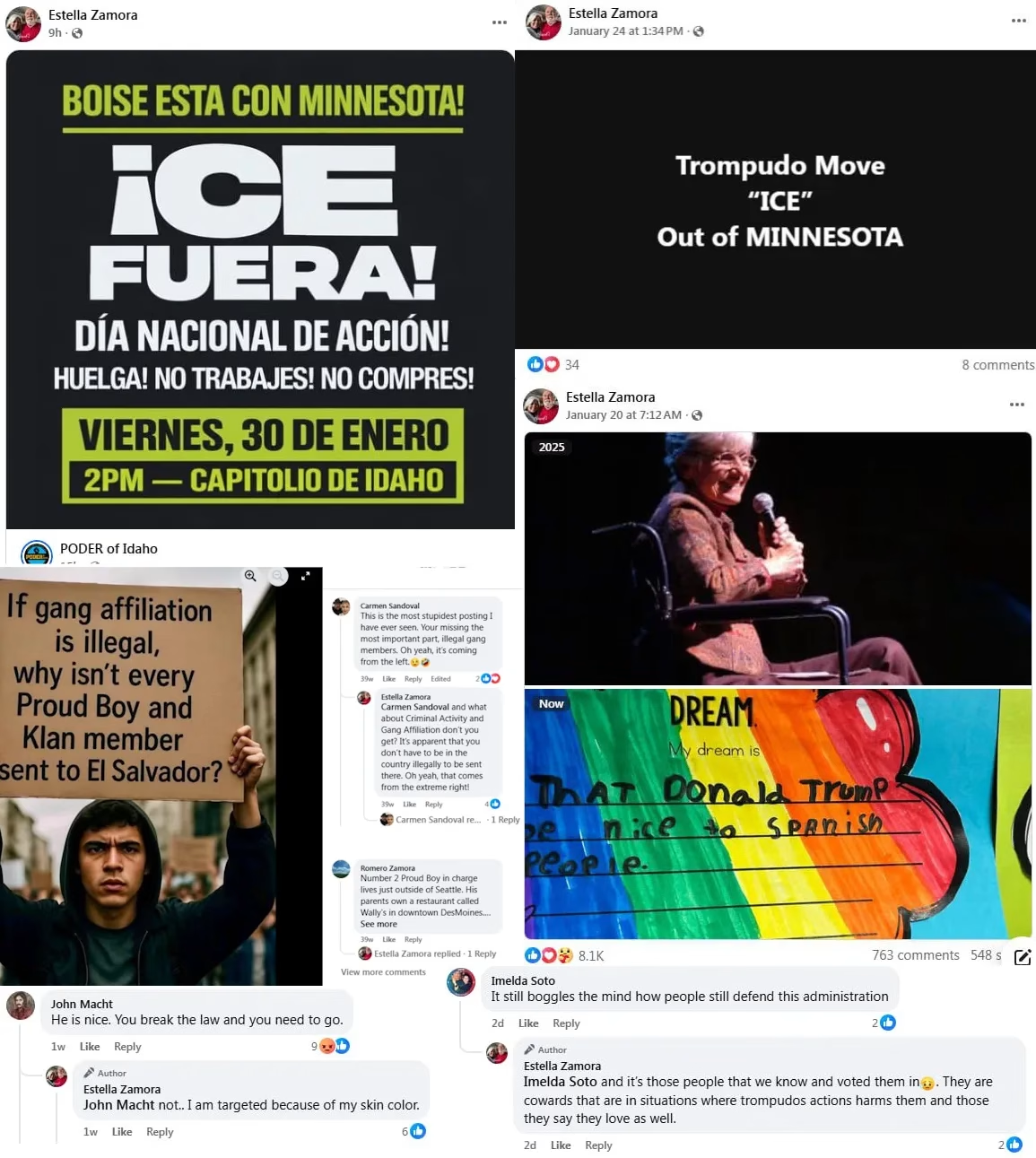
However, the IHRC, and Zamora herself, appear to have a much broader focus. A quick perusal of Zamora’s Facebook page shows constant agitation against President Trump, Immigration and Customs Enforcement (ICE), and the rule of law in America:
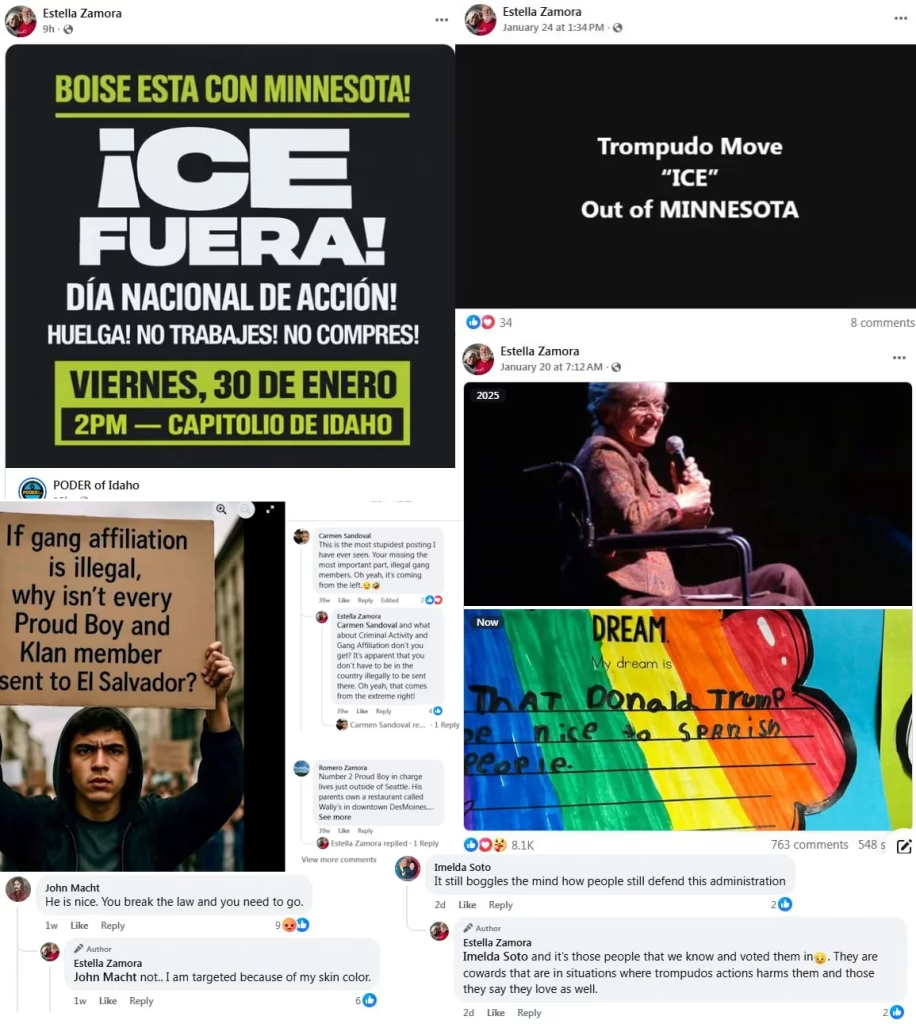
Zamora claims that she has been “targeted” because of her skin color, and that Trump’s immigration enforcement actions are driven by racism. She has reposted calls to protest against ICE from PODER of Idaho, an explicitly pro–illegal alien organization that uses the imagery of militant communism.
Was Gov. Brad Little aware of Zamora’s public proclamations before reappointing her to the IHRC? While it’s easy to say that one’s personal political positions shouldn’t matter, if an appointee were found posting white supremacist rhetoric, I don’t think anyone would support their appointment to a government board—especially one as politically sensitive as the IHRC. And rightly so. If you’re tasked with applying anti-discrimination law in an objective manner, then you need to see things objectively, not through the lens of critical race theory or any form of ethnic chauvinism.
I expect that if Zamora responds to the attention drawn to her nomination, she will once again claim that she is being targeted because of her ethnicity. That’s self-evidently false. As just one example, the same conservatives in Idaho who support President Trump’s efforts to enforce immigration law voted overwhelmingly to elect Raúl Labrador, born in Puerto Rico, as our attorney general. Conservatives believe in meritocracy and a color-blind application of the law.
This appointment has real impact; it’s not just a dog-and-pony show. The commissioners on the IHRC have real authority to investigate claims of discrimination based on a set of protected classes, and then bring the weight of government down against employers or organizations accused of that discrimination.
Additionally, the IHRC has a tremendous bully pulpit to issue statements on a variety of issues. A look at the commission’s social media accounts shows a close relationship with the Wassmuth Center for Human Rights, a private organization that has a decidedly left-wing identity-politics perspective. The Wassmuth Center is a big proponent of the “Everyone Is Welcome Here” campaign in public schools, which Attorney General Labrador labeled as “woke indoctrination”:
Related movements like “Everyone is Welcome” similarly incorporate symbols from the “Intersex-Inclusive Pride Flag” and promote LGBTQ+ ideology through educational messaging. A simple visit to any of these organizations’ websites reveals their unmistakably political nature — complete with progressive activism, social justice messaging and ideological programming that extends far beyond genuine hospitality. When teachers display signs bearing the same name as these political organizations, what are parents supposed to think?
I discussed Zamora’s appointment and the history and duties of the IHRC on Idaho Signal this morning:
During the conversation, I briefly touched on the way in which people like her are attempting to cast immigration enforcement as a human rights issue, rather than a rule-of-law issue. That is perhaps my biggest concern should she continue in her position on the commission. The IHRC already dabbles in left-wing social justice—will it start to use its authority and weight to oppose immigration enforcement? Will it twist the rule of law into an explicitly racial or ethnic controversy?
When ICE detained more than 100 suspected illegal aliens following a law enforcement raid on an illegal gambling operation in Wilder, Gov. Little issued a statement in support of ICE. Yet now he reappoints a commissioner who explicitly opposes ICE, claiming that it is engaged in racism, and that Trump supporters are “cowards.” He was either unaware of these statements, or he does not believe they have bearing on her performance as a commissioner. Either way, it is up to the Senate to correct this mistake and reject her nomination.
The Senate State Affairs Committee will vote on Zamora on Friday, either recommending that the full Senate affirm the governor’s reappointment or reject it. You can use the button below to share your thoughts with the committee:
I sense an unspoken perception that agencies such as the IHRC are part of the left’s domain. Why is that? Why do we cede this ground to the other side, which stands opposed to everything we believe in as Americans? We believe that civil rights apply without regard to race, ethnicity, sex, religion, or any other factor. We believe that social justice is a perversion of real justice—that it puts a thumb on the scale in favor of certain people or groups because of their race, ethnicity, sex, religion, or other factors. Someone who views immigration enforcement through the lens of ethnicity rather than the rule of law should not sit on such an influential commission.
I believe that the authority and reach of the IHRC itself is also fair game for discussion in the future. For now, it’s important to ensure that its leaders believe in America and in the ideal that we are all equal before the law. The people of Idaho deserve nothing less from their government.
Gem State Chronicle is a reader-supported publication. To receive new posts and support my work, consider becoming a free or paid subscriber.
The Gem State Chronicle delivers daily analysis, op-eds, press releases, and Idaho Insider updates — free to your inbox.
Free newsletter · Unsubscribe anytime · View on Substack

About Brian Almon
Brian Almon is the Editor of the Gem State Chronicle. He also serves as Chairman of the District 14 Republican Party and is a trustee of the Eagle Public Library Board. He lives with his wife and six children in Eagle.