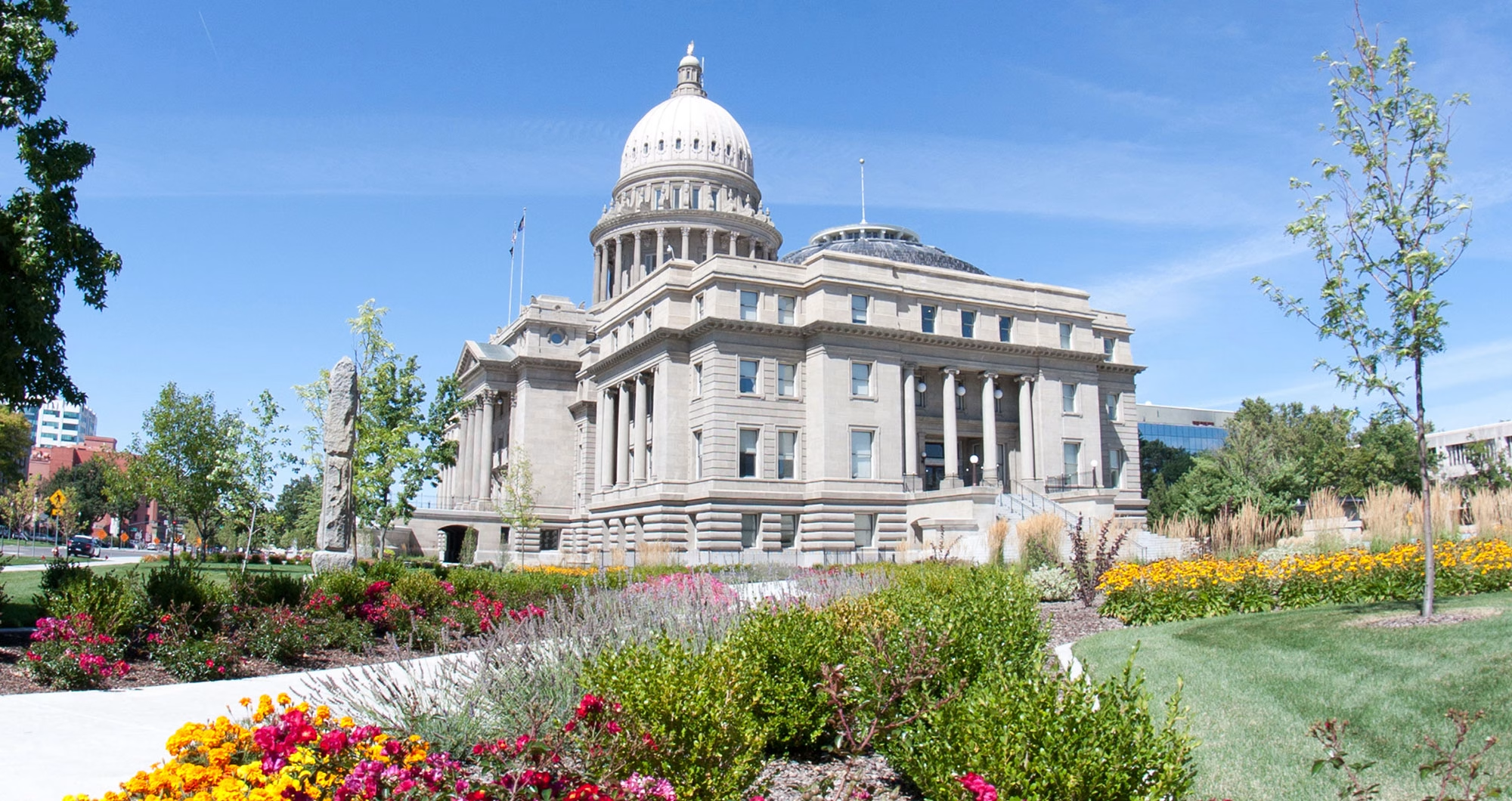
This morning, Rep. Heather Scott presented a draft bill to the House State Affairs Committee that would eliminate the Idaho Commission on Hispanic Affairs (ICHA). The committee deadlocked 7-7, meaning it will not be printed as a bill. However, I’m told it will return with minor changes.
Back in 2024, I wrote about the ICHA and its place within Idaho government:
In 1987, the Legislature created the Idaho Commission on Hispanic Affairs (ICHA), with a broad mandate to promote Hispanic people and culture. Original appropriations for the ICHA in fiscal year 2024 totaled just over $500,000. While not a significant amount in the grand scheme of things, it is still a curious use of taxpayer dollars.
The ICHA was created during the tenure of Democratic governor Cecil Andrus. At the time, Hispanics—defined as those who trace their origin or ancestry to Spanish-speaking countries or cultures, particularly from Latin America—numbered about 40,000 Idaho residents, or 5% of the state’s population. According to the most recent demographic estimates, Hispanics now total roughly 300,000, making up 15% of Idaho’s population.
The late Justice Antonin Scalia used to characterize programs meant to “level the playing field” for racial minorities, such as affirmative action, as racial entitlements, noting that once established, they are difficult to repeal—especially as the groups they benefit grow more politically influential. It’s almost paradoxical: once a minority group reaches a level that demonstrates it no longer needs special government programs, it may now have enough influence to maintain them. Is that dynamic at play here with the ICHA?
A special government commission created four decades ago to promote civic engagement and economic prosperity in a relatively small ethnic group now faces significant barriers to repeal, perhaps because that group is much larger and more politically active.
Of the seven “no” votes on Rep. Scott’s routing slip, two came from Democrats, while several others came from Republicans whose districts are characterized by farms and dairies that rely heavily on migrant labor from Hispanic countries. Rep. Bruce Skaug appeared concerned about the rapidity of winding down the commission.

When I wrote that article in 2024, I noted that Executive Director Margie Gonzalez had served in that position for more than twenty years. The ICHA website looked like it had been around for awhile as well. Gonzalez retired in 2025, and Gov. Brad Little appointed Annette Tipton in her place. Tipton had previously worked in the Office of the State Controller and in the private sector at JPMorgan Chase, and she came within just a few votes of unseating longtime Democratic representative Steve Berch in District 15, west Boise.
I had the pleasure of meeting Tipton throughout that campaign and found her to be earnest, data-driven, and a tremendously hard worker. From all accounts, she has done a great job at the ICHA, trimming the budget, eliminating inefficiencies, and returning its focus to its core mission. She even updated the website.
Members of the DOGE Task Force praised Tipton’s work when she testified before the committee last month. However, most everyone on the committee agreed that it was time to—if not completely eliminate the ICHA—transition it to private funding.
This is the core conversation. As great a job as Tipton has done, legislators and citizens must ask whether a taxpayer-funded commission dedicated to a single ethnic group is the proper role of state government. Just because something may be a good idea with noble goals does not necessarily mean it should be funded by taxpayers.
Any other such commission would sound unusual, wouldn’t it? According to self-reported surveys, Idahoans of English and German ancestry each make up about the same share of the population as Hispanics. What about people of Irish, Norwegian, Russian, or Basque descent?
It seems paradoxical that Hispanics are just as much a part of Idaho’s culture as any other ethnic group, yet a dedicated taxpayer-funded agency exists for them. Are we a melting pot, or aren’t we?
Government should serve all the citizens of Idaho equally, no matter their ethnic background or other innate characteristics. In 2009, the Legislature defunded the Idaho Women’s Commission, though it still remains on the books in vestigial form.
I think the idea floated in DOGE to shift funding away from taxpayers to private donations is a reasonable one. Rep. Heather Scott pointed out in that December meeting that nonprofits like the Idaho Hispanic Foundation already exist, with six-figure budgets, so covering the ICHA’s modest $500,000 budget should not be a problem.
I appreciate my Hispanic neighbors in Idaho. I have especially high regard for great Republican fighters like Annette Tipton and the many Ada County precinct committeemen I’ve worked alongside over the years. I believe we can come together to maintain this great state for our posterity, and I don’t think we need a special government agency to do it.
Feature image by CSHQA
Gem State Chronicle is a reader-supported publication. To receive new posts and support my work, consider becoming a free or paid subscriber.
The Gem State Chronicle delivers daily analysis, op-eds, press releases, and Idaho Insider updates — free to your inbox.
Free newsletter · Unsubscribe anytime · View on Substack

About Brian Almon
Brian Almon is the Editor of the Gem State Chronicle. He also serves as Chairman of the District 14 Republican Party and is a trustee of the Eagle Public Library Board. He lives with his wife and six children in Eagle.