On Monday, July 6, a homeless man named Ross Wardlaw allegedly murdered 25-year-old Jordan Habst, stabbing him multiple times while Habst walked along the Boise Greenbelt, for no apparent reason.
Late in the evening on Saturday, July 11, an Oregon man named Javier Ortiz allegedly assaulted a woman walking along the Greenbelt, pulling her off the path, apparently intending to do who knows what before nearby residents heard her screaming and intervened.
Following the earlier incident, Boise Police issued “safety reminders” for Greenbelt users, reiterating them after the attempted kidnapping:
…the Boise Police Department is asking everyone using the Greenbelt to remain aware of their surroundings and to take common-sense safety precautions, including:
- Stay alert and be aware of your surroundings.
- Walk, run, or bike with others whenever possible.
- Avoid wearing headphones or anything that limits your ability to hear or observe your surroundings.
- If you see something suspicious, say something and report it to police.
As an added safety measure and as part of the investigation, Boise Police have increased patrols along the Greenbelt.
Is this the Boise Greenbelt we’re talking about, or the Baghdad Green Zone? Should citizens be required to treat a stroll through the park like an excursion into a war zone?
House Speaker Mike Moyle and Rep. Bruce Skaug condemned the City of Boise and Mayor Lauren McLean for failing to enforce state law regarding vagrancy, issuing a press release this week:
“This attack is a tragedy,” said Rep. Bruce Skaug, “But it is even more horrific because it may have been prevented.”
In 2025, the Idaho Legislature passed a S1141a. The law requires cities to enforce bans on camping or overnight stays in public places, and requires cities to clean up such encampments and campers.
“The law was not written to criminalize homelessness,” said House Judiciary and Rules Committee Chairman Bruce Skaug, who co-sponsored the bill with Sen. Codi Galloway. “The law was written to protect citizens from mentally unstable people who camp in public places. If the City of Boise had followed the law, that young man would likely be alive. My heart goes out to the victim’s family. They should consider hiring a wrongful death attorney for possible action against the City of Boise.”
Legislative leaders said the law is clear, and want to know why the camping ban has not been enforced along the greenbelt and city parks.
“The law doesn’t need to be strengthened or changed — it just needs to be followed,” said Speaker of the House Mike Moyle. “Idahoans who use the Boise greenbelt, float the Boise River or visit a downtown restaurant should not have to fear for their safety because Boise Mayor Lauren McLean won’t follow the law. We are a nation of laws, and Idahoans expect our public officials to follow the law. It is sad and infuriating to see a possibly preventable crime occur because Boise won’t enforce the law.”
Moyle and Skaug have requested and been assured, by the Idaho Attorney General, that potential legal options against the City of Boise are being reviewed.
Senate Bill 1141, sponsored in 2025 by Rep. Bruce Skaug and Sen. Codi Galloway, prohibits public camping in large Idaho cities, including Boise. Every Democrat voted against the bill, along with Sen. Jim Guthrie, and someone vandalized a fence in Galloway’s district, accusing her of hating the homeless. After Gov. Brad Little signed S1141 into law, Boise Mayor Lauren McLean denounced the legislation, claiming it would make it harder to address homelessness.
Now a man is dead because Boise refused to enforce state law regarding public camping, and the rhetoric coming from Boise PD treats it as though it were a random act of nature rather than the result of deliberate policy choices.
Former Solicitor General Theo Wold discovered a clip of a local news reporter interviewing alleged Greenbelt murderer Ross Wardlaw only two weeks ago. In the clip, Wardlaw praises the cooling stations provided by Our Path Home, a public-private partnership intended to address homelessness. Yet this situation demonstrates how such programs often subsidize homelessness rather than solve it, and they did nothing to stop Wardlaw from allegedly killing an innocent traveler.
This is unfortunately not the first time I’ve had to argue about how threats to public safety are allowed or even encouraged by left-wing officials. Last September, following the brutal murder of Iryna Zarutska on a Charlotte light rail train by a career criminal with mental health issues, I wrote about how tolerating crime is a policy choice:
America has forgotten the idea of justice. Our ancestors knew that criminals must be punished and that threats to social order must be removed. Today, we have it backward. We have come to believe that justice is served by not punishing criminals, and our compassion is directed not to innocent victims but to the perpetrators themselves.
DeCarlos Brown Jr. was not a productive member of society. He repeatedly ignored the law yet faced no meaningful consequences. A person like that would have long ago been incarcerated or executed in past societies, but in America today he was free to commit murder. The magistrate who released him most recently, Teresa Stokes, is not a lawyer—she apparently never passed the bar—but has the responsibility of deciding the fate of criminals in North Carolina. She is also the director of operations for Second Chance Services, a mental health and addiction clinic in Charlotte.
Is there a conflict of interest in a magistrate who releases criminals that could then potentially be taxpayer-supported clients of her firm?
Indeed, we are told that rampant crime is just part and parcel of life in 21st-century America: that being assaulted, robbed, carjacked, or even murdered is an unavoidable part of living in big cities. Democrats protested when President Donald Trump used his authority to mobilize the National Guard to fight crime in Washington, D.C., seemingly more outraged at the crackdown than at the crime itself.
Crime is treated like a force of nature, something we must simply live with, rather than a deliberate policy choice. It’s not as if America lacks the resources or the willpower to address crime—after the unauthorized tour of the Capitol on January 6, 2021, the FBI and other law enforcement agencies devoted immense effort to investigating everyone who was anywhere near the building, arresting hundreds who simply walked through open doors.
Like many left-wing cities, Boise has decided to treat criminals as victims and mentally ill homeless people not as dangers to society, but as forces of nature. City leaders see themselves as acting out of compassion toward criminals, the homeless, and the mentally ill, but in doing so, they recklessly endanger innocent people like Jordan Habst, Iryna Zarutska, and the woman who was assaulted on the Greenbelt last weekend.
The point is that these problems can be solved, but modern progressive sensibilities do not allow them to be. If the City of Boise refuses to protect its citizens, then it falls to the State of Idaho to do so. Staying alert for danger is always prudent, but the Greenbelt should be safer than a war zone.
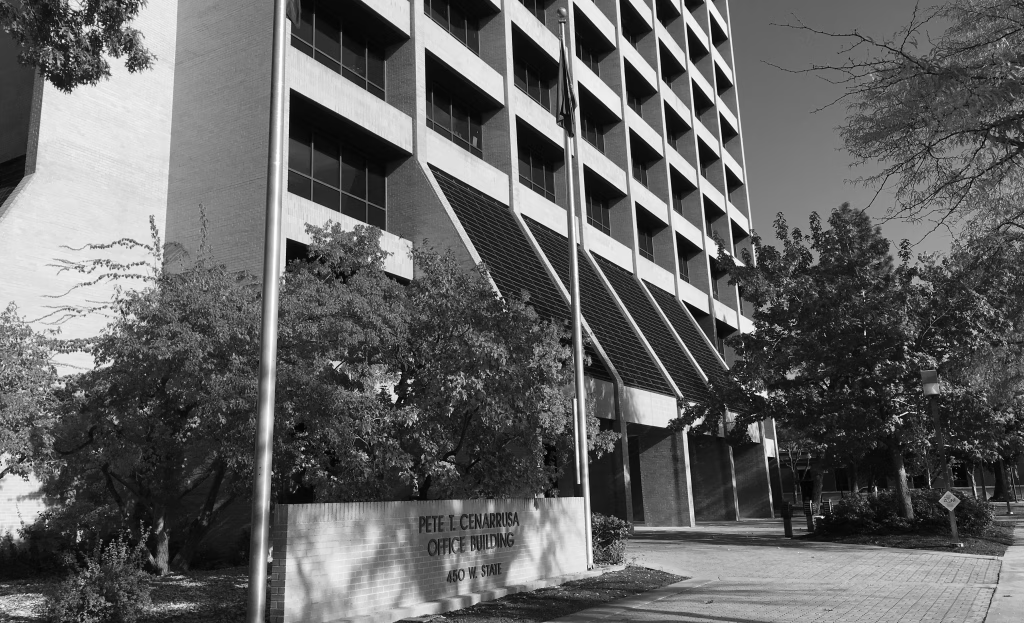
Feature image courtesy of the City of Boise.
The Gem State Chronicle delivers daily analysis, op-eds, press releases, and Idaho Insider updates — free to your inbox.
Free newsletter · Unsubscribe anytime · View on Substack

About Brian Almon
Brian Almon is the Editor of the Gem State Chronicle. He also serves as Chairman of the District 14 Republican Party and is a trustee of the Eagle Public Library Board. He lives with his wife and six children in Eagle.