By Todd Hoffman
In the film A Beautiful Mind, Russell Crowe portrays John Nash, a brilliant and troubled Nobel Prize–winning mathematician. Nash’s work centered on game theory, particularly the concept of Nash equilibrium. Game theory models situations where players face both aligned and competing interests, often producing outcomes that are suboptimal for all parties, despite the existence of mutually beneficial alternatives.
The Prisoner’s dilemma is the canonical example of Nash equilibrium. Two suspects are interrogated separately, and each is offered leniency for betraying the other. If both remain silent, both receive relatively light sentences; if one defects while the other cooperates, the defector goes free while the other is punished; if both defect, both receive harsher sentences. In the absence of coordination or trust, rational self-interest leads both to defect—the equilibrium predicted by Nash that is worse for both than mutual cooperation.
For those who follow Idaho politics, this pattern may feel less abstract than it sounds. In the legislature, it may take the form of an unpopular vote from a key member that strains caucus relationships and alienates constituents, or a committee chair quietly holding a bill, raising questions about transparency and process. In the executive branch, defensive responses to allegations of misconduct may erode public trust or undermine institutional effectiveness.
In the case of the legislature, there may be some logical rationale behind the outcomes when cases are viewed in their entirety. Lawmakers may face rewards or penalties invisible to the public, such as backdoor campaign support from special interests or pressure from key leadership figures behind closed doors. Viewed in light of all factors, the outcomes match behaviors predicted by Nash’s equilibrium. Legislators know that election cycles are long, and accountability can be diffused. An unpopular decision is a calculated trade-off made in self-interest.
In the executive branch, however, the calculus is murkier — producing outcomes that would likely leave Nash himself at a loss. Take the example of Idaho Fish and Game Commissioner Brody Harshbarger, who was recently arrested on seven poaching-related charges. The evidence against Commissioner Harshbarger appears highly credible and potentially very damaging. It includes a confession from his codefendant, eyewitness reports, and substantive forensic evidence collected from the crime scene.
Absent action from the Governor or the commission to remove Harshbarger, there is no outcome that will not cause significant reputational harm to the state, to the Fish and Game Commission, and to the governor. If Harshbarger is found guilty, it casts doubt on the integrity of all appointed commission members. If a poacher can be appointed to the body charged with preventing poaching, what does that say about the appointment process? If his charges are reduced or dismissed, the public will certainly draw the conclusion that he received preferential treatment unavailable to ordinary citizens.
A random citizen in Harshbarger’s situation would undoubtedly face harsh potential legal consequences. Idaho’s courts routinely come down hard on poachers. Sentences include lifetime loss of hunting privileges, significant jail time, and substantial restitution costs.
In Harshbarger’s dilemma, his co-defendant has already turned against him, confessing key details to law enforcement. His options are bleak, with no direct leverage over the outcome. However, the other commission members and the governor both have options that could potentially reduce or increase collective reputational harm.
The commission could intervene with a public letter of no confidence, urging Harshbarger to resign. This would at least signal integrity on the part of the remaining commission members, potentially mitigating reputational harm. The governor could remove Harshbarger from the commission, which would signal his own commitment to integrity, again potentially mitigating collective reputational harm.
Conversely, if either party fails to act, the outcome looks like passive acceptance of criminal behavior and weak leadership. Either outcome signals institutional tolerance of misconduct, compounding the reputational harm already done. In game theory, this scenario could be modeled in the below contingency table.
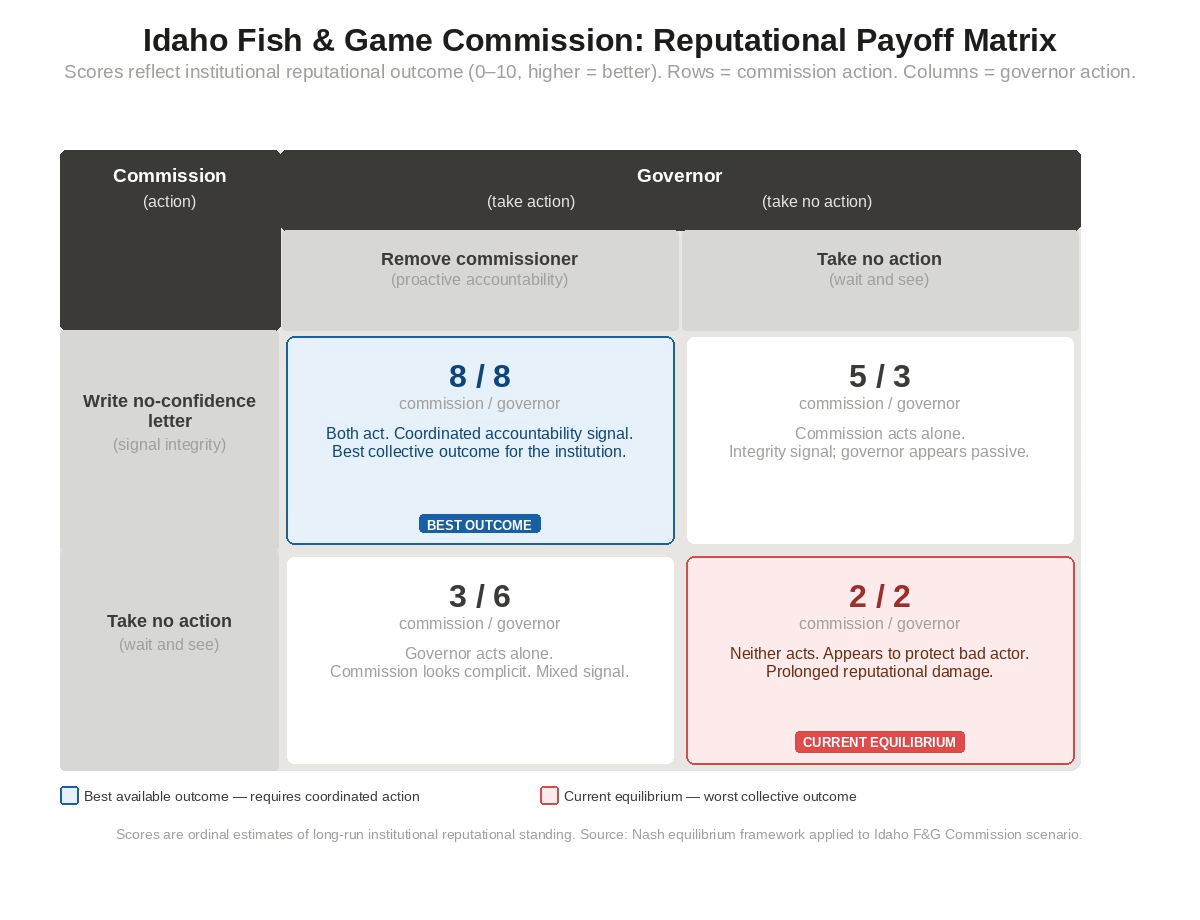
Unfortunately, the commission and the governor have chosen not to act, which, in light of Nash’s equilibrium, begs the question of what self-interests they are pursuing. There appears to be no individual or collective upside in failing to act, which unfortunately calls integrity into question.
Conventional government communications instinct defaults to keeping things quiet. However, with the incident already headlined on every hunting media outlet nationally, it’s safe to say that strategy only signals deliberate avoidance, likely prolonging the news cycle as readers eagerly wait for answers, all while IDF&G’s reputation continues to sour.
As a defense for inaction, others might say everyone deserves their day in court. Harshbarger certainly deserves due process; however, his due process rights do not reduce the standards of conduct expected of a member of the Fish and Game Commission, the governing body charged with setting the very rules Harshbarger is accused of violating.
Most organizations have strict codes of conduct for directors to address scenarios of harm to reputation and damage to stakeholder trust. In this case, the harm has already occurred, and Harshbarger is solely responsible for it, regardless of the outcome of his legal case. The rational move is visible to anyone willing to look at the math. Whether anyone in the executive branch is looking remains to be seen.
Methodology note: Scores in the payoff matrix are ordinal estimates of institutional reputational outcome on a 0–10 scale, assigned based on likely public perception, media cycle dynamics, and precedent from comparable cases. They are not actuarial measurements. The analytical value lies not in the precise numbers but in their relative ordering, which reveals why rational self-interest tends to produce suboptimal collective outcomes — exactly the dynamic Nash’s equilibrium predicts.

About Todd Hoffman
Todd Hoffman is a data scientist specializing in user behavior, pricing and experimentation, with a strong foundation in machine learning and product strategy. He lives in Coeur d'Alene.