By Tim Oren
The flood of bills hit the House floor this past week, with 20 significantly divided roll calls. The overall shape of the voting coalitions map is well established at this point:
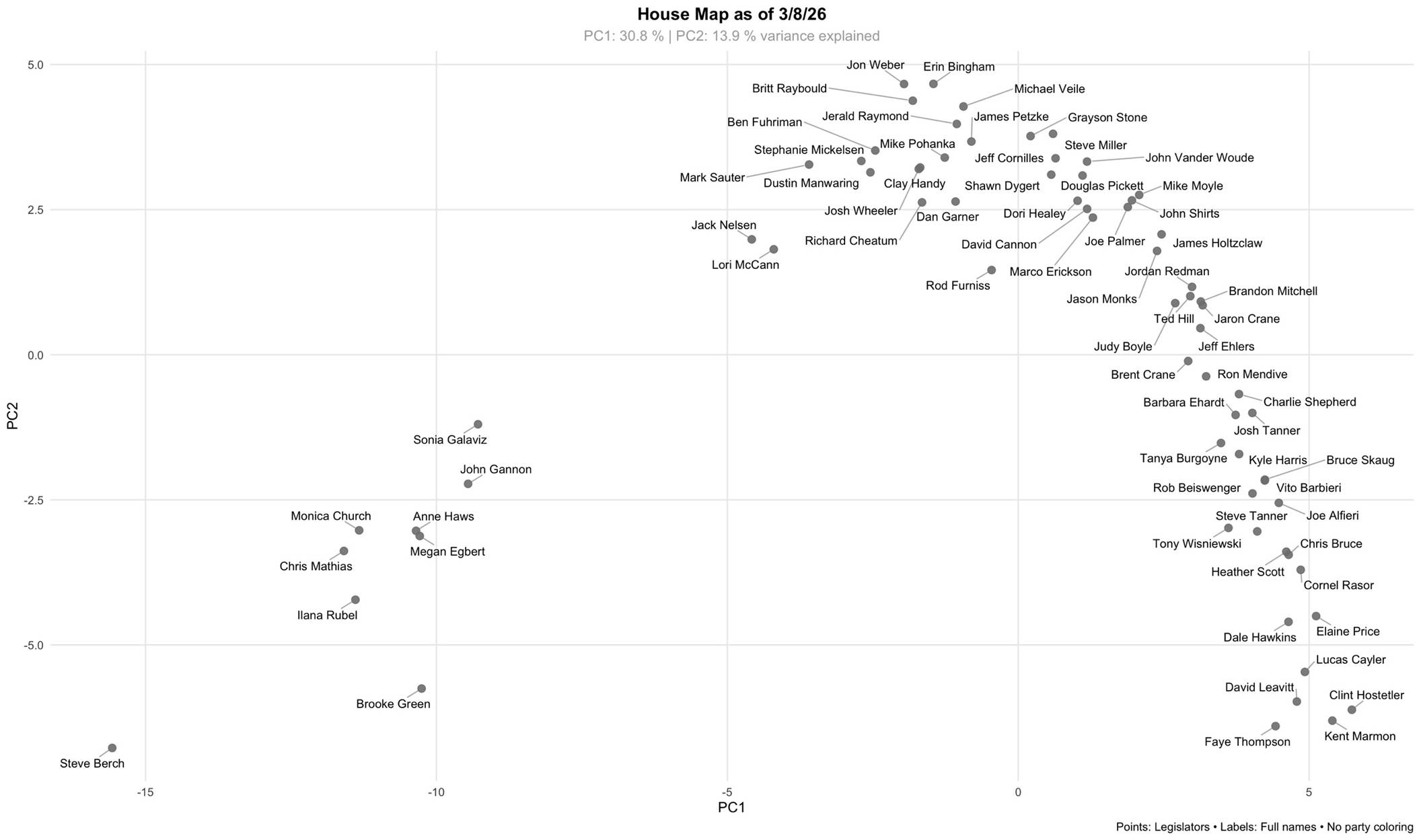
The remainder of the Democrats are continuing their migration to join Steve Berch in outer left field. Some R’s individual positions have shifted a bit, but with over 80 divided votes in the books by now, the map isn’t likely to change significantly until the spending bills hit the floor, if then.
With so many divided votes, it’s hard to pick one House bill to feature. So, I’ll ask this question: What would you call a legislator who voted against stopping taxpayers’ money going to public employee unions (H0745), against securing home-schooling rights in the Idaho Constitution (HJR009), against requiring Idaho sheriffs to cooperate with ICE (H0659), and against a budget rescission to partially fix Idaho’s deficit caused by overspending (S1331). I’d call them a Democrat. By that measure, here’s how the House is actually divided:
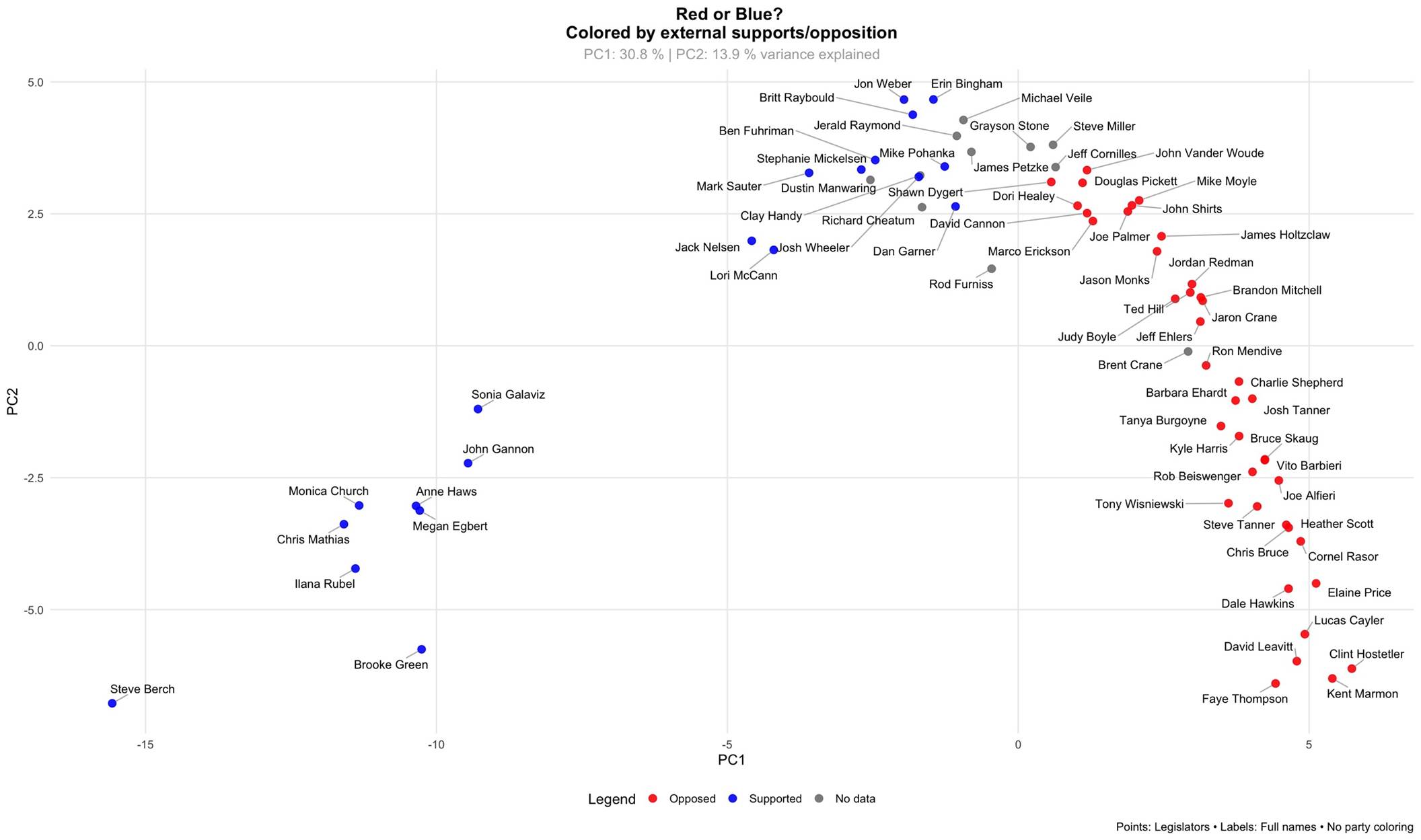
Those colored blue voted ‘nay’ on all of those bills. Credit where it’s due: Those colored red were ‘ayes’ on all. Those uncolored split their votes, or were absent for one or more. (Note that the legend on this chart is misleading. I’ve hijacked my usual aye/nay chart routine to give the traditional colors to the parties.)
The Senate continues on a more sedate pace. With some of the most contentious House bills stuck in Senator Guthrie and Foreman’s desk drawers, the Senate managed 10 divided votes, and now has over 30 in the books. The map has spread out a bit:
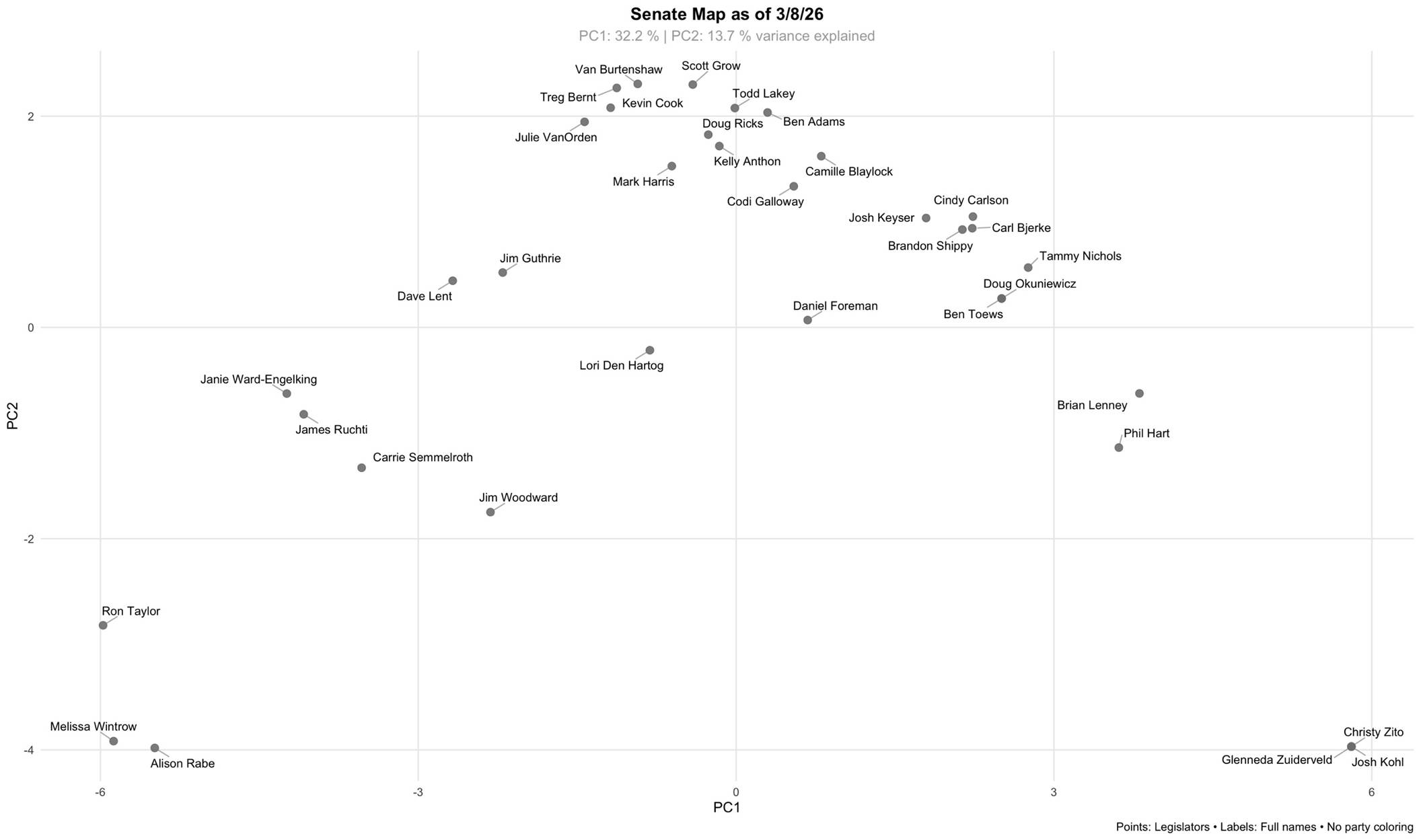
Note “R” Senator Woodward voting with the Democrat cluster, and Lent, Guthrie and Den Hartog in ‘D-adjacent’ positions. Meanwhile, the Gang of Eight’s Senate members continue to vote in lock step at the other end of the map.
This is the first week where both chambers voted on the same bill, the S1331 budget rescission, so here’s the Senate roll call:
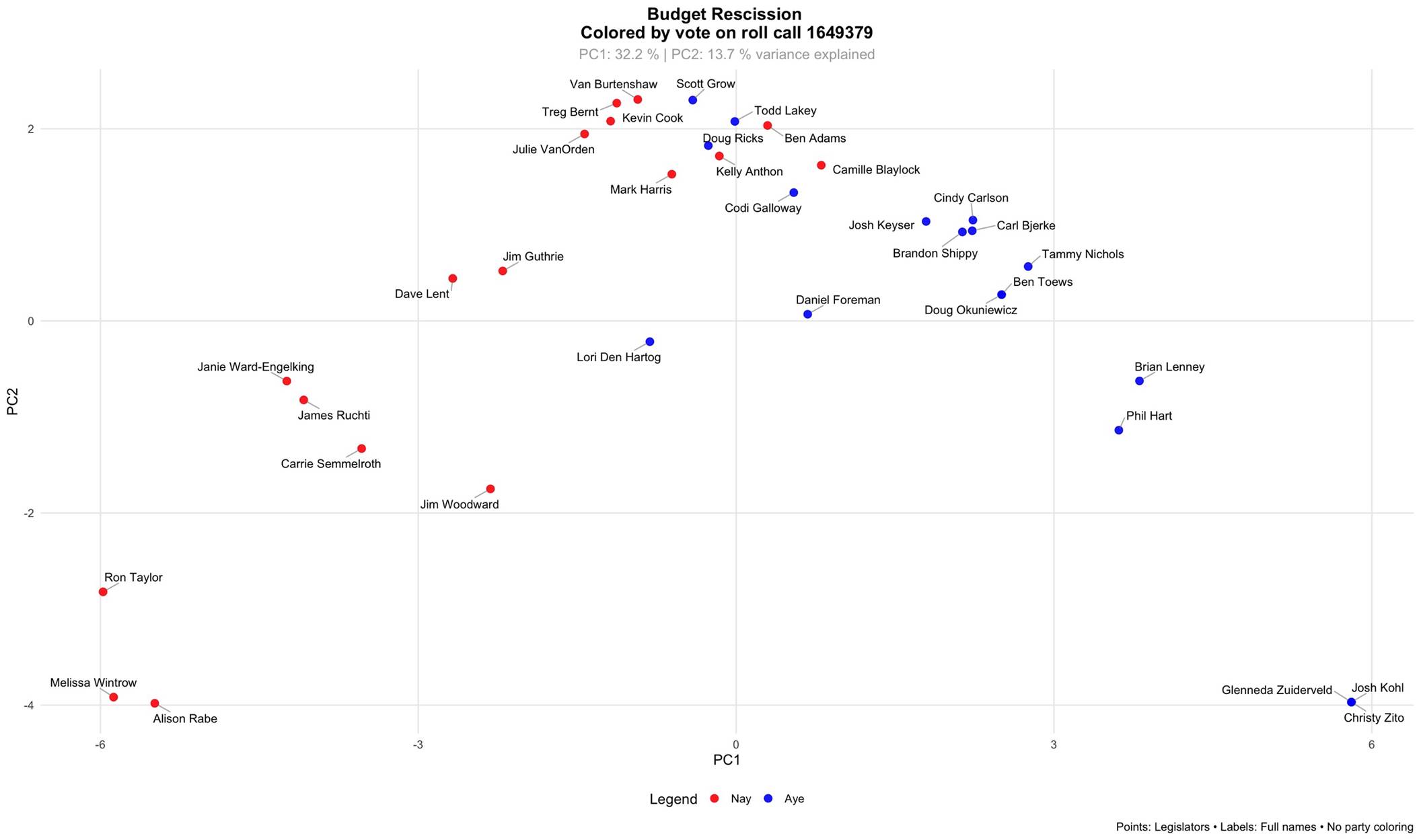
Those in red were unwilling to vote for a budget cut when we already know we’re in a deficit position due to the state government overspending its income. It does not bode well for their willingness to show fiscal restraint in the 2027 budget.
Afterwords
As always, remember the maps are laid out on automatically generated axes not having a simple English definition.
Those who read my earlier retrospective look at the 2025 session may remember the maps being clustered into effective voting coalitions. There are now enough compiled votes in the House to attempt this, so look for it next week.
With the primary season underway, I’ve begun a new project to analyze patterns in campaign contributions. Look for some preliminary experiments in my personal X account, and results may turn up here as the session draws to a close and the campaign gets rolling.

About Tim Oren
Tim Oren retired to Idaho after a 30 year career in Silicon Valley. Here he gardens, home-brews, teaches kids to shoot, and has applied his well-aged statistics degree to subjects such as educational funding and results, Idaho legislative race targeting, and now legislators' voting patterns. He is a contributor to the Idaho Freedom Foundation and a number of Idaho candidates.