I haven’t watched much professional sports lately—it really is a black hole for time and energy. But I kept an eye out as the Seattle Seahawks, a team I’ve rooted for since childhood, made their way through the NFL playoffs.
I often use football analogies in politics, and the past few games provided ample examples. Near the end of the NFC Championship Game, with the LA Rams trailing the Seahawks 31–27, coach Sean McVay chose to go for it on 4th down and 4 at the Seattle 6-yard line. McVay was hoping to take the lead rather than kick a field goal and give the ball back while down by one with less than five minutes to go.
However, the Seahawks defended a pass attempt, and the Rams turned the ball over on downs. LA was able to stop Seattle and get the ball back with 25 seconds left on the clock, but that was not enough time to march down the field and score a touchdown. Had the Rams elected to take the field goal, they might have been in that same position down one rather than four, which changes the calculus completely. In that situation, they may have been able to get into range and stop the clock in time to kick a game-winning field goal.
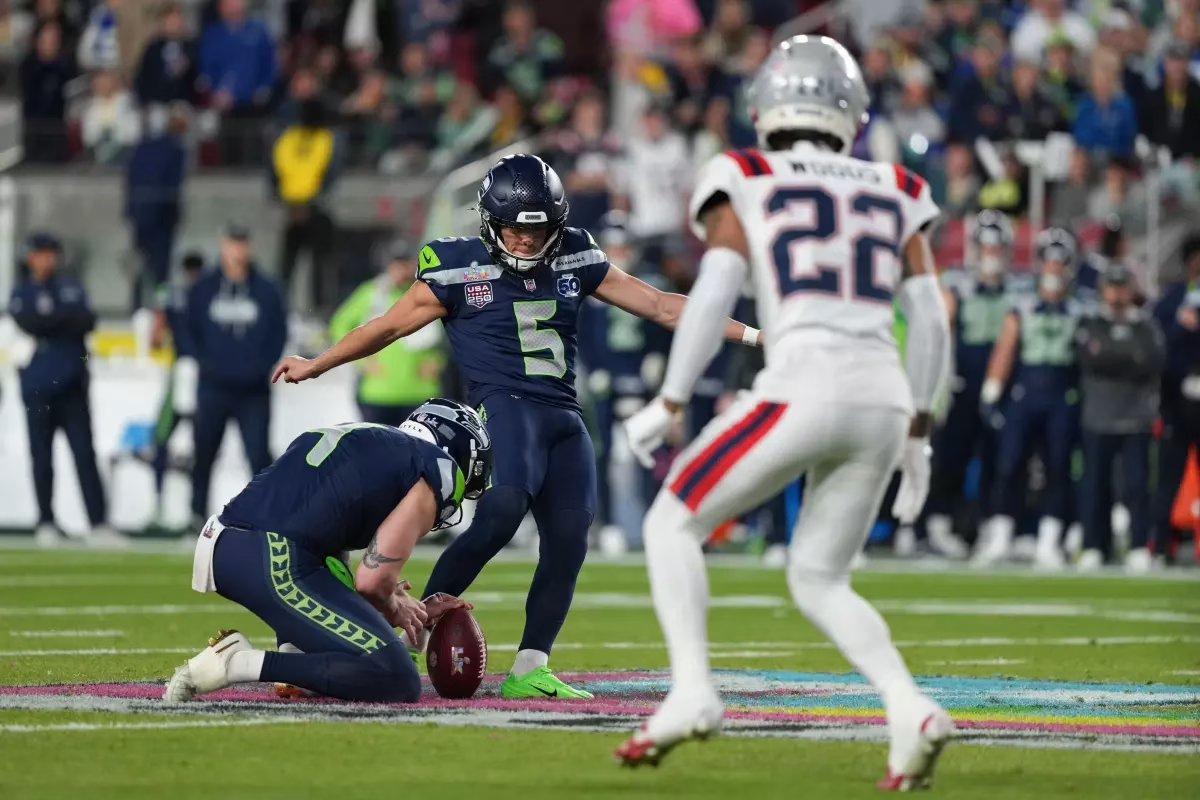
Seahawks coach Mike Macdonald played a much more conservative game in Super Bowl LX last weekend. Kicker Jason Myers was a perfect five for five in field goal attempts, as Seattle was content to take three points whenever it could. Punter Michael Dickson was active as well, with seven punts—three of them pinning the New England Patriots inside their own six-yard line.
There are times for aggression and times for playing conservatively. Seattle led 9–0 at halftime and 12–0 at the end of the third quarter, but despite the score, the game really wasn’t close. The Seahawks defense was completely dominating the New England offensive line, and the coach made the sensible decision to bank as many points as possible while consistently forcing the Patriots into terrible field position.
What does that mean for politics? It means take the points whenever they’re available and then come back for more. It means play the game that develops, not the one you imagined in your head.
I’ve noticed a storm brewing on the fringes of the internet regarding geoengineering and weather modification. A small but loud group, convinced the government is deliberately poisoning us by spraying chemicals into the sky, wants to ban the practice—whatever it might entail. This week, Sen. Tammy Nichols introduced a fairly narrow bill requiring transparency in cloud-seeding projects. That set off quite a tempest, with online activists accusing Nichols of selling out because her bill doesn’t ban everything all at once.
Without wading into the weather-modification debate itself, this seems like a case where kicking the field goal is the reasonable course of action. Sen. Nichols’ bill seeks to bring transparency and data to the practice of cloud seeding—data that will be necessary for any future debate about whether to continue allowing it. Until we have that data, all the outrage in the world won’t get any legislation past the finish line.
People often worry that taking the points now means forgoing chances for future action. That’s a legitimate fear. Consider the dueling E-Verify bills we’ve seen this year. The Senate version, sponsored by Sen. Mark Harris, looks very much like a veneer crafted to maintain the status quo and allow industries that have come to depend on illegal labor to claim the problem is solved. On the other hand, Rep. Jordan Redman’s bill appears much stronger, requiring all employers to use E-Verify to ensure their employees have the legal right to work in our country.
Passing the Senate bill, in this case, would be like kicking a field goal on second-and-goal. It would be a premature compromise when we have a chance for something much better.
One more example of why it often makes sense to take the points when you can and then come back for more: In Idaho, minors under age 17 are required to take a certified driver’s education course, whether through a public school or a private provider. Several lawmakers have worked for years to change the law to allow parents to teach their own children how to drive, after which the child could take the same test required for a driver’s license.
- In 2020, then-Rep. Christy Zito had a bill drafted to repeal driver’s ed requirements, but it failed to receive a hearing.
- In 2021, Rep. Brandon Mitchell sponsored a similar bill near the end of the session, which languished in the amending order.
- In 2022, Rep. Ron Mendive took up the issue, sponsoring a bill to allow parents to teach their own children how to drive. It passed the House overwhelmingly but failed to receive a hearing in the Senate.
- In 2023, Mendive sponsored another bill, which passed both chambers but was vetoed by Gov. Brad Little. Despite a veto-proof majority in the House, 22 members declined to override the governor on this issue.
- In 2024, Mendive came back again, this time with a narrowly-tailored bill to allow parents in rural areas lacking access to driver’s ed programs to teach their own children how to drive. This bill passed the Legislature and was signed into law.
- In 2025, Mendive carried a bill that made virtual learning a valid option for completing the in-class portion of driver’s ed coursework.
Rep. Mendive introduced yet another bill this week that would allow any parent to choose to teach their children how to drive. If passed, it would fulfill the original idea of giving parents more options while still maintaining the test that all minors must pass before receiving a full driver’s license.
This shows the value of perseverance in the political process. Proponents of allowing parents to teach their own children to drive have kicked a couple of field goals and, at times, punted to gain good field position. Now they stand at the goal line, ready to score a touchdown. They did not give up after the first bill failed to receive a print hearing, nor after the governor vetoed the 2023 bill. Accepting a compromise in 2024 did not stop them from returning again.
Good legislators and citizen activists must play the game as it presents itself. Once in a great while it might make sense to go for it on fourth down, but often the better course is to take the points and prepare to fight another day. Don’t be like the Rams coach, watching the Super Bowl from his couch because he got too aggressive at the wrong time.
Conservative legislative victories are possible if we play the game well—and that means playing patiently and smartly. I’ve spent the last six years watching what works and what doesn’t, trying to learn the game so I can help you play it wisely as well. Because this isn’t a game—it’s the future of our state, an inheritance for our posterity.
Feature image by Matt Slocum / Associated Press
Gem State Chronicle is a reader-supported publication. To receive new posts and support my work, consider becoming a free or paid subscriber.

About Brian Almon
Brian Almon is the Editor of the Gem State Chronicle. He also serves as Chairman of the District 14 Republican Party and is a trustee of the Eagle Public Library Board. He lives with his wife and five children in Eagle.