By Horace Cooper
Up until now the United States Postal Service (USPS) has been the nation’s only truly affordable and reliable package delivery service, available to all Americans, for the same rate, no matter where they live. This did not happen by accident. Our founders specifically gave the power to the federal government to provide such a service. And it came about as the result of deliberate policymaking by Congress that was designed to protect rural communities from the kinds of abuses they faced in the early 1900s, when private express companies took advantage of rural Americans by overcharging customers living in these areas or refusing to deliver to them at all.
Unfortunately, it now looks like the Postal Service is poised to engage in the very practices it was created to guard against.
The USPS recently announced a new initiative that would have shippers bid on access to its delivery network for “final mile” delivery to homes and business down to areas as small as a single zip code. In other words, instead of the same fee for every location in the country for packages, the USPS is setting up a mechanism to assess the fee based on the location almost the same way as FedEx and UPS.
Any individual who has tried sending a package with one of these private carriers knows that once your package destination goes out of the metropolitan areas, shipping prices go up dramatically due to steep “rural surcharges.” In the past the USPS didn’t discriminate on parcel pricing for the final destination or impose such surcharges, instead it simply used zones and charge reasonable rates for “final mile” delivery since a carrier was already going to be passing right by your home and the shipper was responsible for delivering the package up to the appropriate regional or district Post Office.
It is likely that around 10,000 of those “final mile” entry points are located in rural America and if this initiative goes into effect, the Postal Service wants companies and consumers—including you—to pay substantially more for the Postal Service to deliver packages to those addresses. To add insult to injury, service to rural America has already deteriorated as USPS has restructured how mail is collected and processed. For example, the Postal Service decreased the number of mail pickups from Post Offices in rural communities by half increasing delivery times to and from these areas.
Last summer scores of Boise residents gathered in the Capitol to ensure lawmakers were aware of the vital services provided by the USPS and how those could be at risk. At the rally, Lisa Bright, a Boise resident explained “As a disabled voter and American, I get my medicine through the mail, like a lot of Americans do,” Bright added, “To have it be privatized or disbanded for money means that my costs are going to go up, and as a disabled American, I then no longer could afford my medications.”
Just as the private carriers did at the turn of the 20th century, it seems the Postal Service plans to price squeeze rural America and the households of working families just like Lisa Bright warned us about. Companies in the city will be able to cheaply send parcels to people in other cities, but the price to do so to rural and less populated areas will rise.
The Postal Service is upfront about the purpose of these initiatives: to increase revenue for itself. But since postal carriers already have to deliver to every home in the United States several days a week, “final mile” delivery has been one of the few revenue bright spots for the agency because they could deliver third-party packages while also delivering first class mail and USPS packages. Consequently, companies realized this and regularly utilized the USPS for their deliveries. These steps have kept costs down for shippers (benefiting consumers) and insured a steady revenue to supplement USPS operations.
But all of that is changing. Under the new plan, shippers seeking to improve efficiency by transporting their packages directly to the Postal Service for “final mile” delivery will lose those efficiencies as well, due to the higher costs the Postal Service is imposing. They may resort to FedEx or UPS – costing the USPS the revenue they have captured to date from this model – or simply pass these costs on to rural residents. And why does the USPS need to increase revenue? Because they are losing over $9 billion a year— even though they already collect $80 billion in revenue from postage annually. The issue is not that they aren’t charging enough, it is that they have done nothing to control costs.
Clearly, Postmaster General David Steiner isn’t paying attention to what President Trump is trying to do to address Americans’ concerns about affordability and rural access. Instead, he is making things worse for rural Americans when he should be focused on a DOGE process to cut wasteful spending at the USPS itself.
Rural Idahoans are already struggling. The Postal Service should not add to their burdens. This bait and switch campaign needs to be stopped.

About Horace Cooper
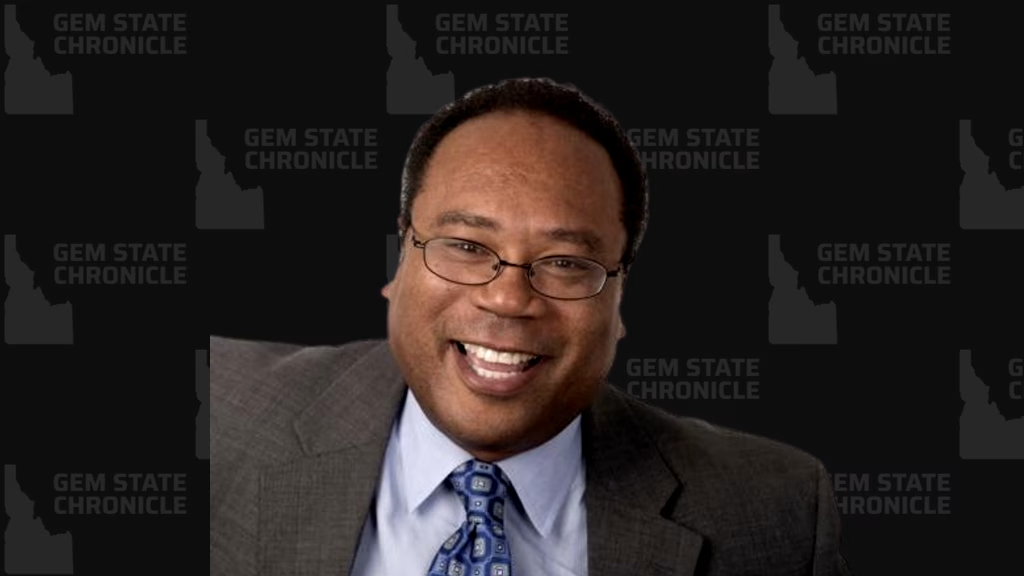
Horace Cooper is an author and legal commentator who appears frequently on Fox News.