When delegates to the Philadelphia Convention of 1787 drafted the Constitution, they did so in a fairly radical way. Lacking any actual legal authority to overthrow the Articles of Confederation, the Framers appealed to a higher authority—the people of the United States of America.
“We the people.” Every American schoolchild knows the first three words of the Constitution. By beginning the document this way, the Framers were acknowledging that governmental power derived from, as the Declaration of Independence stated, the consent of the governed. Who were “we the people”? The citizens of the United States—that new nation in the New World—who had secured their liberty through blood, treasure, and toil.
Over the course of our nation’s history, we have constantly grappled with the question of who is part of the “people.” Our word republic comes from the Latin phrase res publica, meaning the public thing, the public affair. The public consists of those who participate in the political process. Over the years, America has expanded who is able to vote and stand for office. Today, some places have even extended the franchise to noncitizens, and so the debate continues.
The Idaho Constitution begins with the same three words:
We, the people of the State of Idaho, grateful to Almighty God for our freedom, to secure its blessings and promote our common welfare do establish this Constitution.
Again, we confront the question of who are the people of Idaho. Is it anyone residing in the state? Registered voters? Those who can trace their lineage back to the 19th century?
Several years ago, I wrote about how leftists misuse the word “democracy.” That word comes from the Greek—demos, meaning people, and kratos, meaning rule. In that article, I wrote that progressives use the word “democracy” to mean any situation in which Democrats win, rather than true rule by the people:
For them, democracy does not mean the will of the people, rather it has come to mean a magic word that is synonymous with left-wing progressivism. In their minds, democracy means Democrats win, no more, no less. Once you understand this, it makes perfect sense that a dozen activists can come to a town hall and claim the council is ignoring the will of the people because they did not get their way.
Leftists who cannot accept the results of the last presidential election appeal to democracy to justify whatever it is they’re attempting to do. They justify protesting in the streets and impeding ICE agents by claiming they’re acting on behalf of “the people.” For nearly a century, the American left has claimed that street protests—and even riots—are the true, raw, unfiltered voice of the American people. Yet a loud mob does not always represent the will of the people. In the late 1960s, the antiwar movement was loud enough to force President Lyndon Johnson out of the 1968 campaign, but by 1972, Richard Nixon’s “silent majority” gave him a 49-state landslide.
Your high school history teacher might point to the fatal shooting of four students at Kent State University in 1970 by National Guardsmen as a moment that galvanized America against the war, law enforcement, and the establishment. But opinion polls at the time showed that 58% of Americans blamed the students for what happened, compared to only 11% who blamed the guardsmen.
Americans have always wanted law, order, peace, and safety.
While it’s easy to dunk on the left for falsely believing that their angry tantrums are representative of the will of the American people, our side can easily fall into the same trap. I can’t count the number of times I’ve seen social media posts from conservatives who are extremely concerned about one issue or another—from geoengineering to vaccines to Covid-era lockdowns to illegal immigration—that say something to the effect of, “We the people demand you address this problem!”
The problem is, again, who are the people? We all live in little self-selected bubbles that make it easy to forget that there are other people who see things differently. If we’re not consciously aware of these bubbles, then reality has a bad habit of overturning our expectations. For example, when election results are contrary to what we expect from our own experience, we can either reevaluate the situation with the benefit of new data, or we can retreat into cope by claiming that elections are rigged, or that we’re not going to vote our way out of this.
The 2022 statewide primary elections are instructive here. People within Idaho’s conservative circles were outraged at the way Gov. Brad Little handled the Covid lockdowns. While many were divided over who should replace him—then Lt. Gov. Janice McGeachin, newcomer Ed Humphreys, or even Steven Bradshaw or Ashley Jackson—they were sure that he had to go. Considering that Little had received only 37% of the vote in a three-way race in 2018, he seemed beatable. However, for a variety of reasons, he won handily, with more than 52% of the vote.
I wrote a post-mortem of the 2022 primaries in which I asked what seemed to me to be obvious questions: Why did things turn out the way they did? How did conservatives miscalculate the mood of the people of Idaho?
There is no use in crying, complaining, coping, or casting blame when your side loses an election. The best way forward is to analyze the race with a coldly objective eye, figure out what worked and what didn’t, learn from it, and move on to the next one. The lesson of the 2022 primary is that, despite a very loud contingent of conservatives who were fired up following the overreach of the Covid lockdowns, we were never an outright majority of voters. The largest number of Republican voters in Idaho are generally conservative on the big issues—pro-life, pro-gun, favoring low taxes and generally low regulation—but do not necessarily share some of the more esoteric concerns of our circles.
Perhaps that is changing—the Legislature has swung pretty convincingly to the right over the past two election cycles. The next primary this May will give us some insight into whether this is a long-term trend or a short-term aberration. Conservative victories are being won by slow and deliberate work, by persuasion, rather than impotent demands from outside the arena.
Perhaps the biggest cognitive dissonance in our conception of we the people can be found in Boise, Idaho’s capital and largest city. In the course of working on Lynn Bradescu’s campaign for City Council last year, I came across dozens—hundreds—of people who were fired up for change and wanted more conservative representation in Boise. They were outraged by high property taxes, council decisions including upzoning and moving the Interfaith Sanctuary, as well as the mayor and council’s decision to brazenly fly the LGBTQ+ flag in defiance of the Legislature.
When the votes were counted, Bradescu received 2,651 compared to the incumbent’s 8,482. Despite every one of those 2,651 being fired up for change, they were dwarfed by those who wanted to maintain the status quo.
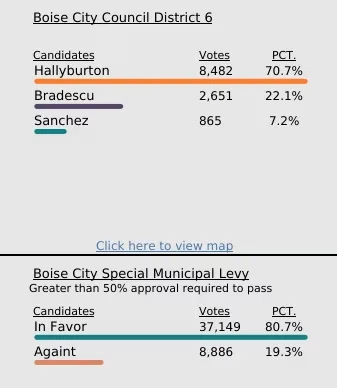
In that same election, Boise voters approved a property tax increase to “protect open spaces” by a margin of 80.7% to 19.3%. A quick and dirty count of votes in the precincts of council district 6 shows that the voters who reelected Jimmy Hallyburton over Lynn Bradescu voted for the open spaces levy in even greater numbers, 84.3% to 15.7%. Around 700 people voted both for Bradescu and the open spaces levy, for whatever reason.
As conservatives, we believe in America, which means we believe in the idea of government of the people, by the people, and for the people. So how do we confront the fact that four out of every five voters in our most important city potentially have vastly different beliefs about the nature and purpose of government?
I think the most important thing we can do is discard the pretense that our views represent a Nixon-era Silent Majority, and that any loss or setback is solely due to cheating, fraud, or other such shenanigans. Remember that only about a third of the population of the American colonies were in favor of independence. We look back on that generation and see patriots because that’s the side that won the day. Had the British been victorious, those patriots would have been imprisoned or executed, and the histories written to favor the Loyalist cause instead.
Most people simply want to live their lives in peace. That often means going with the flow, or adopting the trappings of whatever is perceived to be high status. During the Obama years, average non-political Americans were generally supportive of our first black president and went along with what they were told was the right side of history. Following the Supreme Court’s decision in Obergefell v. Hodges in 2015, even a majority of self-identified Evangelical Christians said they supported gay marriage. Yet when Obama’s racial harmony deteriorated into destructive riots, and gay marriage led inexorably to transing children, people began retreating from those positions.
All political movements, even those we consider dictatorial, claim the mantle of “we the people.” Mussolini and Hitler claimed to be carrying out the will of their people, as did Lenin, Stalin, Mao, and nearly every other murderous dictator throughout history. Sometimes reality hits hard, as when Nicolae Ceaușescu was confronted with the horrifying realization that he had lost the confidence of the Romanian people in 1989. (He was summarily shot four days later.)
The protesters on the ground in Minnesota are no different. They are using words like “democracy” and “the will of the people” to justify resisting and impeding federal law enforcement that is carrying out the actual will of the people as expressed on November 5, 2024. Or, as Lomez explained succinctly on X:
One asymmetry among many is the fiction that the active resistance of a few hundred protesters are an expression of democratic will equal in legitimacy to the democratic will of the 77 million people who voted explicitly for enforcement of federal immigration law
If President Trump is successful in restoring order and deporting those here illegally, we will eventually return to a peaceful equilibrium in this country, and many who today claim to be opposing ICE will adapt to the new normal and pretend it never happened. On the other hand, if Trump fails and we go down the totalitarian road that Democrats have in mind, many conservatives who today claim to support mass deportations will adapt to that dystopian world as well, pretending they never wore the MAGA hat.
That’s just human nature; there’s no use in crying about it.
The only way forward is to win, and the only way to win is to put in the work. Continue working to elect conservative lawmakers and executives, who must then work to enact conservative policy. We must maintain the momentum we’ve built here in Idaho and continue pushing the Overton Window further to the right. Those who are happy to go with the flow will be satisfied so long as we maintain safety and prosperity. Hardcore leftists may be disheartened enough to flee to blue states. So much the better.
Remember that our nation was founded not by a mass uprising, but by determined action by a small but resolute group of exceptional men. Following the Philadelphia Convention of 1787, men such as Alexander Hamilton and James Madison put in enormous work persuading their fellow Americans to adopt the Constitution, and even then it was extremely close. Massachusetts voted to ratify the Constitution by a vote of 187–168, New Hampshire 57–47, Virginia 89–79, and New York 30–27. Once ratified, however, our Constitution became the foundation for the greatest nation in the history of the world. It didn’t happen on its own or by accident. Our Founders did not conduct opinion polls to ensure they were carrying out the will of the people; rather, they did what they believed was right for their country and their posterity.
That is the difference between a republican form of government, and direct democracy, which is little different than mob rule. In America, and in Idaho, political power derives from the people, but the future belongs specifically to those people who show up, step into the arena, and do the work. Let’s get to it.
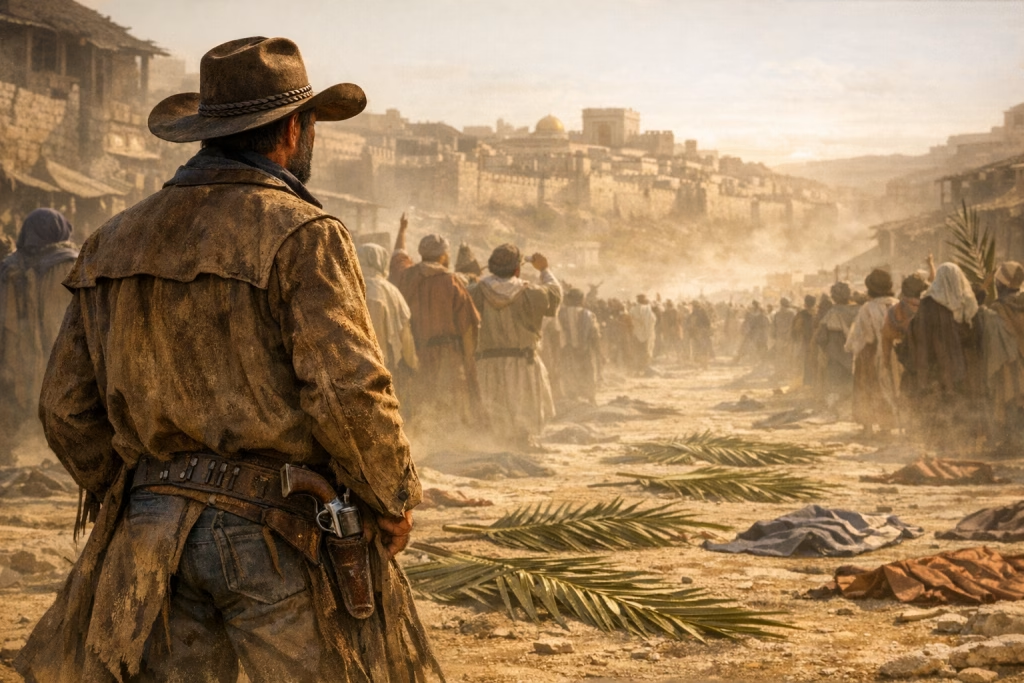
Feature image created with Microsoft Copilot.
Gem State Chronicle is a reader-supported publication. To receive new posts and support my work, consider becoming a free or paid subscriber.

About Brian Almon
Brian Almon is the Editor of the Gem State Chronicle. He also serves as Chairman of the District 14 Republican Party and is a trustee of the Eagle Public Library Board. He lives with his wife and five children in Eagle.