Following YouTuber Nick Shirley’s exposé of potentially fraudulent daycares in Minnesota last month, citizen journalists throughout America have been investigating their own states. To say the problem appears widespread is an understatement.
Here in Idaho, focus has turned toward a specific appropriation bill from the 2025 session after Sen. Brian Lenney and Rep. Josh Tanner called for payments under that bill to be temporarily suspended:
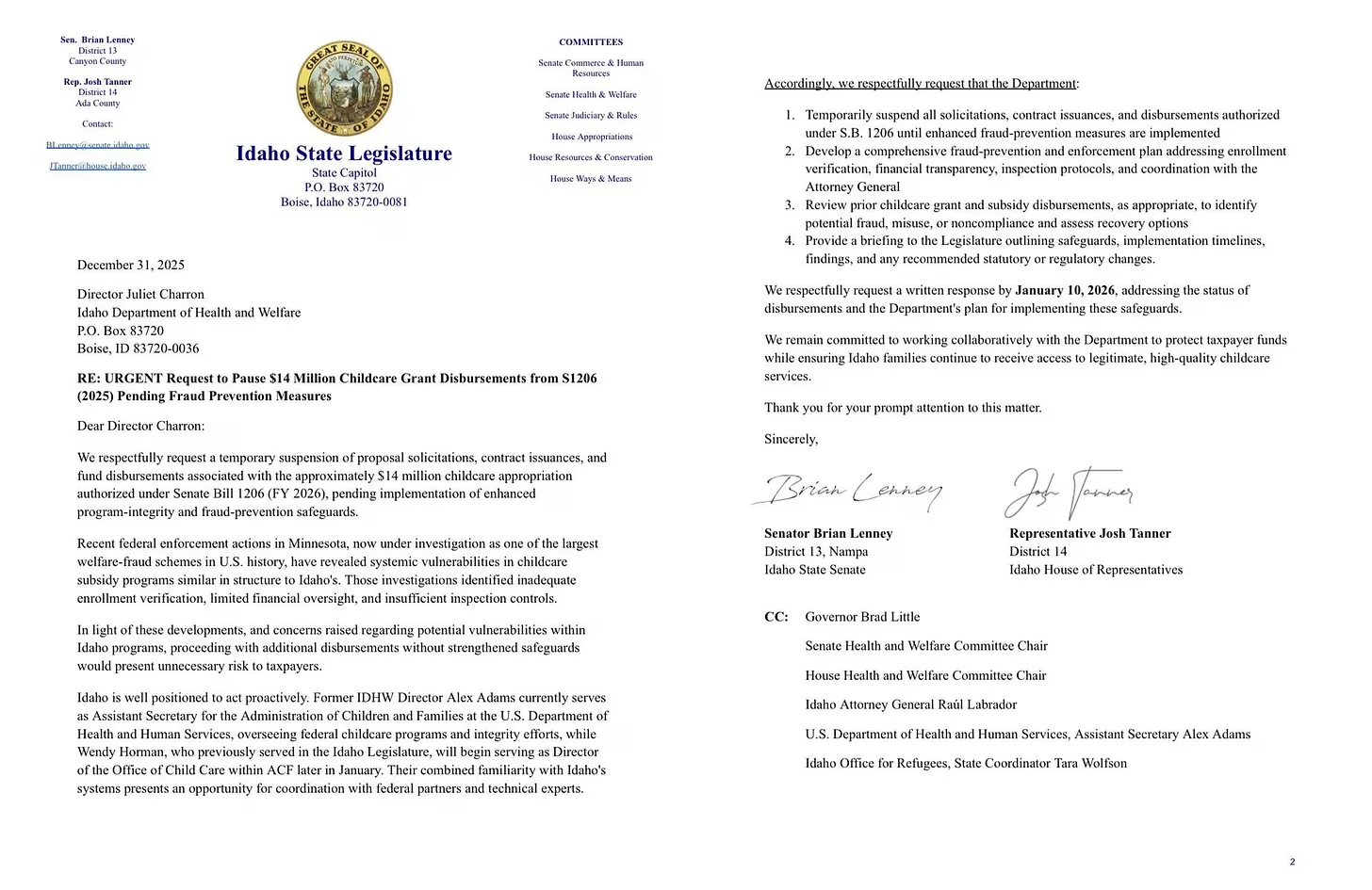
This quickly turned into a political football on social media, with various figures engaging in recriminations over the vote on Senate Bill 1206. The Idaho Freedom Foundation reposted its -2 rating of the bill, which deducted points for continuing to subsidize childcare as well as increasing dependence on federal funds.
While Sen. Lenney voted against S1206 on the floor last spring, Rep. Tanner not only voted for it, he was the House sponsor coming out of the Joint Finance-Appropriations Committee (JFAC). Let’s do a deep dive into S1206 to figure out what it was actually about, how it fits into the greater ecosystem of subsidies, and how it fits into a plan to unwind government from the child care ecosystem.
Recall that the Idaho Child Care Program (ICCP) was created to manage federal funding for childcare that was initially allocated more than three decades ago:
In 1990, Congress passed the Omnibus Budget Reconciliation Act, which included sweeping changes to the tax code and other regulations. It is most remembered for breaking President George H.W. Bush’s promise not to raise taxes. However, tucked into this omnibus bill was the Child Care and Development Block Grant (CCDBG), a federal program to subsidize childcare costs for low-income families.
The CCDBG initially appropriated $750 million in grants to be distributed through the states, and that amount has steadily increased since. In 2018, President Donald Trump signed a bill increasing those grants to $2.37 billion, and in 2021, President Joe Biden signed the American Rescue Plan, which included $15 billion for the CCDBG.
Money grows on trees, right?
It’s up to the states to distribute the grants. According to federal guidelines, recipients must have children under 13, be working or in a job training or education program, have a family income at or below 85% of each state’s median income, and have less than $1 million in assets. Additionally, the guidelines recommend that states set payment rates equal to the 75th percentile of childcare providers and require these rates to be updated every three years.
The Idaho Legislature retains the authority to appropriate federal funds for the CCDBG program, but it is administered by the Idaho Department of Health and Welfare (IDHW) under the Idaho Child Care Program (ICCP). For fiscal year 2024, the Legislature appropriated just over $52 million for ICCP, which currently serves 7,800 children in Idaho.
In August 2024, then-DHW Director Alex Adams notified JFAC that ICCP was structurally over budget. He laid out a plan to contain costs restore solvency to the program:
In Adams’ letter to JFAC, the director laid out plans to rein in ICCP expenditures by delaying updated reimbursement rates until next year, restoring the pre-2021 reimbursement rates to the 65th percentile of childcare facilities in Idaho, temporarily pausing new enrollments, and restoring the eligibility threshold to 130% of the federal poverty level.
In his single year on the job at DHW, Adams systematically reorganized the department and its budgets, including moving ICCP out of the Division of Self-Reliance and into a new Division of Early Learning and Development. Several bills in the 2025 session were involved in this process, including S1206.
Another bill, House Bill 243, sought to deregulate Idaho’s child care system, allowing more free market and less government regulation. H243 increased the number of children that can be supervised by licensed caregivers, allowed more flexibility in how children were supervised, and prohibited cities and counties from requiring more stringent regulations.
During debate on S1206, Sen. Codi Galloway argued that these two bills together would allow more growth in the childcare market. The intent of the bill was to ensure that federal funds, including the $14 million highlighted in the letter, were used as one-time grants to help new childcare facilities open, rather than adding to direct subsidies.
Sen. Melissa Wintrow carried S1206 on the floor, while Sens. Galloway, Scott Grow, Kevin Cook, and Carl Bjerke debated in favor. Sen. Tammy Nichols, explaining her “yes” vote, stated that while she typically opposes such appropriations, she believed this bill moved in the right direction by encouraging private enterprise.
Watch the full Senate debate here:
Debate on the House side was even shorter. Rep. Josh Tanner opened debate by explaining how S1206 fit within the larger framework of reorganizing DHW programs, and there was no additional either way.
S1206 also established safeguards: if federal grant money disappears, state funds cannot automatically be used to backfill them.
Sen. Lenney added some additional clarification regarding the bill on Twitter Thursday morning:
There’s a tad bit of confusion (and muddying the waters) about what this letter is actually about…
Senate Bill 1206 has nothing to do with this (per se). Rep. Tanner voted for that bill. And I voted against it because I think it’s a massive expansion of the nanny state. That disagreement is completely beside the point.
Because nobody who voted for S1206 was voting for fraud.
I don’t care where you stand on childcare policy. Nobody in the legislature wants taxpayer dollars stolen. This is about fraud prevention and if Health and Welfare be trusted with our money.
The $14 million we’re asking to pause is one tiny piece of something much bigger. What I’ve been watching over the past few years keeps me up at night, and I think we’re looking at the tip of the tip of the iceberg.
Lenney went on to argue that nobody in government is ever truly held accountable for fraud, overspending, or ignoring the will of the Legislature.
Is he right? Former DHW Director Dave Jeppesen presided over numerous problems that ultimately led to an audit identifying eight instances in which the department failed to follow proper procedures. The only accountability Jeppesen faced was a comfortable retirement. According to his Facebook page, he spent 2025 visiting Antarctica, taking his family to Disneyland, road-tripping through South Dakota, vacationing in Europe, and making another trip to Southern California. His current profile picture still touts the COVID-19 vaccine:

Earlier this year, I wrote about the difficulty of evaluating legislation in isolation rather than understanding how individual bills fit into a larger agenda. It is impossible to assess the merits—or flaws—of S1206 in a vacuum without also considering efforts to deregulate childcare, reorganize DHW, and rein in the power of unelected bureaucrats.
Good conservatives disagree on whether S1206 was ultimately the right approach. Rep. Tanner supported it; Sen. Lenney opposed it through his substitute. Yet both have now called on DHW to halt disbursement of federal funds until safeguards can be implemented to ensure taxpayers are not being defrauded.
That question may soon be moot. The Trump administration has indicated it will freeze all federal childcare funding until they can be fully audited. Assistant Secretary for the Administration of Children and Families Alex Adams—the very same who led DHW during the last legislative session—joined Deputy Secretary of Health and Human Services Jim O’Neill earlier this week to announce a freeze on payments to Minnesota.
Beyond concerns about fraud, incentives, and government involvement in the market lies a more basic question: why should taxpayers subsidize childcare at all? Wayne Hoffman addressed this question in a Substack post this week:
In the aftermath of scandals like the one in Minnesota, the typical response is predictable: investigations, hearings, tighter rules, and new oversight mechanisms. These may address immediate failures, but they rarely prompt a deeper conversation about whether the underlying system makes sense in the first place.
Should we at least be willing to ask whether a society built around early, subsidized separation of children from parents is the best arrangement for families, communities, or children themselves?
I hope you and I can agree that government should not be subsidizing childcare. The real question is how to unwind that system. Legislation in a republican form of government requires building a majority consensus. That means persuading 36 representatives, 18 senators, and one governor. No matter how good an idea may be—or how self-evident or moral it seems—you cannot enact change without a majority.
Even in a Republican supermajority state like Idaho, completely eliminating childcare subsidies appears unlikely, at least for now. Some Republicans believe subsidies are necessary; others fear the political backlash that would accompany repeal.
At this point, there are two options. One is to give up and shout into the void about a lack of courage. The other is to build a viable coalition. That requires articulating a better alternative and laying out a roadmap for how government can withdraw without creating chaos for families and businesses that have come to rely on these programs.
The first step is explaining why the current system does not work. Hoffman made the moral case, while citizen journalists like Nick Shirley have demonstrated how such systems inevitably invite fraud—or at least exploitation.
Depending on your perspective, S1206 is either an unnecessary extension of a failing system or a temporary step toward extricating government from it. Unfortunately, the system has grown so complex that ordinary citizens struggle to make sense of it, which is itself a major problem.
Last year, following up on my essay on the history of ICCP, I wrote about the contrasting views of Idaho Democratic chairwoman Lauren Necochea and then–vice-presidential candidate J.D. Vance:
Vance touched on something missing not only from the narrative of Idaho Democrats but also from the broader discourse on child care: the current system of subsidies nudges families toward corporate solutions rather than encouraging children to stay with grandparents or other relatives. Kleinworth’s suggestion to loosen regulations on the required ratio of staff to children is a step in the right direction, but perhaps it’s time to rethink how we view the entire child care ecosystem.
Ultimately, we must return to a society that allows and incentivizes mothers to stay home with their young children. Call me a misogynist if you want, but every possible metric shows that children do best when raised by their mothers and fathers rather than by teachers or child care staff, no matter how caring and competent those strangers may be. The entire child care industry exists as a symptom of a broken society. While we can and should work to improve it in the short term, we must keep in mind the long-term survival of our civilization.
The 2026 legislative session presents additional opportunities for reform and for unwinding this web of state and federal subsidies. The looming revenue shortfall should force JFAC and the governor to make substantive budget cuts, and ICCP and other childcare subsidies should be part of that discussion. This will not happen overnight—families and businesses need a viable off-ramp—but outright fraud and seemingly endless cash flows to refugees and other noncitizens are surely low-hanging fruit.
The dream of the 1960s was that a wealthy nation like the United States could afford to meet people’s basic needs through government programs. The reality of 2026 is that welfare programs do not work as intended. They distort market incentives and generate demand for even more welfare. It is time to begin unwinding this Gordian Knot of taxpayer subsidies and allow the free market to do its job once again.
Gem State Chronicle is a reader-supported publication. To receive new posts and support my work, consider becoming a free or paid subscriber.

About Brian Almon
Brian Almon is the Editor of the Gem State Chronicle. He also serves as Chairman of the District 14 Republican Party and is a trustee of the Eagle Public Library Board. He lives with his wife and five children in Eagle.