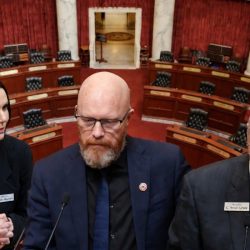
The real work of the 2026 legislative session kicked off this morning at 8:00 a.m. MT when the Joint Finance–Appropriations Committee (JFAC) convened for the first time. Rep. Josh Tanner, recently elevated to co-chair, opened the meeting with introductions and welcomed new members Reps. Kyle Harris and Chris Bruce.
Lori Wolff, administrator of the Division of Financial Management, presented Gov. Brad Little’s budget recommendations, which he first alluded to in yesterday’s State of the State address. The governor’s “Enduring Idaho Plan” aims to balance the budget in the face of lower-than-expected tax revenues through a mix of spending cuts, rescissions to the general fund, some creative accounting, and a little bit of hope.
The fiscal year 2027 legislative budget book is now available, showing the governor’s recommendations. Click here to check it out. Despite agencies requesting an overall increase of 4.1% above FY2026, Gov. Little is recommending only a 0.1% increase. Highlights include an 11.3% decrease for Idaho Public Television, a 14.6% decrease for the Idaho Land Board, a 15.5% reduction for the Department of Administration, a 12.7% decrease for the Office of the Governor, and a 62.9% reduction for the Office of the State Board of Education.
I won’t complain about any of these numbers, but some are not quite what they seem. For example, the 62.9% decrease for the State Board of Education results from removing roughly $30 million that had been appropriated for the Empowering Parents Program, which was already repealed by the Legislature in 2025. The remainder of the office’s budget actually increases by about $5 million under the governor’s recommendation.
Another area where Gov. Little is looking to save money is by recommending no pay raises for state employees this year. JFAC endorsed roughly a 5% change in employee compensation in 2025. Administrator Wolff said Idaho state employees and teachers still lag behind their counterparts nationwide, but acknowledged that this is a cutting year rather than a spending year. During the hearing, Democratic Sen. Janie Ward-Engelking pointed out that flat pay combined with an increased employer share of health insurance costs effectively means state workers are taking a pay cut this year.
Wayne Hoffman wrote a piece yesterday calling the governor’s address a missed opportunity to reorient government away from welfare and subsidies:
Gov. Brad Little’s latest budget proposal follows perfectly in line with my thesis: He carefully considered how to sustain the government programs above all other considerations. This represents a very big missed opportunity.
You will recall that I have projected that the state faces a budget deficit this year and next, getting close to $800 million or more in FY2027. My numbers were primarily based on revenue forecasts, supplemental budget requests, and the cost of conforming to the Trump tax cuts.
But on Monday, Little released a budget that — surprise — shows the state government running comfortably in the black both years. How does he accomplish this? Magic. Specifically, the kind of fiscal “smoke and mirrors” that prioritizes bureaucratic survival over honest accounting.
Some of the “smoke and mirrors” include moving accrued interest from agency accounts into the general fund, conforming to President Trump’s tax cuts in the One Big Beautiful Bill (OBBB) during tax year 2026 rather than 2025, and relying on an optimistic revenue projection for FY2027.
Both co-chair Sen. Scott Grow and Administrator Wolff agreed it was wise to delay implementation of the OBBB tax cuts to allow the federal government to finalize its rules and give the Idaho Tax Commission time to adjust its paperwork and software. That means when you file your 2025 taxes in the near future, you’ll be able to exempt tips, overtime, and other income covered by the OBBB on your federal return—but not on your state return.
Grow and Wolff may well be right, but as Hoffman pointed out, that delay gives Gov. Little more wiggle room for FY2027, postponing what could be a more serious revenue shortfall down the line.
Sen. Kevin Cook asked Administrator Wolff about the revenue projection during the hearing. As you may recall, JFAC could not agree on a revenue number until March of 2025, and the current problem stems from tax revenues coming in below that projection. Wolff said the number did not come from her office or the governor, but from a consensus of experts who believe Idaho’s economy will continue to grow over the next two years.
Over at Idaho Freedom Foundation, Fred Birnbaum wrote that the governor’s plan simply kicks the can down the road:
…after increasing the total funds by about 60% over the last six years (FY20-26), this year is the year for a critical re-evaluation of all spending. Instead, we get a budget balanced for the remainder of FY26 and upcoming FY27, mostly using one-time savings.
It’s a short-term solution with no attention to long-term spending discipline.
Rep. Tanner was skeptical as well. In remarks near the end of the hearing, he called the governor’s recommendation “balancing on hope” and warned that even a slight economic deviation could force the Legislature back into session next July to fix the problem.
Tanner expanded upon his concerns in a press release this afternoon:
“This budget spends today and sends the bill to tomorrow’s taxpayers,” Tanner said.
Tanner concluded by making clear that the Legislature will act to restore fiscal discipline.
“Idaho families cannot spend more than they earn, and neither can state government,” Tanner said. “JFAC and the Legislature will restore structural balance, rein in non-discretionary spending, and protect Idaho taxpayers. Idaho needs a budget that lives within its means—and that is exactly what we intend to deliver.”
Sen. Grow said he expects JFAC to set a revenue projection for FY2027 by the end of the week. That is an audacious goal, considering it took more than two months to reach consensus last session. If the committee can pull it off, it would be a good sign for the rest of the year. Birnbaum ended his article on a hopeful note:
At the end of the day, the governor has applied short-term remedies, leaving the hard work of restoring fiscal discipline to the Legislature. We are optimistic that they are up to the task.
Last year, Gov. Little called for $100 million in tax cuts, and House Republicans delivered more than $450 million instead. This year, the governor is calling for targeted spending cuts along with some creative accounting to balance the budget. What will Republicans in the Legislature deliver this time?
Gem State Chronicle is a reader-supported publication. To receive new posts and support my work, consider becoming a free or paid subscriber.

About Brian Almon
Brian Almon is the Editor of the Gem State Chronicle. He also serves as Chairman of the District 14 Republican Party and is a trustee of the Eagle Public Library Board. He lives with his wife and five children in Eagle.