If regular municipal elections are sprints, runoff elections are a movie series starring Vin Diesel. Candidates get back to work the morning after Election Day—not only chasing new voters, but reminding their own supporters that they have to do it all over again.
I wrote yesterday about the insane amount of money and influence brought to bear on the Idaho Falls mayoral runoff. The local political establishment joined forces with Gov. Brad Little and a range of PACs—from the far left to the moderate right—to ensure that Council Member Lisa Burtenshaw became the next mayor. I was curious to see whether a grassroots campaign could overcome such a powerful machine. Perhaps it could, but not this time.
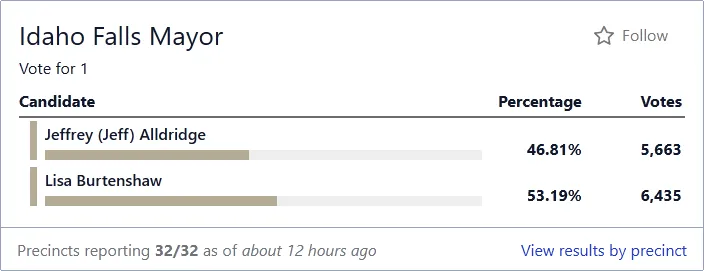
Burtenshaw defeated Jeff Alldridge by nearly 900 votes out of 12,098 cast, which was slightly more than the 11,869 who voted in the initial election last month, which featured Alldridge, Burtenshaw, and Christian Ashcraft.
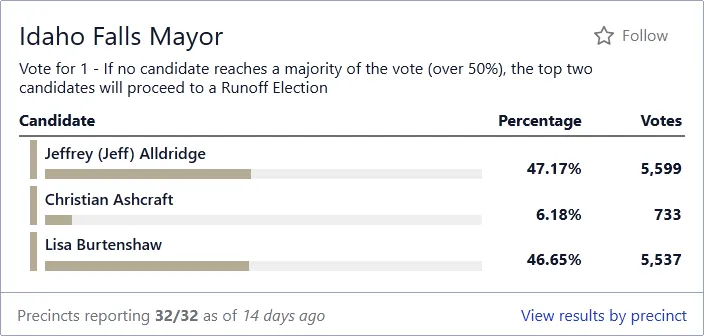
Alldridge increased his vote total by only 64 ballots, from 5,599 to 5,663. Burtenshaw, on the other hand, added 898 votes to her initial tally.
Going into the runoff, I believed Ashcraft’s voters would break for Alldridge, since I saw both candidates as outsiders campaigning against the local establishment. That does not appear to have happened. Considering how influential religious differences seemed to be in this race—recall that Alldridge, the only non-LDS candidate, was asked by an East Idaho News reporter for his opinion on Mormons—I wonder if that proved a more decisive factor than expected. Members of the LDS Church make up between 50% and 75% of Idaho Falls’ population, depending on the source, and that undoubtedly plays into local politics.
In any case, yesterday’s results confirm what I wrote on Monday: once a powerful political machine revs up to achieve its desired outcome, it takes tremendous effort to counter it. Goliath beats David 99 times out of 100. That suggests we need a Goliath of our own. Rather than pulling each other down like crabs in a bucket, conservatives need to get serious about working together to elevate conservative candidates across the board.
My purpose in highlighting the governor’s political machine is not simply to point and gawk or to create outrage. I want to reverse engineer what works and figure out how to not only match it, but exceed it. This isn’t about policy or principles—it’s about strategies and systems that deliver results.
The special election in Tennessee’s 6th Congressional District offers similar lessons. Following Republican Congressman Mark Green’s resignation last summer, Army veteran and Tennessee Department of General Services commissioner Matt Van Epps won a crowded Republican primary. He faced progressive activist Aftyn Behn, who made headlines when remarks from a 2020 podcast resurfaced in which she said she “hates” Nashville and country music.
Nashville didn’t hate her, though—Davidson County went her way with nearly 78% of the vote. But Van Epps won every other county in the district, finishing with just under 54%.
On the one hand, a win is a win. On the other, winning by only nine points in a district Donald Trump carried by 22 just a year ago should raise eyebrows. It’s easy to overreact either way, but fundamentally it appears that when Trump himself is not on the ballot, many Republican voters stay home. That’s a structural problem the GOP must solve, because barring a repeal of the 22nd Amendment, Trump has run his last campaign.
At the same time, Democrats did not gain 13 points by flipping red voters to blue; they simply turned out their base in Nashville while Republicans stayed home. That’s not a reassuring trend, but it does counter the claim that Republicans are losing their base to the Democrats.
The few remaining NeverTrump Republicans are desperate to argue that Trump is dragging down GOP candidates. I don’t buy it. After his win, Congressman-elect Van Epps said the results “showed running from Trump is how you lose; running with Trump is how you win.”
Robby Starbuck laid out the way forward on Twitter this morning:
We need to right the ship or voters will sink our ship in 2026. Enthusiasm from 2024 is gone. The blind trust is gone. They want action. The people in Congress need to realize that they aren’t Trump and he isn’t there to carry them on the ballot in 2026. They need to deliver now. And even then we likely have to run ‘26 like a Presidential election with Trump going around the country.
The results in both Tennessee and Idaho Falls show that conservative Republicans must take politics seriously. Resting on our laurels is not an option, and we cannot assume our voters will automatically turn out. The left has a powerful network of NGOs dedicated to driving their turnout. And here in Idaho, the governor and his allies have a tremendous political machine that can move money and influence quickly and decisively. It’s time we start playing to win as well.
Gem State Chronicle is a reader-supported publication. To receive new posts and support my work, consider becoming a free or paid subscriber.

About Brian Almon
Brian Almon is the Editor of the Gem State Chronicle. He also serves as Chairman of the District 14 Republican Party and is a trustee of the Eagle Public Library Board. He lives with his wife and five children in Eagle.