A debate is brewing over how Idaho should fund its public schools. Our State Constitution mandates that the Legislature “establish and maintain a general, uniform and thorough system of public, free common schools.” The debate ahead of the 2027 legislative session is over exactly how the Legislature should accomplish that mandate.
Idaho’s public school funding formula is rather complicated, but the basic idea is fairly simple: the state counts the children who actually attend school, converts that number into “support units” based on factors such as grade level, school size, and special needs, and then uses those support units to determine how much money each district receives. While activists and policymakers often point to approximately $9,000 in Idaho tax dollars spent per public school student, the formula is more complex than a single chunk of money allocated for each student. Attendance is the starting point, and the number and type of students being served determine how many support units a school generates.
According to State Superintendent of Public Instruction Debbie Critchfield, this formula has not undergone any meaningful updates for more than thirty years. Earlier this week, she issued an op-ed calling upon the Legislature to be open to reforming the funding formula:
When I think about what schools looked like 32 years ago, I can confidently tell you it’s not the same now. To name just a few: schools used blackboards, overhead projectors, and dial-up internet, available in a computer lab (if at all!). Our state was smaller, and we were over a decade away from the population boom we’ve recently experienced.
Between 1994 and today, the Idaho classroom has changed. Your life and household looks different from 1994 too. These changes are not limited to education; it’s just life. Our students deserve to be supported by a formula that reflects the needs of the 21st century, not those of students who sat in classrooms over three decades ago. In fact, many of the students from the early 90s now have their own children in our schools! And trust me, they have opinions on how we should educate.
[…]
So, what’s next? Now that the formal work of listening is logged, what can Idahoans expect as we dig into the work of revising and rewriting?
We will be working with legislators to help shape what changes will look like. That will include financial analyses and putting together models to be shared with districts and charters, the public at large, the Joint Finance-Appropriations Committee, and anyone else that’s interested, as we head into next legislative session this winter.
The superintendent did not make any specific policy prescriptions regarding the funding formula, but I’m sure her office is already in discussions with legislators to craft a new system.
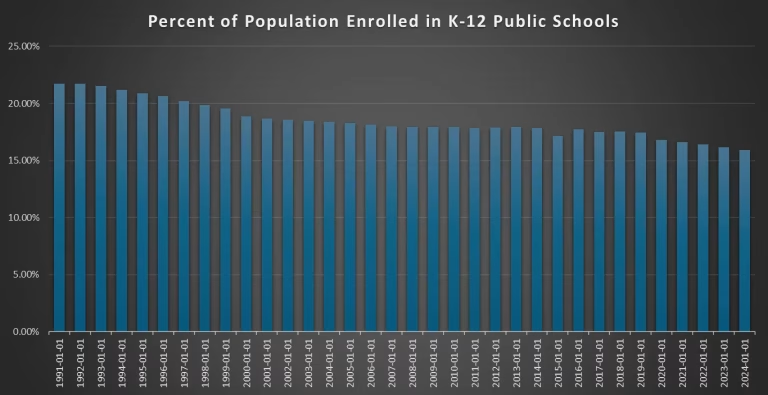
Something else is different between the 1990s and today, and that is how many students are enrolled in our public school system. Last December, I examined how the student population of Idaho has changed over the past few decades and found that, as a percentage of the total population, public school enrollment has dropped from 21.72% in 1991 to just 15.89% in 2024. Total public school enrollment peaked at just under 319,000 in 2022 but then declined over the following two years.
What does this mean for public school funding?
This paradigm has significant implications for budgeting and public policy in Idaho. Despite continual historic and unprecedented investments in public education, K-12 enrollment is not only shrinking as a share of the population but is now declining in raw numbers. Because the funding formula is based on enrollment, this means the cost per student can only increase. It costs a certain amount to run a district office, maintain buildings, and pay teachers and support staff regardless of how many students are enrolled. Inflation has made all of this more expensive as well.
Note: In the December 2025 article, I used the term “enrollment” to refer to the funding formula. “Attendance” is a more precise term, as Chris Cargill explains in his recent op-ed.
Schools have certain fixed costs, no matter how many students are enrolled. A building made to accommodate 1,000 students still has the same basic costs for electricity, heating and air conditioning, water and sewer, and some support staff even if it is serving only 500. If each grade level loses five students, that’s not necessarily enough to lay off one teacher and consolidate classrooms, but it could decrease the amount of money received from state coffers. This is a real issue districts face, but preserving the status quo should not be the goal of our funding formula.
Earlier this year, I took a look at Boise School District’s open enrollment reports, which showed how many vacancies there were in classrooms and grade levels throughout the district. The state requires districts to publish these reports so families who want to enroll their children in a different district than the one in which they live can know where there is available space. It never made it into an article, but what I found was that many grade levels throughout Boise had up to dozens of available seats. At the time, there were more than 4,000 open spots in the district as a whole, not counting virtual or special schools. That many vacancies would suggest that some sort of consolidation might be warranted to account for decreasing enrollment. However, the Boise School Board decided to raise taxes by 18% instead.
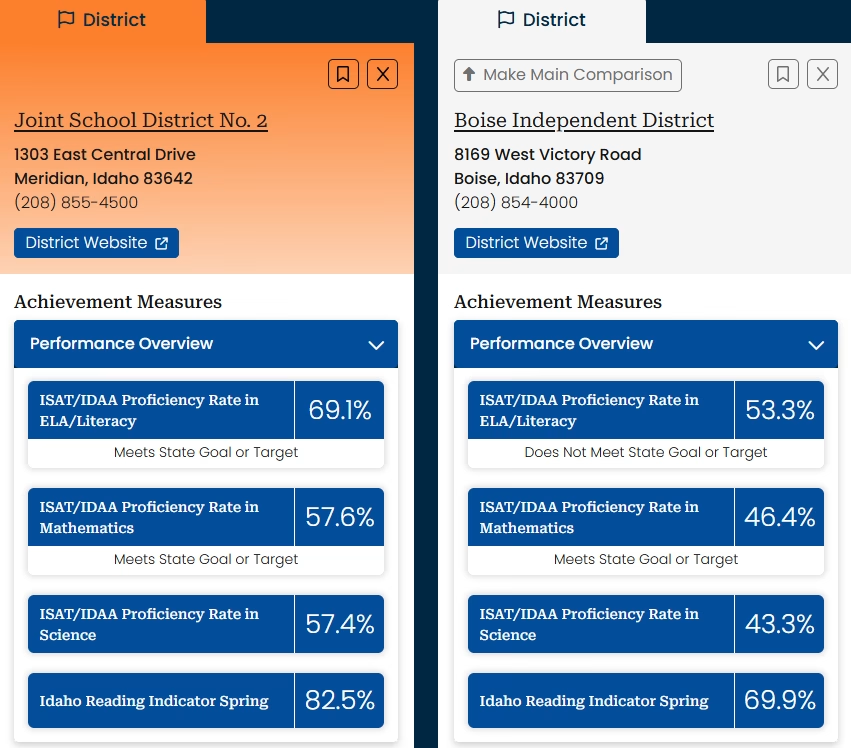
Indeed, the contrast between Boise and neighboring West Ada School District is a reminder that money isn’t everything. Boise taxpayers spend more than $16,000 per student, compared to less than $10,000 per student in West Ada. Yet West Ada clearly outperforms Boise when it comes to several measures of student outcomes. Its graduation rate is 88.8%, compared to Boise’s 82.3%. On the Idaho Standards Achievement Test (ISAT), West Ada students averaged 69.1% in English language arts and 57.6% in math, compared to 53.3% and 46.4% in Boise.
If money were solely responsible for student success, then Boise would be at the top of the charts. Yet public school advocates inevitably demand more money every year, arguing that our public schools are underfunded. Late last year, a coalition of school districts, teachers’ unions, and individuals sued Idaho over the Parental Choice Tax Credit, claiming that the $50 million appropriation detracted from the Legislature’s constitutional mandate to fund public schools—despite the state already spending around $3 billion a year on public education, plus much more from local taxpayers in the form of bonds and levies.
Money isn’t everything; how we spend money is perhaps more important than the total amount. So how should we fund our public schools? Mountain States Policy Center President Chris Cargill’s recent op-ed warned that shifting to an enrollment-based formula, rather than our current system based on attendance, is the wrong idea:
Idaho’s ADA system isn’t as unforgiving as critics sometimes portray it. For funding purposes, the state can use the 28 weeks with the highest average daily attendance. There are also protections for unusual attendance disruptions. In other words, a flu outbreak, a terrible snow week or a child staying home sick for a few days doesn’t automatically blow a hole in a district’s budget.
There is another reason Idaho lawmakers should be cautious about turning enrollment into a blank check. We recently discovered that the definition of “enrolled” can be considerably more expansive than many parents realize.
During implementation of Idaho’s new Parental Choice Tax Credit, some homeschool families were surprised to discover that their children were considered enrolled in public schools because they participated in activities such as sports, cheerleading or after-school clubs.
Some families didn’t even know their children were considered enrolled until it suddenly mattered. That became an issue because Idaho’s original parental choice law generally prohibited families from receiving the credit during a semester in which their child was enrolled in a public school. Lawmakers wisely corrected the problem in 2026, clarifying that participation in nonacademic extracurricular activities does not make a student “enrolled” for purposes of the parental choice program.
Cargill concluded with this:
The purpose of Idaho’s education system is to serve students. The purpose of students is not to fund the system.
As we near the 2027 legislative session, let’s have a sober and rational discussion about how to best fund the students our public education system is meant to serve. Superintendent Critchfield is absolutely right that the 21st century has changed the way classroom education takes place. We need a nimble and agile system that gets the best bang for its buck and produces well-educated adults ready to take up the mantle of citizenship in our Republic—not one that exists to serve ossified special interests like the teachers’ union.
I believe there are some basic principles around which conservatives should be able to unite:
- Funding must be based on real students, not accounting categories.
- Fixed costs are real, and districts need predictability, but they don’t justify permanently insulating districts from enrollment changes.
- Funding must be transparent enough that citizens can understand how their money is being used. Conversely, districts must be held accountable for how they use taxpayer money.
- The funding formula should be based on what works best for students, not designed to protect existing institutions.
- Most importantly, more money should no longer be treated as synonymous with better education.
Our students deserve the best education possible, and taxpayers deserve the best investment possible. I think it’s possible for a system to accomplish both, but it’s going to take hard work and involvement from you. If you’re not talking to your lawmakers, know that special interests and lobbyists are, and their concerns might not be the same as yours. As a reminder, you can share your thoughts on this issue directly with your elected legislators using tools like Email the Legislature at Idaho Insider.
Feature image created with Microsoft Copilot.
The Gem State Chronicle delivers daily analysis, op-eds, press releases, and Idaho Insider updates — free to your inbox.
Free newsletter · Unsubscribe anytime · View on Substack

About Brian Almon
Brian Almon is the Editor of the Gem State Chronicle. He also serves as Chairman of the District 14 Republican Party and is a trustee of the Eagle Public Library Board. He lives with his wife and six children in Eagle.